
Inflation is one of the most discussed economic terms in today’s world. We experience it in daily life when grocery bills increase, fuel becomes expensive, or rent goes up. In simple words, inflation means a continuous rise in the general price level of goods and services over a period of time. When inflation rises, the purchasing power of money falls. That means the same amount of money buys fewer things than before.
In recent years, many countries have experienced noticeable inflation due to global disruptions, rising energy costs, and changes in demand patterns. Some economies faced moderate inflation, while others struggled with rapid price increases. However, inflation does not happen in only one way. It appears in different forms depending on the cause and economic situation.
the major types of inflation explained in a clear and simple manner.
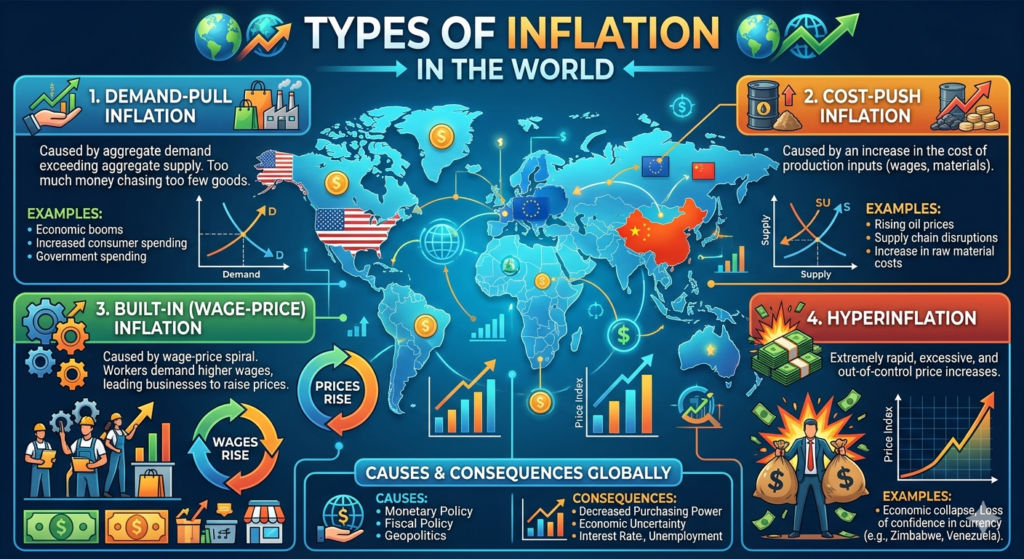
1. Demand-Pull Inflation:-
Demand-pull inflation occurs when demand for goods and services exceeds supply. When people have more money to spend and confidence in the economy increases, they start buying more products. If production does not increase at the same speed, prices begin to rise.
This type of inflation usually happens during periods of economic growth. Rising employment, higher income, and increased government spending can all increase demand. When businesses cannot keep up with this demand, they increase prices.
In short, demand-pull inflation happens because too many buyers are chasing too few goods.
2. Cost-Push Inflation:-
Cost-push inflation happens when the cost of production increases. When businesses have to pay more for raw materials, electricity, transportation, or wages, they transfer this extra cost to consumers in the form of higher prices.
For example, if fuel prices rise, transportation becomes expensive. As a result, the cost of delivering food, clothes, and other products increases. This leads to higher prices in the market.
Here, prices rise not because people are buying more, but because producing goods has become more expensive.
3. Built-In Inflation (Wage-Price Cycle):-
Built-in inflation is based on expectations. When workers expect prices to increase in the future, they demand higher wages to maintain their living standards. When wages increase, companies face higher production costs and raise prices to protect profits.
This creates a cycle: Higher wages – Higher production cost – Higher prices – Demand for higher wages again.
If this cycle continues for a long time, inflation becomes difficult to control. It often requires strict financial policies to break the pattern.
4. Creeping Inflation:-
Creeping inflation refers to a slow and steady rise in prices. It is usually considered normal and even beneficial for an economy.
When inflation remains low and stable, it encourages people to invest and spend rather than keep money idle. Moderate inflation supports economic growth and prevents stagnation.
However, it must remain under control. Even slow inflation can become harmful if ignored.
5. Galloping Inflation:-
Galloping inflation is a faster and more serious rise in prices. In this situation, prices increase rapidly within a short period.
This type of inflation reduces purchasing power quickly. Salaries often fail to increase at the same speed as prices, affecting middle-income and fixed-income groups the most.
If proper measures are not taken, galloping inflation can turn into extreme inflation.
6. Hyperinflation:-
Hyperinflation is the most severe form of inflation. Prices increase extremely fast, sometimes daily or even hourly. Money loses value quickly, and people lose confidence in the currency.
In such situations:-
Savings become almost worthless.
Basic goods become unaffordable.
Economic stability collapses.
Hyperinflation usually occurs due to excessive money printing, political instability, or severe economic crisis. Recovering from it requires major reforms and strong financial discipline.
7. Stagflation:-
Stagflation is a rare but serious economic condition where high inflation exists along with high unemployment and slow economic growth.
Normally, inflation increases when the economy grows. But in stagflation, prices rise even when economic activity is weak and job opportunities are limited.
This situation is difficult to manage because policies that reduce inflation may increase unemployment, and policies that create jobs may increase inflation.
8. Core Inflation:-
Core inflation excludes food and fuel prices because these items are highly unstable and change frequently due to seasonal or global factors.
Economists study core inflation to understand long-term price trends. It helps policymakers know whether inflation is temporary or part of a deeper economic issue.
Core inflation gives a clearer picture of the overall health of the economy.
9. Imported Inflation:-
Imported inflation occurs when a country depends heavily on imported goods and global prices increase.
In today’s interconnected world, many nations import oil, machinery, technology, and raw materials. If international prices rise or the local currency weakens, imported goods become more expensive. This increases domestic prices even if internal demand remains stable.
Countries that rely heavily on imports are more vulnerable to this type of inflation.
10. Structural Inflation:-
Structural inflation happens due to long-term weaknesses in an economy. Poor infrastructure, weak supply chains, agricultural inefficiency, and limited industrial capacity can cause frequent price increases.
For example, if storage and transportation systems are not strong, even small disruptions can lead to food shortages and higher prices.
Structural inflation cannot be solved quickly. It requires long-term planning, investment, and economic reforms.
Why Understanding Inflation Is Important????
Inflation affects everyone – consumers, businesses, investors, and governments. When inflation rises too much:-
Purchasing power decreases
Interest rates increase
Borrowing becomes expensive
Economic growth may slow
On the other hand, extremely low inflation can also create problems like reduced spending and slow economic activity.
That is why maintaining balance is important. Governments and financial authorities continuously monitor price levels and take steps to control excessive inflation.
Conclusion:-
Inflation is not just about rising prices;- it reflects the overall condition of an economy. Different types of inflation – demand-pull, cost-push, built-in, creeping, galloping, hyperinflation, stagflation, core, imported, and structural -show that price rise can occur for different reasons and under different conditions.
A small and controlled level of inflation is normal in a growing economy. However, when inflation becomes too high or unstable, it creates serious economic and social challenges.
Understanding these types helps us analyze economic situations more clearly and prepares us to understand global financial changes in a better way.