
Introduction:-
Employment is the backbone of economic and social development. It provides income, improves living standards, and gives people a sense of dignity. For a country like India, where a large young population is entering the workforce every year, job creation is not just important—it is essential.
In 2025–26, India is growing fast, but the challenge is to ensure that this growth creates enough quality jobs. The focus today is not only on increasing employment but also on making jobs secure, productive, and future-ready.
Current Employment Situation (2025–26)
India’s economy is expected to grow at around 6.5%–7%, making it one of the fastest-growing major economies. However, employment growth has not fully matched this pace.
The unemployment rate is estimated at around 7–8%
Youth unemployment is higher, especially among educated individuals
Nearly 45–50% of the workforce is still dependent on agriculture
A large share of workers are in the informal sector, without job security
This shows that while jobs are being created, there is a need for more quality and stable employment opportunities.
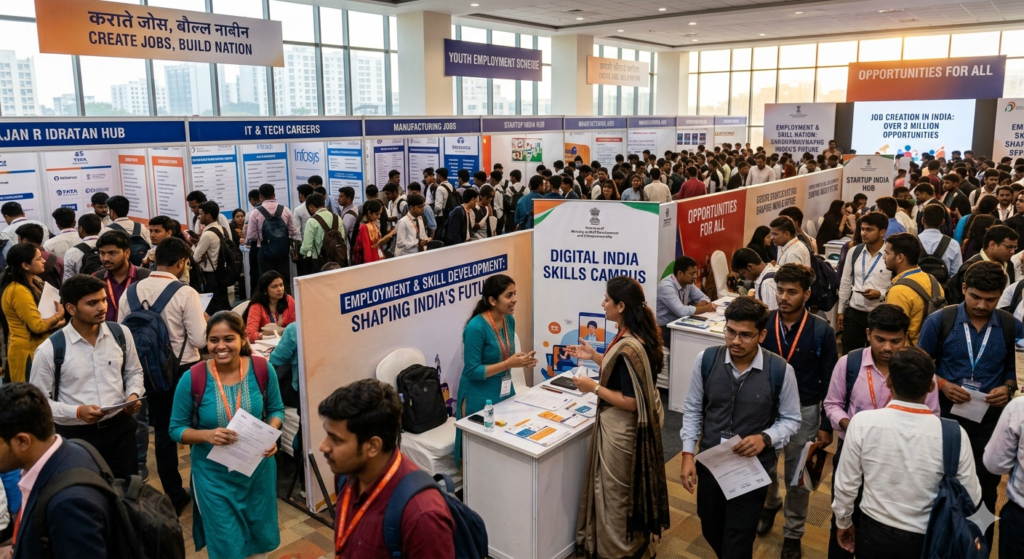
Why Job Creation Matters
Employment generation plays a key role in nation-building:-
Reduces poverty and income inequality
Increases demand in the economy
Promotes social stability
Utilizes the demographic dividend effectively
Without sufficient jobs, economic growth cannot be inclusive or sustainable.
(Major Sources of Employment Growth)
1. Agriculture and Rural Economy:-
Agriculture still employs a large population, but income levels remain low.
Shift towards allied sectors like dairy, fisheries, and food processing
Growth of agri-based startups and digital tools
Increasing focus on rural infrastructure and storage facilities
This sector has strong potential to generate local employment if modernized.
2. Manufacturing Sector:-
Manufacturing is crucial for large-scale job creation.
Expansion in electronics, textiles, and automobile industries
Push towards domestic production and exports
Development of industrial corridors and clusters
A strong manufacturing base can absorb semi-skilled labor and reduce unemployment.
3. Services Sector:-
The services sector is the biggest contributor to GDP and employment.
Growth in IT, healthcare, banking, tourism, and education
Increase in digital platforms and online services
Rise of remote jobs and freelancing opportunities
This sector is driving urban employment and modern job roles.
4. Startup and Innovation Ecosystem:-
India’s startup ecosystem is expanding rapidly.
Over 1 lakh startups are active in 2025–26
Creating both direct and indirect employment
Growth in areas like fintech, edtech, and e-commerce
Startups are important for innovation, entrepreneurship, and new-age jobs.
5. Gig and Platform Economy:-
The gig economy is becoming a major source of employment.
Jobs in delivery, transport, freelancing, and online services
Flexible work options for youth
Use of digital platforms to connect workers and employers
However, issues like job security and social protection need attention.
(Government Efforts for Employment Generation)
1. Skill Development and Training:-
Focus on making youth job-ready
Promotion of technical and vocational education
Emphasis on industry-relevant skills
2. Support to MSMEs:-
MSMEs are the backbone of employment
Financial support and simplified regulations
Encouragement to expand and hire more workers
3. Infrastructure Development:-
Investment in roads, railways, and energy
Generates both direct and indirect jobs
Boosts economic activity in multiple sectors
4. Promotion of Manufacturing:-
Incentives for domestic production
Encouragement to global companies to invest in India
Focus on export-oriented growth
5. Digital Expansion:-
Growth of digital services and online businesses
Creation of jobs in IT and technology sectors
Key Challenges in Job Creation:-
1. Skill Gap:-
Many workers lack the practical skills required by industries, leading to unemployment even when jobs exist.
2. Informal Employment:-
A large number of workers are in low-paying, insecure jobs without benefits.
3. Slow Growth in Labour-Intensive Sectors:-
Sectors that can create mass jobs are not growing fast enough.
4. Impact of Technology:-
Automation is reducing demand for low-skilled jobs while increasing demand for skilled workers.
5. Regional Imbalance:-
Most jobs are concentrated in urban areas, causing migration and urban pressure.
(Role of Technology in Employment)
Technology is transforming the job market.
Opportunities:-
New jobs in AI, data analysis, cybersecurity
Growth of remote work and global employment
Increased efficiency and productivity
Challenges:-
Replacement of repetitive jobs
Need for continuous learning and upskilling
Adapting to technological change is essential for future employment.
Importance of Skill Development:-
Skill development is the key solution to unemployment.
Focus on practical and vocational training
Alignment between education and industry needs
Promotion of digital and soft skills
In 2025–26, reskilling and upskilling have become necessary due to changing job demands.
Women and Employment:-
Women’s participation in the workforce is improving but still low.
Growth in sectors like healthcare, education, and services
Increase in work-from-home opportunities
Rise in women entrepreneurship
Improving female workforce participation can significantly boost economic growth.
Way Forward:- What Needs to Be Done????
Strengthen labour-intensive sectors
Improve quality of education and skills
Provide social security for informal workers
Promote rural employment opportunities
Encourage innovation and entrepreneurship
Ensure balanced regional development
A combined effort from government, private sector, and society is needed.
Conclusion:-
Employment and job creation are central to India’s growth story. While economic progress in 2025–26 is strong, the real success lies in creating enough meaningful and secure jobs.
India has the advantage of a young population, but this can become a challenge if jobs are not created. By focusing on skill development, industrial growth, and inclusive policies, the country can turn this challenge into an opportunity.
The goal should not just be to create more jobs, but to create better, stable, and future-ready jobs that ensure long-term prosperity for all.