
Introduction:- Why Is Daily Life Becoming So Expensive
Today, almost every family feels the same problem — daily expenses are increasing. Groceries cost more. Cooking oil is expensive. Milk prices have gone up. Fuel prices affect travel and electricity bills. Medicines are also not cheap anymore.
This is not happening in just one country. It is a global issue. People in developed and developing countries are facing the same pressure. The cost of living has increased everywhere.
But why is this happening??? Is it only inflation??? Or are there deeper reasons???? See in a simple way.
1. Inflation:- The Main Reason
The biggest reason behind rising prices is inflation. Inflation means a general increase in prices over time.
After the pandemic years, many governments spent large amounts of money to support businesses and provide jobs. This helped economies recover, but it also increased the money supply in markets.
When more money is available but the number of goods is limited, prices go up. Even though inflation rates have slowed in 2025 compared to previous years, prices have not come back down. Once prices increase, they usually stay at that higher level.
So inflation is like a slow but steady force pushing prices upward.
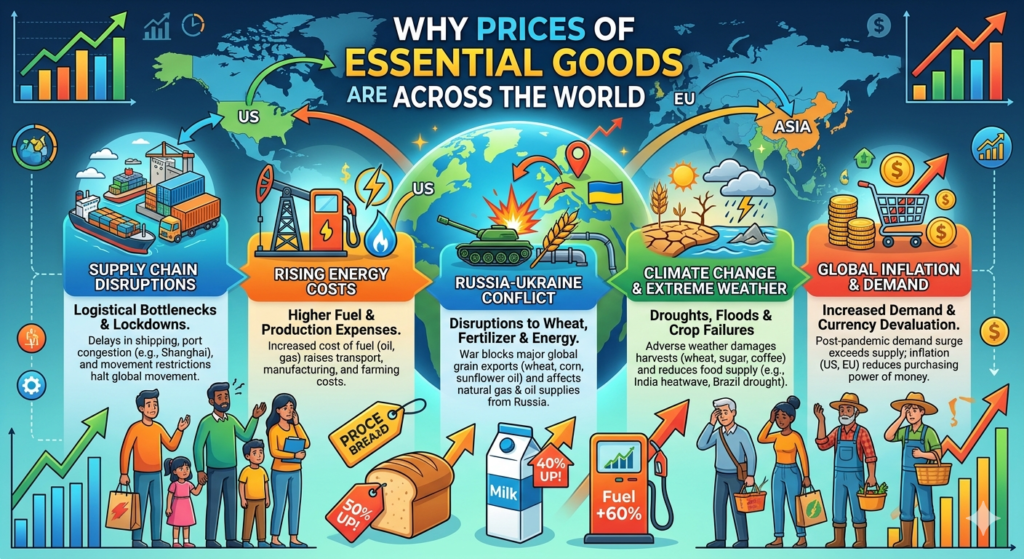
2. Energy Prices Affect Everything:-
Energy plays a very important role in our daily life. Fuel and electricity are needed for farming, factories, transportation, and even storing food.
When oil and gas prices rise, transportation becomes expensive. Trucks, ships, and planes charge more. Factories spend more on electricity. Farmers pay more for diesel and fertilizers.
Because of this, the final price of food and other goods increases. Energy cost is like the base of the entire economic system. If it increases, almost everything becomes expensive.
3. Supply Problems Around the World:-
Essential goods do not come from one place. For example, wheat may be grown in one country, processed in another, and sold in a different market.
In recent years, global supply chains have faced many problems:-
Shortage of shipping containers
Delays at ports
Higher transportation costs
Worker shortages
When goods do not move smoothly, supply becomes limited. If supply decreases and demand stays the same, prices rise.
Even today, supply systems are not fully stable in many regions, which keeps prices under pressure.
4. Climate Change and Extreme Weather:-
Weather conditions are becoming unpredictable. Many countries have faced droughts, floods, and heatwaves in the last few years.
When crops are damaged due to extreme weather, food production decreases. If there is less wheat, rice, or vegetables in the market, prices automatically increase.
Climate change is now directly affecting food supply. It is no longer just an environmental issue; it is also an economic issue.
5. Global Conflicts and Trade Tensions:-
The world economy is connected. If one major country faces conflict or political tension, it affects global trade.
Sometimes countries restrict exports of important items like grains or fuel to protect their own people. This reduces global supply.
When supply becomes tight in international markets, prices rise everywhere. Even countries that are not directly involved in conflict feel the impact.
6. Rising Production Costs:-
Companies are also spending more money to produce goods.
Costs have increased in:-
Raw materials
Labour wages
Transportation
Packaging
When companies spend more to make products, they increase the final price to maintain profits. This type of price rise is called cost-based inflation.
Even small increases in cost at each step of production can make a big difference in the final price.
7. Weak Currencies in Some Countries:-
In many developing countries, local currencies have become weaker compared to strong global currencies.
When a country imports fuel, edible oil, machinery, or medicines, it has to pay in foreign currency. If the local currency is weak, imports become expensive.
As a result, prices of essential goods increase in the local market. This makes inflation stronger in some countries compared to others.
8. Changing Demand After the Pandemic:-
After the pandemic, people’s buying habits changed. Many families started spending more on:-
Health products
Packaged food
Home essentials
Online shopping
When demand increases faster than supply, prices rise.
Also, in many developing nations, the middle-class population is growing. More people want better quality goods, which increases demand and creates price pressure.
9. Government Policies and Taxes:-
Sometimes government decisions also affect prices.
If fuel subsidies are reduced or taxes are increased, prices go up. Governments sometimes take such steps to control budget deficits or improve long-term financial stability.
However, in the short term, consumers feel the burden.
10. Why Prices Do Not Fall Easily????
Many people think that when inflation slows down, prices will fall. But that is not how it works.
Inflation slowing down means prices are rising at a slower rate — not that they are decreasing.
For prices to fall, there must be deflation, which is rare and often harmful for the economy. So once essential goods become expensive, they usually remain expensive.
Conclusion:- A Global Challenge
The rise in essential goods prices is not caused by one single reason. It is the result of many connected factors:-
Inflation
High energy costs
Supply chain problems
Climate change
Global conflicts
Rising production costs
Weak currencies
Government policies
All these factors together are increasing the cost of living worldwide.
The modern world is deeply connected. A problem in one part of the world quickly affects others.
Understanding these reasons helps us see that rising prices are not random. They are linked to global economic changes, environmental challenges, and policy decisions.
In the coming years, better planning, stable policies, and stronger local production systems can help control prices. But for now, managing higher living costs remains one of the biggest challenges for families across the world.
This is the reality of today’s global economy – simple goods are no longer simple in price.