
Introduction:- The Problem We Hear but Rarely Notice
Imagine you wake up early in the morning. Before you even start your day, you hear vehicle horns, construction machines, loudspeakers, traffic, and endless city noise. Most people think this is a normal part of life. But have you ever wondered how much this noise actually costs us????
Noise pollution is not just an environmental problem. It is also an economic problem. Every unnecessary horn, every loud machine, and every sleepless night slowly affects our health, work, education, and even the country’s economy. The biggest challenge is that these losses are not always visible. Unlike damaged roads or polluted rivers, the cost of noise remains hidden, but it keeps growing every single day.
As cities continue to expand in 2025–26, more vehicles, construction projects, industries, and urban activities are increasing noise levels. Along with development comes a new challenge-how to grow economically without creating an unhealthy sound environment.
This is why the economics of noise pollution deserves more attention than ever before.
When Sound Turns Into an Economic Burden:-
Not every sound is harmful. Music, conversation, rainfall, or birds singing are part of everyday life. Noise pollution begins when sound becomes unwanted, too loud, or continues for a long time, disturbing people and their surroundings.
The economic side of noise pollution starts when this unwanted sound begins to create financial losses.
Instead of helping society move forward, excessive noise creates expenses that people often ignore.
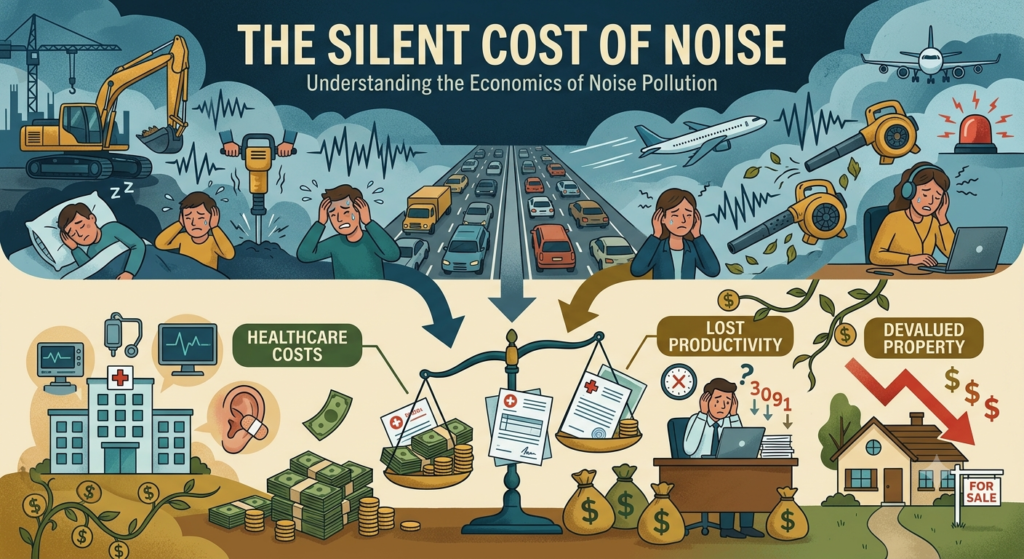
Some of these hidden costs include:-
Higher medical bills because of stress, hearing problems, and sleep disorders.
Lower productivity at workplaces.
Reduced concentration among students.
More workplace mistakes and accidents.
Declining value of houses located in noisy areas.
Extra government spending on health and noise control measures.
In simple words, noise pollution silently takes away money from families, businesses, and governments without anyone receiving a bill directly.
Why Economists Care About Noise????
Economics is not only about money, industries, or markets. It is also about how resources are used and how different problems affect society.
Noise pollution creates what economists call a hidden social cost.
The person creating the noise may not pay for its consequences, but many others suffer from it.
For example:-
A driver keeps pressing the horn unnecessarily.
Nearby students lose concentration while studying.
An elderly patient is unable to sleep peacefully.
Shopkeepers struggle to communicate with customers.
Office workers become mentally tired before completing their work.
The driver does not pay for these losses, but society bears the cost.
This is why economists consider noise pollution an issue that affects overall economic efficiency.
The Hidden Price We Pay Every Day:-
Unlike many other environmental problems, the financial impact of noise pollution builds slowly.
People may not notice it immediately, but over months and years the losses become significant.
1. Health Expenses Continue to Rise:-
Continuous exposure to loud noise can lead to:
Hearing problems
High blood pressure
Anxiety
Sleep disturbance
Headaches
Heart-related illnesses
Families spend more money on treatment, medicines, and medical check-ups.
Governments also spend larger amounts on public healthcare.
Money that could have been invested in education or infrastructure is instead used to manage preventable health problems.
2. Less Productivity Means Less Income:-
A peaceful environment helps people think clearly.
A noisy environment creates distraction.
Workers take longer to complete tasks.
Mistakes increase.
Mental fatigue develops faster.
Over time, businesses produce less while spending more on salaries, electricity, maintenance, and corrections.
Even a small drop in daily productivity can become a huge financial loss after one year.
3. Poor Sleep Reduces Economic Performance:-
Many people living near busy roads, railway stations, airports, or industrial areas struggle to sleep properly.
Lack of quality sleep leads to:-
Low energy.
Poor decision-making.
Reduced concentration.
More sick leaves.
Lower work performance.
The next morning’s tired employee becomes less productive, and businesses indirectly lose money.
Example :-
Imagine two small tailoring shops.
Both have experienced workers.
Both charge similar prices.
The only difference is their location.
The first shop is located beside a crowded road where traffic horns never stop.
The second shop is situated in a peaceful residential area.
After a few months:-
Workers in the quieter shop make fewer stitching mistakes.
Customers communicate more comfortably.
Employees feel less tired.
Orders are completed on time.
Meanwhile, workers in the noisy shop become stressed, repeat measurements, make more errors, and complete fewer orders.
Both businesses started with equal opportunities.
Only one factor changed-the level of surrounding noise.
This simple example shows that noise pollution is not only an environmental issue; it directly affects business performance and income.
The Workplace Pays a Heavy Price:-
Every workplace depends on communication, concentration, and accuracy.
Excessive noise weakens all three.
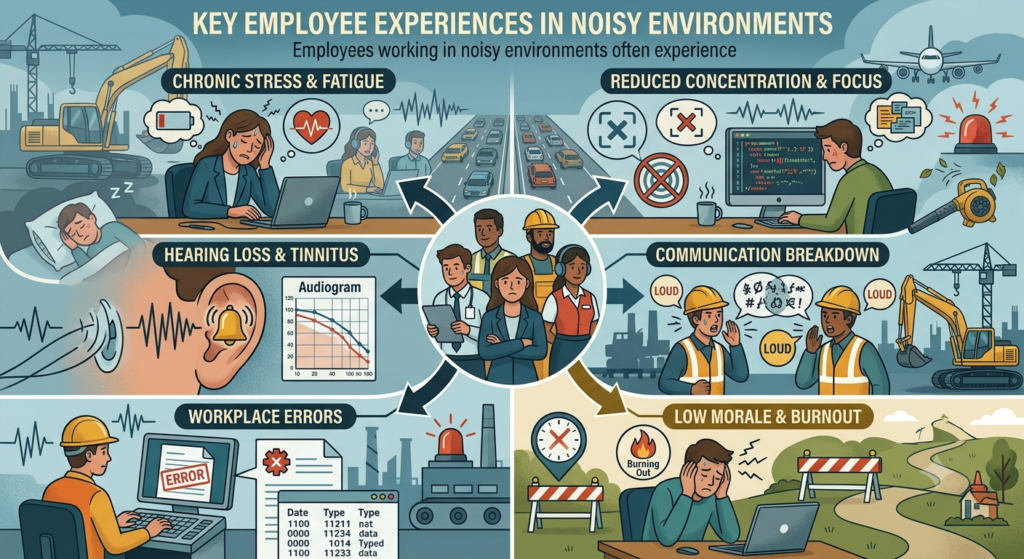
Employees working in noisy environments often experience:-
Difficulty focusing.
More communication errors.
Increased stress.
Mental exhaustion.
Lower job satisfaction.
As a result, companies may face:-
Reduced output.
Higher employee turnover.
Increased training costs.
Lower overall efficiency.
A quieter workplace is not just more comfortable-it is also more profitable.
An Invisible Threat to Future Growth:-
The biggest danger of noise pollution is that its effects continue silently.
People become used to the sound, but their bodies and minds continue to suffer.
Over time, these hidden losses reduce productivity, increase healthcare costs, and slow economic progress.
A country cannot achieve sustainable growth if millions of people work, study, and live in constantly noisy environments.
Economic development is not only about building more roads, factories, or cities.
It is also about creating places where people can live healthier, learn better, and work more efficiently.
That is why controlling noise pollution should be seen as an investment in the country’s future-not simply as an environmental responsibility.
How Noise Pollution Affects Education and Human Capital????
A peaceful environment is one of the basic needs for learning. Unfortunately, many schools and homes are surrounded by heavy traffic, construction work, railway lines, or busy markets. Constant noise makes it difficult for students to concentrate.
The economic impact may not be visible today, but it becomes clear in the future.
When students cannot learn properly, the country loses skilled professionals, creative thinkers, and productive workers.
Some common effects on students include:-
Poor concentration during study.
Difficulty remembering lessons.
Lower confidence during examinations.
Increased stress and mental fatigue.
Reduced academic performance.
Example:-
Imagine two students preparing for the same competitive exam.
One studies in a quiet village library, while the other studies in a room beside a busy road where vehicle horns never stop.
Both are equally hardworking, but the student in the peaceful environment is more likely to understand concepts better and stay focused for longer hours.
This small difference can influence future career opportunities and lifetime earnings.
When Property Prices Start Falling:-
Noise pollution also affects the real estate market.
Before buying or renting a house, people usually look for a safe and peaceful neighbourhood. Areas with continuous traffic noise, airports, industries, or construction activities often become less attractive.
As a result:-
Property prices may decline.
Rental demand becomes weaker.
Investors prefer quieter locations.
Families choose to shift to peaceful neighbourhoods whenever possible.
This shows that even sound has a financial value. A quieter location often becomes a more valuable asset.
Tourism Needs Peace, Not Noise
Many people travel to relax, enjoy nature, and spend quality time with their families.
If tourist destinations become filled with loud traffic, construction work, or unnecessary noise, visitors may not return.
The economic impact includes:-
Lower tourist satisfaction.
Reduced income for hotels and restaurants.
Fewer customers for local shops.
Decline in employment linked to tourism.
Protecting peaceful tourist destinations is not only good for visitors but also supports local businesses and creates long-term economic benefits.
The Situation in 2025–26:-
Rapid urban development is increasing noise levels in many growing cities.
Some important trends during 2025–26 include:-
Rising vehicle ownership has increased traffic-related noise.
Large infrastructure and construction projects have become major sources of urban noise.
Expanding cities have brought residential areas closer to highways and industrial zones.
Electric vehicles are slowly helping reduce engine noise, although traffic and unnecessary honking remain significant challenges.
Greater public awareness and stricter monitoring are encouraging better noise management in many places.
These developments show that economic growth and environmental protection must move together.
Reducing Noise is an Investment, Not an Expense
Many people think controlling noise requires unnecessary spending.
In reality, reducing noise often saves money in the long run.
Some practical solutions include:-
Promoting responsible driving and avoiding unnecessary honking.
Maintaining vehicles and industrial machines regularly.
Installing sound barriers near highways and busy roads.
Increasing green belts and urban tree plantations.
Planning residential and industrial areas more carefully.
Encouraging the use of quieter technologies.
Creating awareness through schools, workplaces, and local communities.
These measures improve public health, increase productivity, and reduce future healthcare costs.
What Every Citizen Can Do???
Governments alone cannot solve this problem.
Every individual can contribute by making simple changes.
For example:-
Use the vehicle horn only when necessary.
Keep music and loudspeakers at reasonable volume.
Respect silence in hospitals, schools, and residential areas.
Maintain vehicles to reduce unnecessary noise.
Plant more trees, as they help absorb sound.
Encourage others to follow responsible behaviour.
Small actions by millions of people can create a big positive change.
Conclusion:-
A Quiet Economy is a Strong Economy:-
Noise pollution is often ignored because its damage cannot be seen. However, its economic impact is real and continuous. It increases healthcare expenses, lowers workplace productivity, affects children’s education, reduces tourism income, and decreases property values. These hidden losses slow economic progress and reduce the quality of life.
A developed nation is not defined only by tall buildings, wider roads, or faster industries. True development also means creating cities where people can study without distraction, work with better concentration, sleep peacefully, and live healthier lives.
The economics of noise pollution teaches us an important lesson:-
every unnecessary sound carries a hidden cost, while every effort to reduce noise is an investment in better health, stronger businesses, higher productivity, and sustainable economic growth. A quieter society is not only a happier society-it is also a more prosperous one.