
Introduction:- A Case That Never Ends, A Cost That Never Stops
Ramesh owns a small manufacturing unit. He supplies products to another company, but the payment gets stuck because of a contract dispute. He believes the court will solve the problem within a few months. Instead, the case continues for years.
During this time, Ramesh cannot buy new machines. He cannot hire more workers. He delays his expansion plans because most of his money remains locked in the dispute. Slowly, one legal case starts affecting many lives. His employees lose overtime work, suppliers receive fewer orders, and customers experience delays.
This is not just the story of one businessman. It reflects a much larger reality. Every delayed court case creates a chain of economic consequences that goes far beyond the courtroom.
For this reason, judicial delay should not be seen only as a legal problem. It is also an economic challenge. When justice takes too long, the country pays through lower investment, slower business growth, reduced employment, and weaker public confidence.
As India moves towards becoming a developed economy, improving the speed of justice is no longer just a legal reform-it is an economic necessity.
Justice and the Economy:- A Connection That Is Often Ignored
A strong economy runs on trust. Businesses trust contracts, investors trust the legal system, and citizens trust that their rights will be protected.
When this trust weakens because disputes remain unresolved for years, the economy begins to slow down.
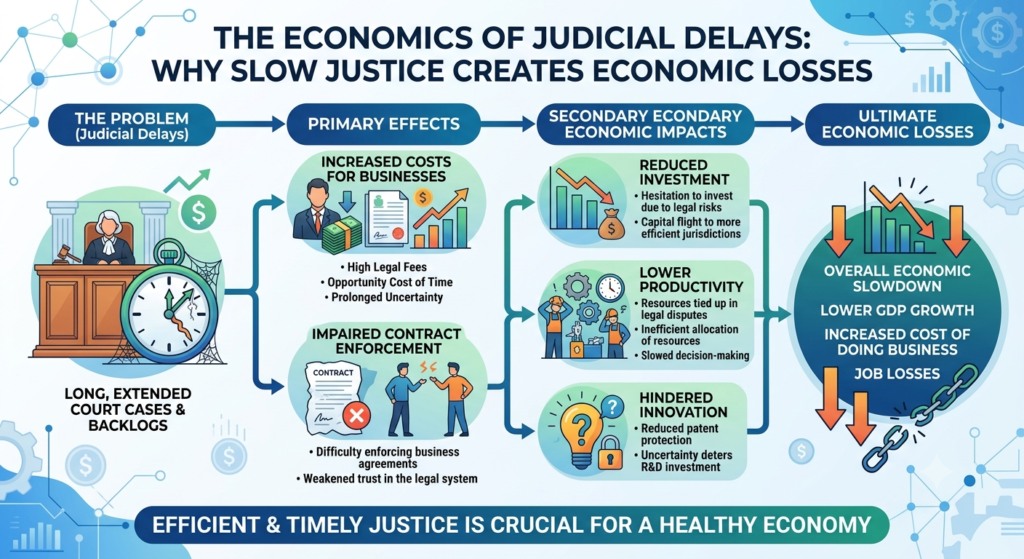
Judicial delays affect the economy in many ways:-
Money remains locked in pending disputes.
Business decisions are postponed.
Investment becomes more risky.
Development projects move slowly.
Families spend more on legal expenses.
Productive time is lost.
In simple words, delayed justice reduces the speed at which money and opportunities move through the economy.
The Present Reality:-
India has one of the largest judicial systems in the world. At the same time, it also carries a huge number of pending cases.
According to the latest official figures available during 2025–26, more than 5 crore cases are pending across different levels of courts. District courts account for the largest share, where common citizens seek justice in matters related to property, family issues, employment, and business.
Every pending case represents more than a legal file. It represents someone’s time, savings, business opportunity, or future plan waiting for a final decision.
When Court Delays Enter the Marketplace??
The impact of judicial delays does not remain inside courtrooms. It reaches markets, industries, banks, and workplaces.
Every business depends on timely decisions. Companies sign agreements with the hope that if a dispute arises, it will be resolved within a reasonable period.
However, long legal proceedings create several problems:-
Payments remain pending.
Contracts become uncertain.
Expansion plans are delayed.
Business confidence decreases.
Operational costs continue to rise.
Instead of investing in innovation, businesses often spend their energy managing legal uncertainty.
Example from Everyday Life:-
Imagine two brothers inherit a small piece of commercial land. They disagree over ownership and the matter reaches court.
Because the dispute continues for years:-
The land remains unused.
No shop or office is built.
The family earns no rental income.
Local employment opportunities are lost.
The government also loses possible tax revenue from future business activity.
A single unresolved dispute quietly affects many people who were never directly involved in the case.
This example shows that judicial delays create economic losses that are often invisible but highly significant.
Why Investors Prefer Fast Justice???
Investment is not driven only by profits. It is also driven by confidence.
Before investing, companies ask important questions:-
Will contracts be protected??
Can disputes be resolved quickly??
Is the legal environment predictable??
If the answer is uncertain, investors become more careful.
Slow dispute resolution increases the cost of doing business because companies must spend more time, money, and resources handling legal risks.
On the other hand, a judicial system that delivers timely justice encourages investment, supports entrepreneurship, and creates a stronger business environment.
For this reason, judicial efficiency has become an important factor in long-term economic development.
When Delayed Justice Reduces Employment Opportunities??
A growing economy needs continuous investment, new businesses, and regular expansion of industries. However, when important projects remain stuck in legal disputes, job creation also slows down.
For example, if a company plans to build a new factory but the land dispute remains pending for several years, the project cannot move forward. As a result:-
Construction workers do not get employment.
Engineers and technicians lose opportunities.
Local transport and small shops receive less business.
The surrounding area’s economic activity slows down.
In this way, one delayed judgment can affect hundreds of people who are not even connected to the legal dispute.
The Hidden Financial Burden on Ordinary Families:-
Judicial delays are expensive not only for businesses but also for common citizens.
A family involved in a property or compensation case often faces:-
Repeated travel to courts.
Lawyer and documentation expenses.
Loss of daily income because of court visits.
Mental stress that affects work performance.
Delay in using valuable property or receiving rightful compensation.
Sometimes, people spend years waiting for a decision while the actual value of the disputed property keeps changing. The financial loss continues even before the judgment is delivered.

Public Projects Also Pay the Price:-
Many important development projects require timely legal clearances and dispute resolution.
These include:-
Roads and highways.
Railway projects.
Housing schemes.
Industrial corridors.
Renewable energy projects.
When legal disputes continue for a long time, construction costs increase because of inflation, changing material prices, and project delays.
A project that could have been completed quickly may eventually cost much more than originally planned. This extra burden ultimately affects public finances and slows the pace of development.
The Cost That Cannot Be Measured Easily:-
Not every economic loss appears in official statistics. Some losses remain invisible but are equally important.
Judicial delays reduce:-
Business confidence.
Productivity.
Innovation.
Long-term financial planning.
Public trust in institutions.
When uncertainty becomes a part of everyday life, people become more cautious about investing, expanding businesses, or taking financial risks.
This invisible economic cost gradually affects the country’s growth potential.
Can Technology Make Justice Faster???
Technology cannot replace judges, but it can make the judicial process more efficient.
Some useful reforms include:-
Online filing of cases.
Digital records and document management.
Video hearings in suitable cases.
Better scheduling of hearings.
Faster access to court orders and judgments.
These improvements reduce unnecessary delays and save both time and public resources.
What More Can Be Done????
Reducing judicial delays requires long-term reforms rather than one single solution.
Some practical measures include:-
Filling vacant judicial positions without unnecessary delay.
Increasing the number of courts where workload is high.
Encouraging mediation and arbitration for suitable disputes.
Simplifying lengthy legal procedures.
Improving court infrastructure.
Promoting legal awareness among citizens.
When these reforms work together, they strengthen both the justice system and the economy.
A Lesson from Everyday Life:-
Imagine a young entrepreneur who develops a new business idea and rents a commercial space. Soon after opening, a legal dispute over the property begins and the case remains pending for years.
Because of this uncertainty:-
The entrepreneur cannot expand the business.
New employees are not hired.
Suppliers receive fewer orders.
Customers lose confidence.
Future investment plans are cancelled.
One unresolved legal dispute quietly limits economic growth at the local level.
Future Possibilities:-
India has set ambitious goals for economic growth, manufacturing, digital development, and employment generation. Achieving these goals requires more than financial investment. It also requires institutions that function efficiently.
A faster judicial system creates confidence among citizens, businesses, and investors. It improves the ease of doing business, encourages entrepreneurship, and supports sustainable development.
Reducing pending cases will take time, but continuous reforms, better infrastructure, wider use of technology, and timely appointments can gradually improve the situation.
Conclusion:-
Judicial delays are not simply about waiting for a court judgment. They influence almost every part of the economy, from business investment and employment to infrastructure development and family finances. Every unnecessary delay creates hidden economic costs that reduce productivity and weaken public confidence.
A modern and growing economy needs a judicial system that delivers justice without unnecessary delay. Faster dispute resolution supports investment, encourages innovation, protects the rights of citizens, and strengthens economic growth.
In the end, justice is not only about deciding who is right or wrong. It is also about ensuring that valuable time, money, and opportunities are not lost while waiting for a decision. A country moves forward not only when its economy grows, but also when its justice system keeps pace with that growth.