
Introduction:-
When people think about agriculture, they usually focus on farming activities such as sowing seeds, irrigation, and harvesting crops. However, the journey of a crop does not end in the field. After harvest, the produce must be stored, transported, processed, and delivered to consumers. This entire journey is known as the agricultural supply chain.
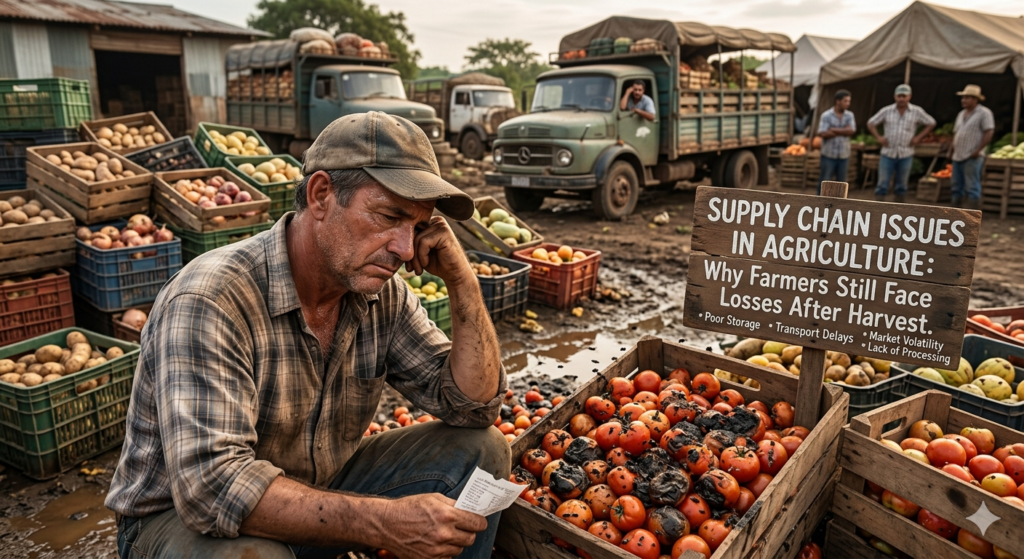
A strong supply chain helps farmers earn better profits and ensures that consumers get fresh food at reasonable prices. But in reality, many supply chain problems continue to affect agriculture. These challenges often lead to food wastage, lower farmer income, and higher prices in the market.
Today, improving the agricultural supply chain is just as important as improving crop production because even a good harvest can result in losses if the supply chain is weak.
Understanding the Agricultural Supply Chain:-
The agricultural supply chain is the network that connects farms to consumers.
It includes several stages:-
Production on farms
Collection of produce
Storage and warehousing
Transportation
Processing and packaging
Distribution to markets
Purchase by consumers
Each stage depends on the previous one. A problem at any point can affect the entire system.
Why Supply Chain Efficiency Matters??
An efficient supply chain provides benefits to everyone.
For Farmers:-
Better prices for crops
Reduced losses after harvest
Faster access to markets
Higher income opportunities
For Consumers:-
Fresh and quality products
Stable food supply
Affordable prices
For the Economy:-
Reduced food wastage
Improved agricultural growth
Better use of resources
Stronger rural development
When the supply chain works smoothly, both farmers and consumers benefit.
Major Supply Chain Issues in Agriculture:-
1. Inadequate Storage Facilities:-
One of the most common problems is the shortage of proper storage facilities.
Many farmers harvest crops and immediately sell them because they do not have access to safe storage. This situation becomes more difficult for fruits and vegetables that spoil quickly.
As a result:-
Produce gets damaged
Farmers sell at low prices
Food wastage increases
Income opportunities decrease
Real-Life Example:-
A vegetable farmer harvests a large quantity of tomatoes. Due to the lack of storage facilities, the tomatoes must be sold immediately. If market prices are low on that day, the farmer has no option but to accept lower earnings.
2. Transportation Challenges:-
Transportation is a crucial link in the supply chain.
Agricultural products often travel long distances from villages to urban markets. Poor roads, traffic delays, and rising transportation costs create major challenges.
Common problems include:-
Delayed delivery
Increased transportation expenses
Damage during transit
Reduced freshness of products
Fresh produce such as vegetables, fruits, flowers, and dairy products is especially vulnerable.
Real-Life Example:-
A farmer sends fresh vegetables to a city market. Due to transportation delays, some vegetables lose quality before reaching buyers. The farmer receives a lower price despite producing good-quality crops.
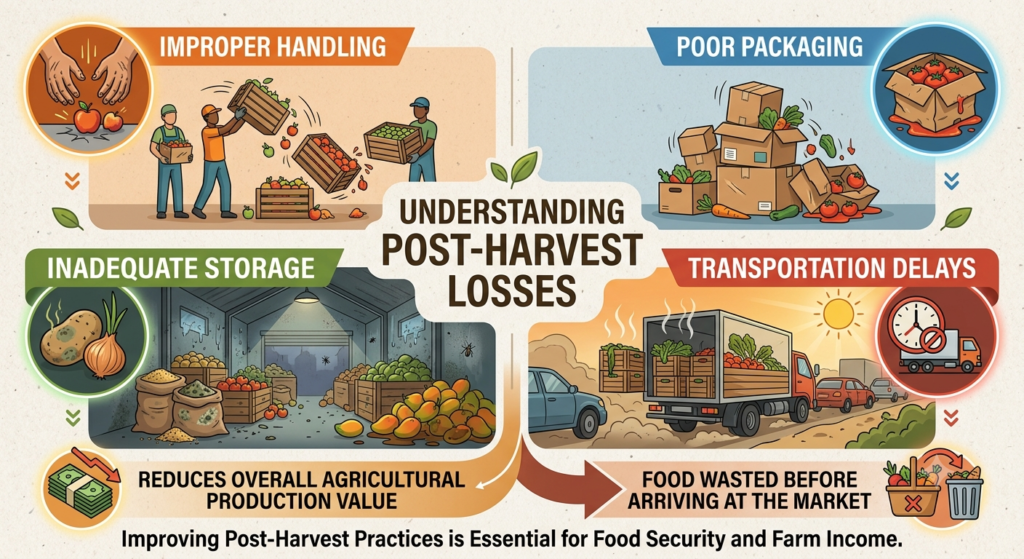
3. High Post-Harvest Losses:-
A significant amount of agricultural produce is lost after harvesting.
Post-harvest losses occur because of:-
Improper handling
Poor packaging
Inadequate storage
Transportation delays
These losses reduce the overall value of agricultural production.
Food that could have reached consumers often gets wasted before arriving at the market.
4. Presence of Multiple Middlemen:-
In many agricultural markets, products pass through several intermediaries before reaching consumers.
The chain may involve:-
Local traders
Commission agents
Wholesalers
Retailers
Each participant adds costs to the product.
As a result:-
Consumers pay more
Farmers receive less
Market transparency decreases
Many farmers feel that they do not receive a fair share of the final selling price.
5. Lack of Market Information:-
Market information is extremely important for farmers.
However, many small farmers still struggle to access accurate information regarding:-
Current prices
Consumer demand
Market trends
Best selling locations
Without proper information, farmers often make decisions based on assumptions rather than facts.
This can result in lower profits and missed opportunities.
6. Seasonal Price Fluctuations:-
Agriculture depends heavily on seasons.
When a large number of farmers harvest the same crop at the same time, market supply increases rapidly. Prices often fall because demand cannot absorb the sudden increase.
Farmers then face two difficult choices:-
Sell at very low prices
Store produce and wait, which is not always possible
This creates financial uncertainty.
Real-Life Example:-
During peak harvest season, onion production may increase significantly. If market demand remains unchanged, prices can fall sharply, affecting farmer income.
7. Limited Cold Chain Infrastructure:-
Certain agricultural products require temperature-controlled storage and transportation.
These products include:-
Fruits
Vegetables
Milk
Meat
Flowers
A cold chain system helps preserve quality and freshness.
However, many rural areas still lack sufficient cold storage facilities and refrigerated transport vehicles.
Because of this limitation:-
Products spoil faster
Market value decreases
Food losses increase
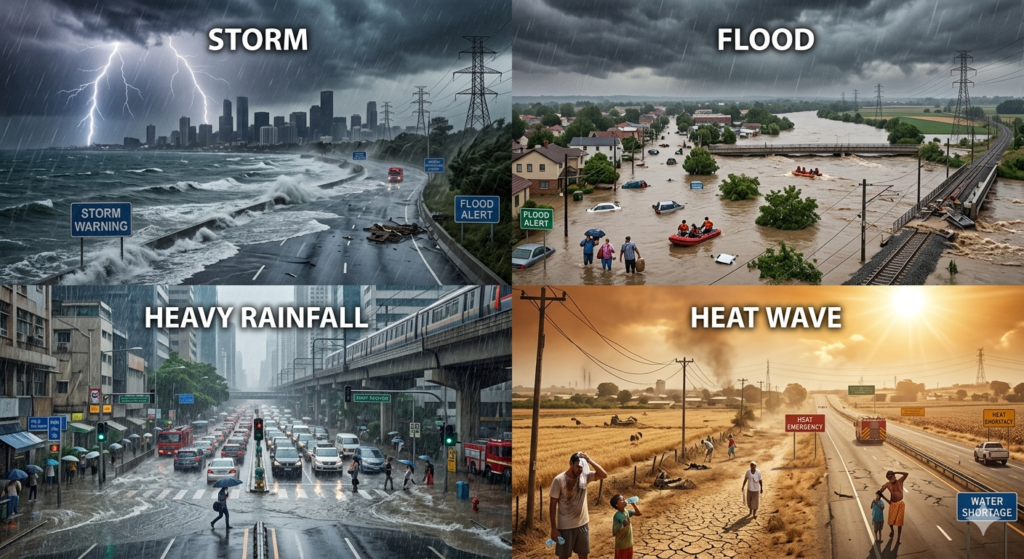
8. Weather-Related Disruptions:-
Weather conditions can affect the supply chain even after crops are harvested.
Heavy rainfall, floods, storms, and heat waves may disrupt:-
Transportation routes
Storage facilities
Market operations
Unexpected weather events create uncertainty and increase supply chain risks.
In recent years, changing climate patterns have made these challenges more noticeable.
9. Limited Processing Facilities:-
Food processing helps increase the value of agricultural products.
Instead of selling raw produce, farmers can earn more when products are processed into:-
Juices
Pickles
Packaged foods
Dried products
Unfortunately, many farming regions have limited processing facilities.
This reduces opportunities for value addition and income growth.
Impact of Supply Chain Issues:-
The effects of supply chain problems go beyond individual farmers.
Impact on Farmers
Lower profits
Higher financial risk
Limited market access
Increased uncertainty
Impact on Consumers
Higher food prices
Reduced product quality
Supply shortages
Impact on the Agricultural Sector
Increased wastage
Reduced efficiency
Slower growth
Loss of valuable resources
A weak supply chain affects the entire agricultural ecosystem.
How Technology Can Improve Agricultural Supply Chains?????
Technology is creating new opportunities to solve supply chain challenges.
Digital Market Platforms:-
Online platforms help farmers connect directly with buyers and access real-time market information.
Smart Storage Systems:-
Modern storage facilities help maintain product quality for longer periods.
GPS-Based Logistics:-
Route planning technologies reduce transportation delays and improve delivery efficiency.
Mobile Applications:-
Farmers can receive updates about:-
Market prices
Weather forecasts
Demand patterns
This information supports better decision-making.
Practical Solutions for Stronger Supply Chains:-
Several steps can improve agricultural supply chains.
Improve Storage Infrastructure:-
More warehouses and cold storage facilities can reduce post-harvest losses significantly.
Strengthen Rural Transportation:-
Better roads and transport networks can improve market connectivity.
Promote Farmer Groups:-
When farmers work together, they can:-
Reduce costs
Access larger markets
Negotiate better prices
Expand Food Processing
More processing units in rural areas can create additional income opportunities.
Increase Access to Information:-
Timely information helps farmers make smarter production and marketing decisions.
Encourage Innovation:-
New technologies can improve efficiency across every stage of the supply chain.
Future of Agricultural Supply Chains:-
Agriculture is gradually becoming more connected and technology-driven.
Future improvements may include:-
Smart warehouses
Digital trading systems
Better cold chain networks
AI-based demand forecasting
Faster logistics systems
Farm-to-consumer supply models
These developments can help reduce losses and improve profitability.
The goal is not only to produce more food but also to ensure that food reaches consumers efficiently and safely.
Conclusion:-
Agriculture depends on much more than successful crop production. A strong supply chain is essential for moving products from farms to consumers without unnecessary losses. However, challenges such as poor storage, transportation difficulties, post-harvest losses, multiple intermediaries, and limited market information continue to affect the sector.
These issues reduce farmer income, increase food wastage, and create inefficiencies throughout the market. Addressing these challenges requires investment in infrastructure, technology, processing facilities, and farmer support systems.
A stronger agricultural supply chain can improve farmer livelihoods, reduce waste, ensure food availability, and contribute to long-term agricultural growth. As the agricultural sector continues to evolve, building an efficient and resilient supply chain will remain one of the most important steps toward a sustainable future.