
Introduction:-
Agriculture is one of the oldest and most important activities in human life. It provides food, raw materials, and employment to millions of people around the world. For a long time, farming was mainly based on traditional knowledge and manual work. Farmers relied on experience, weather patterns, and local practices to grow crops. While these methods are still valuable, modern agriculture now faces many challenges such as climate change, water shortages, rising production costs, and increasing food demand.
When I look at today’s farming sector, it is clear that technology is becoming an important partner for farmers. Modern tools are helping them improve productivity, save resources, and make better decisions. This combination of agriculture and technology is known as Agri-Tech. It is changing the way food is produced and creating new opportunities for the future. In my opinion, the future of farming will depend on how effectively farmers use technology while maintaining sustainable farming practices.
What is Agri-Tech????
Agri-Tech refers to the use of modern technology in agriculture. It includes digital tools, advanced machinery, software applications, sensors, drones, and artificial intelligence that help improve farming activities.
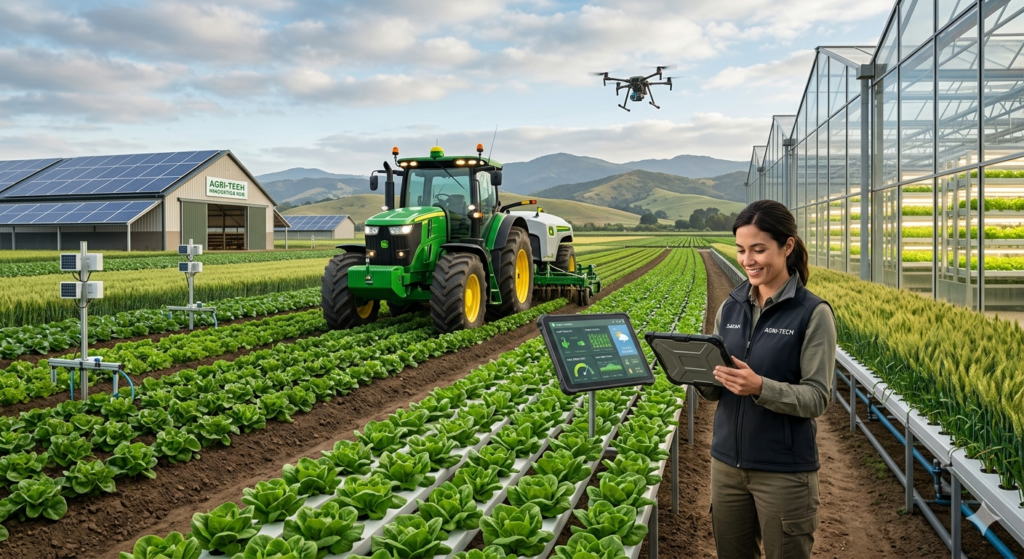
The main purpose of Agri-Tech is to make farming:-
More productive
More efficient
More sustainable
More profitable
Instead of depending only on traditional methods, farmers can now use technology to make informed decisions and improve crop production.
Why Modern Farming Needs Technology????
Agriculture today faces several challenges that were less common in the past. Unpredictable weather conditions, limited natural resources, and increasing food demand require new solutions.
Technology is becoming necessary because it helps farmers:-
Increase crop yields
Save water and energy
Reduce production costs
Improve crop quality
Detect diseases early
Minimize losses
I believe that without technological improvements, it will become difficult to meet the food requirements of future generations.
(Smart Farming:- A New Approach)
Smart farming is one of the most important developments in modern agriculture. It uses technology and real-time information to manage farms more effectively.
Farmers can collect information about their fields and make decisions based on facts rather than guesswork.
(Key Features of Smart Farming)
1. Soil Monitoring:-
Special sensors are used to check:-
Soil moisture
Nutrient levels
Soil temperature
This information helps farmers understand exactly what their crops need.
2. Weather Tracking:-
Modern weather forecasting systems help farmers plan activities such as:-
Sowing
Irrigation
Harvesting
Crop protection
Better planning reduces risks and increases efficiency.
3. Data-Based Decisions:-
Farmers can use collected data to decide:-
Which crop to grow
How much fertilizer to use
When to irrigate
This leads to better results and lower costs.
(Drones in Agriculture)
Drones have become valuable tools in modern farming. They can fly over fields and collect useful information within a short time.
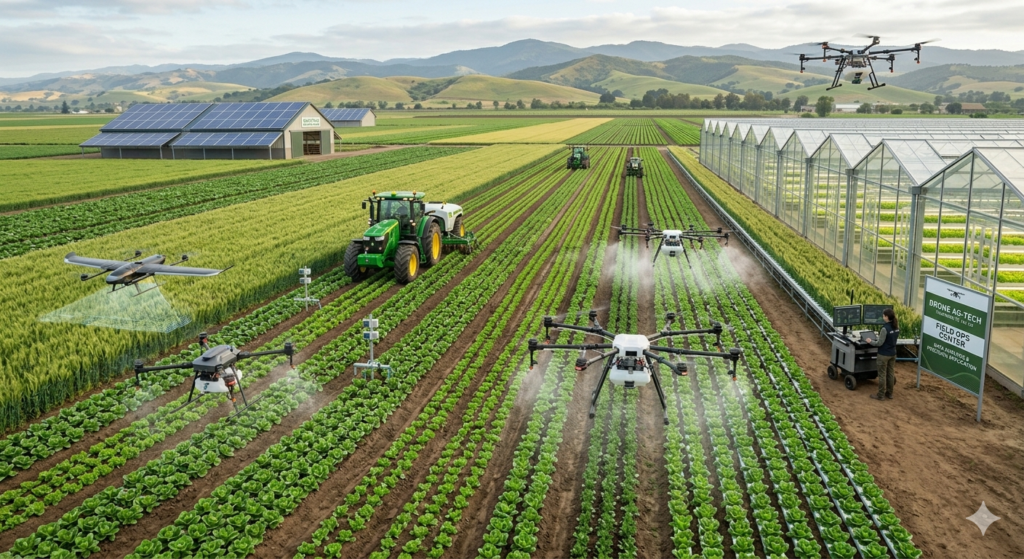
Uses of Drones:-
Monitoring crop health
Detecting pest attacks
Identifying water stress
Mapping agricultural land
Spraying fertilizers and pesticides
Real-Life Example:-
Imagine a farmer managing a large wheat farm. Inspecting every part of the field on foot may take several hours. A drone can scan the entire field within minutes and identify areas that require attention.
This helps farmers solve problems quickly and prevent larger losses.
(Artificial Intelligence in Farming)
Artificial Intelligence (AI) is becoming increasingly important in agriculture. AI systems can analyze large amounts of information and provide useful recommendations.
AI Helps Farmers By:-
Predicting crop diseases
Identifying pest attacks
Estimating crop yields
Suggesting fertilizer use
Monitoring crop growth
Real-Life Example:-
A tomato farmer can use an AI-powered mobile application that analyzes crop images. If the system detects signs of disease, it alerts the farmer immediately. Early action can save a large part of the crop and reduce financial losses.
I find this technology particularly useful because it helps farmers make faster and more accurate decisions.
(Precision Agriculture)
Precision agriculture focuses on providing the right amount of resources at the right place and at the right time.
Instead of treating the entire field equally, farmers can manage different areas according to their specific needs.
Benefits of Precision Agriculture:-
Reduced waste
Better crop growth
Lower production costs
Higher productivity
Improved environmental protection
This method helps farmers use resources more efficiently while increasing profits.
Smart Irrigation and Water Management:-
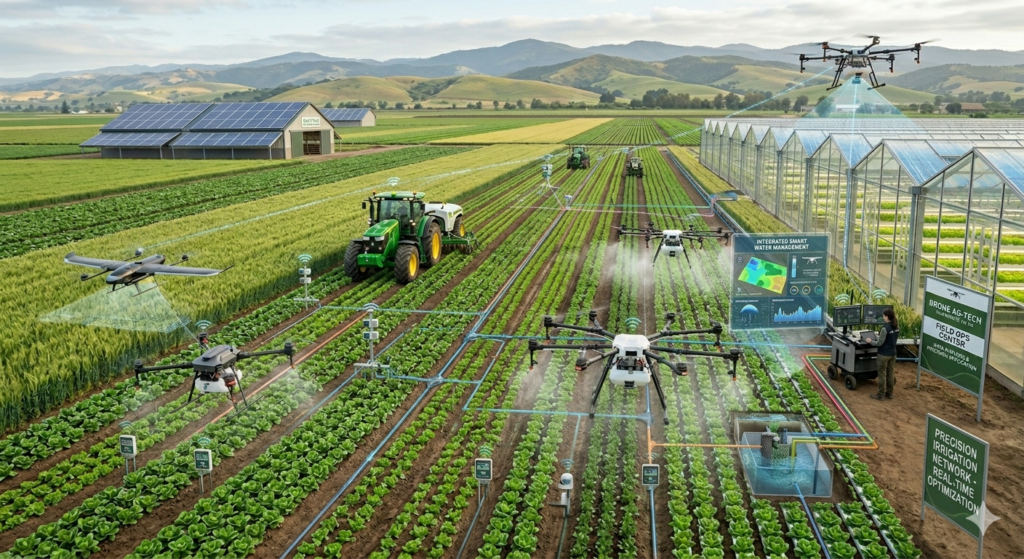
Water is one of the most valuable resources in agriculture. However, water shortages are becoming a serious concern in many regions.
Modern irrigation technologies help farmers use water wisely.
Popular Water-Saving Technologies
Drip irrigation
Smart sprinklers
Soil moisture sensors
Automated irrigation systems
Real-Life Example:-
A vegetable farmer using drip irrigation can deliver water directly to plant roots. This reduces water loss and ensures crops receive the exact amount of moisture needed for healthy growth.
As a result, both water conservation and crop productivity improve.
(Robotics and Automation)
Automation is changing the way farming activities are performed. Agricultural robots can complete several tasks with speed and accuracy.
Functions of Agricultural Robots:-
Planting seeds
Removing weeds
Harvesting crops
Monitoring field conditions
Automation helps reduce labor shortages and increases operational efficiency.
In the future, robotic systems may become common on farms and perform many routine activities automatically.
(Vertical Farming:- Farming in Limited Space)
Vertical farming is an innovative method where crops are grown in stacked layers instead of traditional open fields.
This system is often used inside controlled environments where temperature, humidity, and lighting can be carefully managed.
Advantages of Vertical Farming:-
Requires less land
Uses less water
Produces crops throughout the year
Suitable for urban areas
Reduces transportation needs
Real-Life Example:-
Leafy vegetables such as lettuce and spinach can be grown inside multi-story farming facilities. Even areas with limited agricultural land can produce fresh vegetables regularly.
This method shows how technology can help solve land-related challenges.
(Internet of Things in Agriculture)
The Internet of Things refers to connected devices that collect and share information through the internet.
In agriculture, Internet of things devices help farmers monitor:-
Soil conditions
Temperature
Crop growth
Livestock health
Water usage
Farmers can access this information through smartphones or computers and make timely decisions.
I think this is one of the most practical innovations because it allows farmers to manage farms more effectively even from a distance.
(Benefits of Agri-Tech)
Agri-Tech provides several important benefits for both farmers and society.
Increased Productivity:-
Technology helps farmers produce more food from the same amount of land.
Better Crop Quality:-
Continuous monitoring improves crop health and quality.
Reduced Costs:-
Efficient use of resources lowers production expenses.
Environmental Protection:-
Modern technologies help reduce waste and support sustainable farming.
Improved Farmer Income:-
Higher yields and better-quality produce can increase earnings.
Better Risk Management:-
Early warnings about weather changes, pests, and diseases help reduce losses.
Challenges of Agri-Tech:-
Although Agri-Tech offers many advantages, some challenges still remain.
High Initial Cost:-
Advanced machines and equipment can be expensive for small farmers.
Need for Training:-
Many farmers require training to use modern technologies effectively.
Internet Connectivity Issues:-
Some rural areas still face limited internet access.
Maintenance Requirements:-
Technological devices need regular maintenance and updates.
Despite these challenges, continuous improvements and awareness programs are making Agri-Tech more accessible.
Future of Farming:-
The future of agriculture is expected to be highly technology-driven. Experts believe that farms will increasingly use:-
Artificial Intelligence
Robotics
Drone technology
Smart irrigation systems
Data analytics
Climate-smart farming methods
Future farming will focus not only on increasing production but also on protecting natural resources. Sustainable farming practices will become more important as environmental concerns continue to grow.
In my view, the farmers who adopt technology while preserving traditional agricultural knowledge will be the most successful in the future.
Conclusion:-
Agri-Tech is transforming agriculture and creating new possibilities for farmers around the world. Modern technologies such as drones, artificial intelligence, smart irrigation systems, robotics, and precision agriculture are helping improve productivity, reduce costs, and conserve resources. These innovations are making farming more efficient and environmentally friendly.
After understanding the impact of modern agricultural technologies, I believe that Agri-Tech will play a major role in ensuring food security and sustainable development in the coming years. Technology is not replacing farmers; it is empowering them with better tools and information. As agriculture continues to evolve, the combination of innovation, knowledge, and sustainability will shape the future of farming. Agri-Tech is not just a trend-it is a powerful step toward a smarter and stronger agricultural future.