
Introduction:-
Today, India is connected with almost every major economy in the world. Goods, services, technology, investments, and information move quickly from one country to another. Because of this connection, events happening in other parts of the world can influence India’s markets. A war in one region, a rise in oil prices, a global economic slowdown, or even a natural disaster can affect businesses and investors in India.
Indian markets do not work in isolation anymore. They react to global developments every day. Understanding these connections helps us understand why market prices change and why businesses sometimes grow faster or face difficulties.
What Are Global Events????
Global events are major developments that affect many countries at the same time.
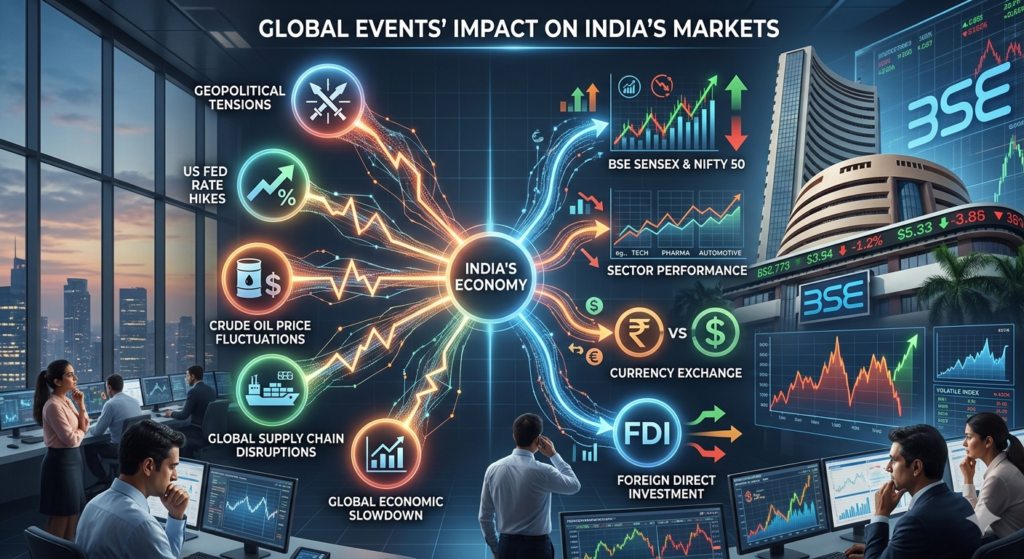
Some common examples include:-
International conflicts and wars
Global economic crises
Changes in oil prices
Natural disasters
Health emergencies
Trade agreements
Political changes in major countries
Technological developments
These events may happen outside India, but their effects can still be felt in Indian markets.
Why India Is Affected by Global Events
India trades with many countries and imports important products such as crude oil, machinery, and electronic goods. At the same time, India exports software services, medicines, agricultural products, and manufactured goods.
India also receives investments from foreign investors. Because of these connections, changes in the global economy often influence Indian businesses and financial markets.
Some important reasons are:-
India is a major trading nation.
Foreign investors invest heavily in Indian markets.
India depends on imported energy resources.
Indian companies do business across the world.
Impact on the Stock Market:-
The stock market is often the first place where the effects of global events become visible.
Positive Effects:-
When the global economy is performing well:
Investors become confident.
More foreign money enters India.
Company profits may increase.
Stock prices often rise.
Negative Effects:-
During global uncertainty:-
Investors become cautious.
Share prices may fall.
Market volatility increases.
Business expansion plans may slow down.
Real-Life Example:-
Imagine a major economy announces strong economic growth. Investors may expect higher business activity worldwide and invest more in Indian companies. As a result, Indian stock prices may increase.
Oil Prices and Their Influence:-
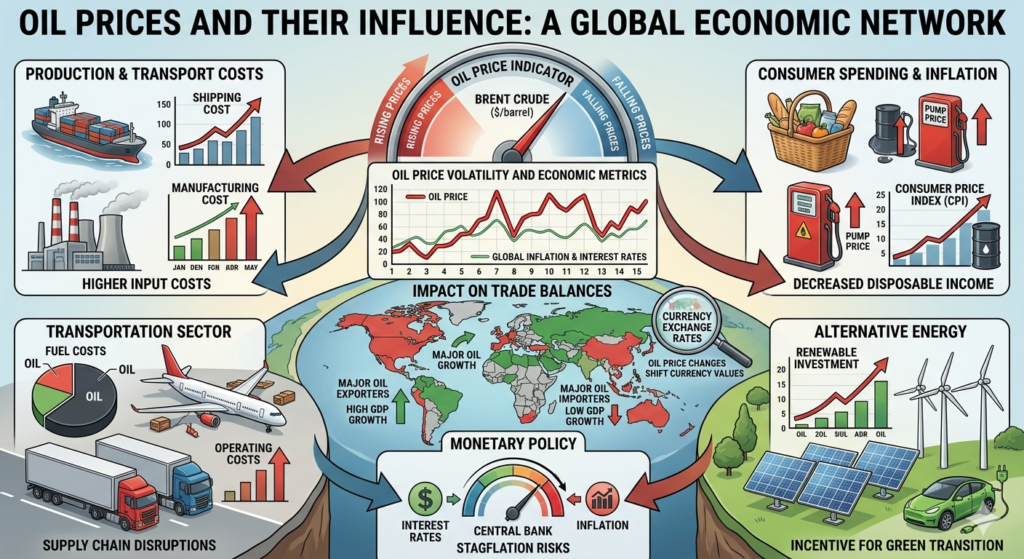
Oil is one of the most important imports for India. Therefore, global oil prices have a direct impact on the economy.
When Oil Prices Rise:-
Transportation becomes expensive.
Production costs increase.
Inflation may rise.
Consumers spend more on fuel.
When Oil Prices Fall:-
Businesses save money.
Transportation costs decrease.
Inflation pressure reduces.
Economic growth may improve.
Real-Life Example:-
If oil-producing countries face political tensions, global oil supply may decrease. This often pushes oil prices higher, affecting fuel costs in India.
Impact on the Indian Rupee:-
Global events can affect the value of the Indian Rupee against foreign currencies.
Effects of a Weak Rupee:-
Imports become costly.
Fuel prices may increase.
Businesses importing products face higher expenses.
Effects of a Strong Rupee:-
Imports become cheaper.
Production costs may reduce.
Businesses buying foreign goods benefit.
Real-Life Example:-
When investors move their money to safer countries during uncertain times, demand for foreign currencies rises. This can weaken the Indian Rupee.
Foreign Investment and Market Movement:-
Foreign investors play an important role in India’s financial system.
During Stable Conditions:-
More money enters Indian markets.
Companies receive investment support.
Employment opportunities may increase.
During Global Problems:-
Investors may withdraw funds.
Stock markets face pressure.
Business confidence may decline.
Example:-
If investors become worried about a global recession, they may reduce investments in developing economies, including India.
Effect on Different Industries:-
Not every sector reacts in the same way. Some industries benefit while others face challenges.
(Information Technology Sector)
Benefits:-
Increased demand for digital services.
More international clients.
Higher export earnings.
Challenges:-
Slow growth in foreign countries can reduce project demand.
(Pharmaceutical Sector)
Benefits:-
Increased demand for medicines.
Strong export opportunities.
Challenges:-
Supply chain disruptions can affect production.
(Automobile Sector)
Benefits:-
Lower raw material prices can support growth.
Challenges:-
Shortage of components can delay manufacturing.
(Agriculture Sector)
Benefits:-
Better export opportunities.
Higher demand for some crops.
Challenges:-
Global price changes can affect farmer income.
Global Trade Policies and India
Trade policies adopted by different countries directly affect India’s exports and imports.
Positive Outcomes:-
Better market access.
Increased exports.
Higher business opportunities.

Negative Outcomes:-
Trade restrictions can reduce exports.
Businesses may face higher costs.
International competition may increase.
Real-Life Example:-
If another country increases taxes on imported products, Indian exporters may find it harder to sell goods in that market.
(Natural Disasters and Their Economic Impact)
Natural disasters can affect production and transportation around the world.
Some effects include:-
Supply chain disruptions.
Delayed shipments.
Increased product prices.
Reduced availability of goods.
Example:-
If a major manufacturing country experiences an earthquake, production may slow down. Indian industries depending on imported components may also face difficulties.
Health Emergencies and Markets:-
Large health emergencies can influence both businesses and consumers.
Challenges:-
Lower consumer spending.
Business interruptions.
Reduced economic activity.
Opportunities:-
Growth in healthcare services.
Increased use of digital technology.
Expansion of online businesses.
Example:-
During major health crises, many businesses shift to online operations, creating new opportunities for technology companies.
How Common People Feel the Impact????
Global events do not affect only investors and companies. Ordinary citizens also experience changes.
Some common impacts are:-
Higher fuel prices.
Increased cost of goods.
Changes in employment opportunities.
Fluctuations in investment returns.
Changes in household expenses.
For example, if transportation costs rise due to expensive oil, the prices of vegetables, groceries, and other daily products may also increase.
How India Responds to Global Challenges????
India continuously works to reduce the impact of global risks.
Important steps include:-
Strengthening domestic manufacturing.
Expanding trade partnerships.
Increasing foreign exchange reserves.
Promoting renewable energy.
Supporting digital development.
Encouraging investment and innovation.
These efforts help make the economy more stable during difficult international situations.
Conclusion:-
Global events have become an important factor in shaping India’s markets. Changes in oil prices, foreign investments, trade policies, economic conditions, natural disasters, and health emergencies can all influence businesses, consumers, and investors. While some events create challenges, others open new opportunities for growth and innovation.
In my view, understanding global events has become essential because today’s economy is highly interconnected. The ability of India to adapt to changing global conditions will continue to play a major role in its economic success. By strengthening domestic industries and maintaining economic stability, India can manage global challenges while taking advantage of international opportunities.
This shows that global events may begin in one part of the world, but their impact can easily reach Indian markets and influence everyday economic life.