
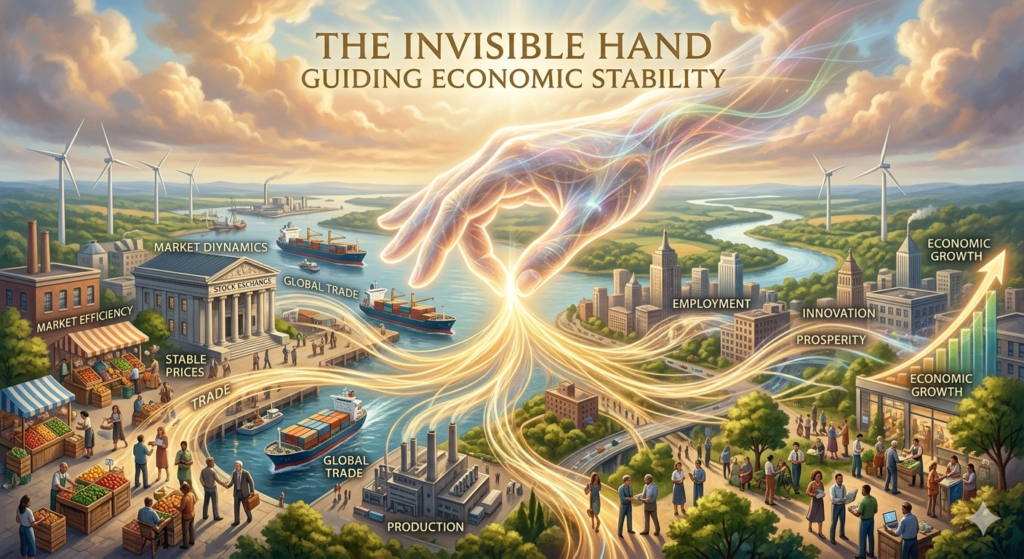
Monetary Policy:- (The Invisible Hand Guiding Economic Stability)
1. Introduction
Monetary policy is one of the most powerful yet least visible instruments of economic management. While government policies related to taxation or welfare are openly debated, monetary policy works silently in the background, shaping the flow of money and credit in the economy. Its influence can be seen in inflation levels, interest rates, investment decisions, and overall economic confidence. For a country like India, where growth aspirations coexist with price pressures, monetary policy plays a critical balancing role.
2. Meaning of Monetary Policy:-
In simple terms, monetary policy refers to the strategy adopted by the central bank to regulate money supply and credit conditions in the economy. It determines how much money should circulate and at what cost it should be available. Instead of directly controlling production or employment, monetary policy affects economic activity indirectly by influencing borrowing, spending, and saving behaviour.
The central idea behind monetary policy is to ensure that money neither becomes excessively scarce nor overly abundant.
3. Relevance of Monetary Policy in India:-
India’s economic structure makes monetary policy particularly significant. The country faces challenges such as inflation sensitivity, income inequality, dependence on credit-driven growth, and exposure to global economic shocks. Monetary policy helps manage these challenges by ensuring macroeconomic stability.
In the absence of effective monetary regulation, excessive inflation can erode purchasing power, while inadequate liquidity can slow economic growth. Thus, monetary policy acts as a stabilising force in a dynamic and complex economy.
4. Primary Objectives of Monetary Policy:-
Monetary policy is guided by multiple objectives that are closely interconnected:-
(1) Price Stability:-
The foremost objective is to maintain stable prices. Controlled inflation protects household savings and prevents uncertainty in economic decision-making.
(2) Supporting Economic Growth:-
While inflation control remains central, monetary policy also ensures that productive sectors have access to credit to support long-term growth.
(3) Financial Stability:-
By regulating liquidity and credit expansion, monetary policy helps prevent banking stress and systemic financial risks.
(4) Confidence Building:-
A predictable and transparent policy framework builds trust among investors, businesses, and consumers.
5. Institutional Framework in India:-
In India, monetary policy decisions are taken by the Monetary Policy Committee (MPC). This committee-based approach ensures collective decision-making rather than individual discretion. The MPC analyses inflation trends, growth indicators, and global developments before deciding the policy stance.
Regular policy reviews and public communication improve transparency and strengthen the credibility of monetary policy.
6. Instruments of Monetary Policy:-
Monetary policy is implemented through a set of carefully designed tools:-
(1) Interest Rate Mechanism:-
Policy interest rates influence the overall cost of borrowing and lending in the economy. Changes in these rates directly affect investment and consumption.
(2) Liquidity Management Tools:-
These tools help regulate short-term liquidity in the banking system, ensuring smooth functioning of financial markets.
(3) Reserve Requirements:-
Banks are required to maintain a certain portion of deposits with the central bank. Altering this requirement impacts banks’ lending capacity.
(4) Market Operations:-
Buying or selling government securities allows the central bank to inject or absorb liquidity without disrupting market stability.
7. Expansionary and Contractionary Monetary Policy:-
Depending on economic conditions, monetary policy may adopt different stances:
Expansionary policy is used during economic slowdown to stimulate demand by lowering interest rates and increasing liquidity.
Contractionary policy is adopted during periods of high inflation to restrain excess demand by tightening credit conditions.
Choosing the appropriate stance requires careful judgement, as wrong timing can worsen economic imbalances.
8. Inflation Targeting Framework:-
India follows a flexible inflation targeting framework, under which controlling inflation is the primary objective, while growth is supported as a complementary goal. This framework has improved policy discipline and anchored inflation expectations.
Flexibility allows the central bank to accommodate temporary shocks such as supply disruptions or global economic disturbances without compromising long-term stability.
9. Transmission of Monetary Policy:-
For monetary policy to be effective, its impact must reach the real economy. This process, known as transmission, occurs through various channels:
Changes in bank lending rates
Availability of credit to businesses and households
Investment and consumption behaviour
Market confidence and expectations
Although transmission has improved in recent years, structural issues such as banking inefficiencies and risk aversion still pose challenges.
10. Monetary Policy in the Current Economic Environment:-
The present economic landscape has made monetary policy more complex than ever. Global uncertainties, volatile commodity prices, supply-side shocks, and capital flow fluctuations influence domestic inflation and growth conditions.
As a result, monetary policy today relies on data-driven decisions, forward-looking assessments, and cautious calibration to avoid sudden disruptions.
11. Limitations of Monetary Policy:-
Despite its importance, monetary policy has certain limitations:-
It has limited control over supply-side inflation
Policy impact is often delayed
Excessive tightening can slow growth
Prolonged easy policy may create asset bubbles
Therefore, monetary policy cannot operate in isolation and must be supported by sound fiscal policy and structural reforms.
12. Role in Inclusive Growth:-
Monetary policy indirectly supports inclusive growth by maintaining stable inflation and enabling access to affordable credit. Small businesses, startups, and employment-generating sectors benefit from stable interest rates and predictable credit conditions.
By protecting purchasing power, monetary policy also safeguards vulnerable sections of society from the adverse effects of high inflation.
13. Conclusion:-
Monetary policy is a silent yet powerful force that shapes the economic environment without direct visibility. It neither aims for rapid expansion nor rigid control but seeks a careful balance between growth and stability. In the Indian context, a credible, flexible, and transparent monetary policy framework has become essential for sustaining development and managing economic uncertainty.
In the long run, effective coordination between monetary policy, fiscal policy, and structural reforms will determine the resilience and stability of the Indian economy.