
Migration of Workers in India
“They Move for Work, But Carry Entire Worlds With Them”
Introduction:- (A Train That Never Stops)
Every night, somewhere in India, a train leaves a small station filled with people carrying bags, hopes, and silent worries.
No one announces it, but this is one of the largest movements happening in the country – workers leaving their homes in search of livelihood.
Some leave for a season, some for years.
Some return, some never do.
This continuous movement is called worker migration – and it quietly shapes the economy, society, and future of India.
Migration:- Not Just Movement, But a Compulsion
Migration may look like a choice from the outside, but for many, it begins with pressure.
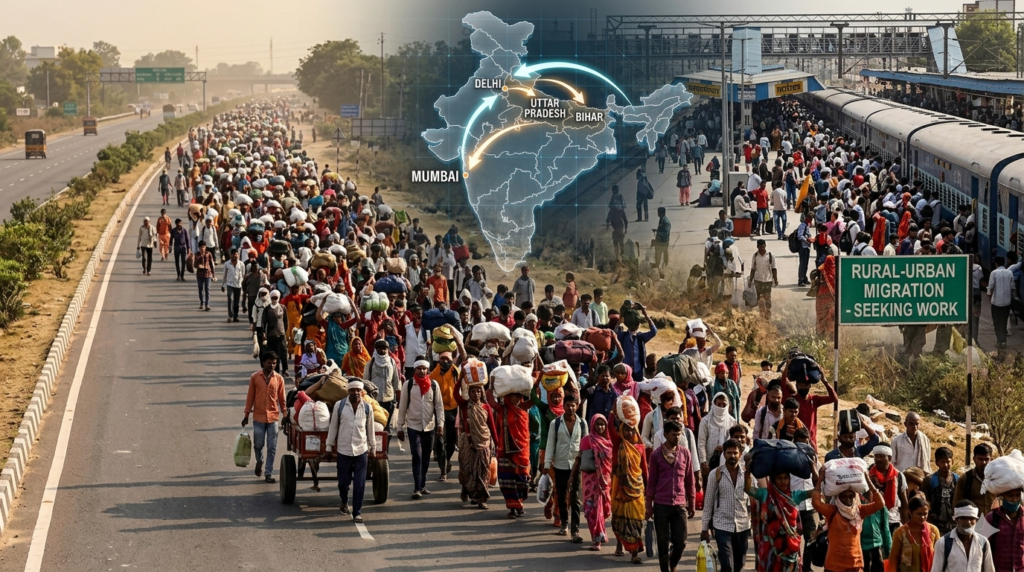
In rural areas:-
Farming income is uncertain
Land is limited
Job opportunities are scarce
At the same time, cities offer:-
Daily wage work
Construction and service jobs
A chance to earn more than the village
So, migration happens not because people want to leave,
but because staying back is no longer enough.
The Scale of Migration Today:-
India has one of the largest migrant populations in the world.
A significant share of the population moves internally for work
Millions depend on seasonal migration
A large portion of the workforce is engaged in informal jobs
You can see migrants everywhere:-
At construction sites
In factories
On roads as drivers and delivery workers
Inside homes as domestic workers
They are present in every part of urban life – yet often remain unnoticed.
The Direction of Movement:- Following Opportunity
Migration in India follows a clear pattern:-
From villages to cities
From less developed regions to more developed ones
From low-income work to slightly better-paying jobs
This movement reflects economic differences across regions.
For instance:-
Workers from eastern and northern regions move towards industrial and urban centers
Seasonal migration increases when local work is unavailable
In simple terms,
people move towards opportunity.
Cities Stand on Invisible Labour:-
Modern cities are symbols of growth – tall buildings, fast transport, and expanding infrastructure.
But behind this growth are migrant workers who:-
Build roads they may never use
Construct buildings they may never live in
Support services they may never fully access
Every structure in a city carries their effort.
Yet, they remain largely invisible in recognition and decision-making.
Migration Strengthens Rural Life Too:-
Migration is not just an urban story -it deeply affects villages.
Workers regularly send money back home. This supports:-
Daily household needs
Children’s education
Medical expenses
Better living conditions
In many cases, migration becomes the main source of income for rural families.
So, migration acts like a bridge –
connecting urban earnings with rural survival.
The Reality Behind the Opportunity:-
While migration creates income, it also brings serious challenges.
1. Difficult Living Conditions:-
Workers often stay in overcrowded rooms or temporary shelters with limited facilities.
2. Lack of Job Security:-
Most jobs are informal:-
No written contracts
No fixed salary
Sudden job loss is common
3. Limited Access to Services:-
Basic needs like healthcare, food support, and housing are not always accessible.
4. Social Isolation:-
Language barriers and cultural differences create a sense of distance.
5. Emotional Struggles:-
Staying away from family leads to loneliness and stress.
These challenges show that migration is not just economic – it is deeply human.
When the System Was Tested???
There are moments when hidden realities become visible.
During sudden disruptions:-
Work stops instantly
Income disappears
Workers are left without support
Many are forced to return to their villages under difficult conditions.
This highlights an important gap:-
Those who support the system are not always supported by it.
A Changing Face of Migration:-
Migration in India is evolving with time.
More Skilled Workers:-
People are now moving with skills, aiming for better opportunities.
Circular Migration:-
Workers often move back and forth instead of settling permanently.
Role of Technology:-
Mobile phones and digital systems have made it easier to:-
Stay connected with family
Send money quickly
Access job information
Migration today is more dynamic, but challenges remain.
Migration:- Problem or Possibility????
Migration is often seen as a problem. But it can also be a powerful opportunity.
It:-
Reduces unemployment in rural areas
Provides labour for industries
Helps families improve their lives
The real issue is not migration itself,
but the conditions under which it happens.
The Way Forward:-
To make migration safer and more beneficial, a balanced approach is needed:-
Better Rural Opportunities:-
Stronger local economies can reduce forced migration.
Improved Urban Planning:-
Cities must provide housing, transport, and basic facilities.
Social Security for Workers:-
Access to food, healthcare, and safety should be ensured.
Fair Working Conditions:-
Workers deserve dignity, proper wages, and protection.
Changing the Mindset:-
One of the biggest changes required is in how society sees migrant workers.
They are often treated as outsiders.
But in reality, they are the ones who keep the system running.
They are not just labourers –
they are builders, providers, and contributors.
Conclusion:- (More Than Just a Journey)
Migration of workers in India is not just about moving from one place to another.
It is about:-
Leaving behind familiarity
Facing uncertainty
Moving towards hope
It reflects both the strengths and gaps in development.
If managed with care, migration can become a force for growth, equality, and opportunity.
Because in the end,
those who build the nation deserve not just wages, but dignity, security, and a sense of belonging.