
Introduction:-
India is known as an agricultural country because a large part of its population depends on farming. Farmers work hard throughout the year to grow crops that feed the nation. However, farming is not always easy. Farmers face many challenges such as changing weather, rising costs of farming, and unstable market prices.
Sometimes, after months of hard work, farmers do not get a good price for their crops. When market prices fall, they may even face losses. To protect farmers from such situations, the government introduced the Minimum Support Price (MSP) system.
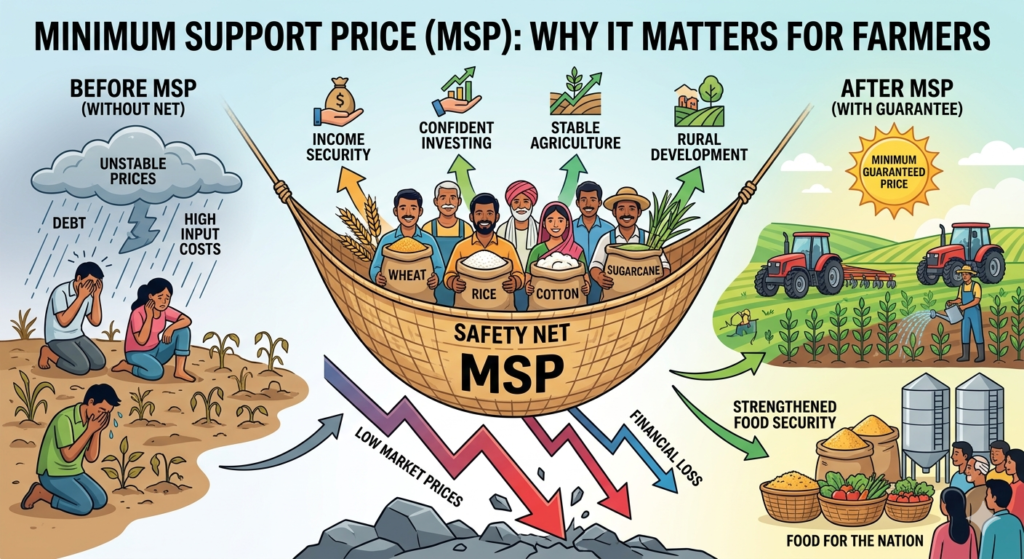
MSP helps farmers by providing a minimum guaranteed price for certain crops. It acts as a safety net and gives farmers confidence that they will receive a fair return for their produce.
What is Minimum Support Price?????
Minimum Support Price, commonly called MSP, is the minimum price at which the government is willing to buy crops from farmers.
If the market price of a crop falls below the MSP, farmers can sell their produce at the support price. This helps them avoid major losses and ensures that they receive a reasonable income for their hard work.
In simple words, MSP is a promise made to farmers that they will not have to sell their crops at extremely low prices.
Why is MSP Important?????
Farming requires a lot of investment. Farmers spend money on seeds, fertilizers, pesticides, irrigation, machinery, and labor. If crop prices become too low after harvest, farmers may not recover their costs.
MSP is important because it protects farmers from this risk. It provides a minimum level of income security and encourages farmers to continue farming.
Without MSP, many farmers could face serious financial problems during years when market prices are low.
How Does MSP Work??????
Every year, the government announces MSP for various crops before the sowing season begins. This helps farmers know the minimum price they can expect for their produce.
After harvesting their crops, farmers can sell them in the market. If market prices are higher than MSP, they usually sell to private buyers. However, if market prices fall below MSP, government agencies may purchase the crops at the announced support price.
This system helps farmers receive a fair price and reduces uncertainty in agriculture.
(Benefits of MSP)
1. Protects Farmers from Losses:-
The biggest advantage of MSP is that it protects farmers from sudden drops in crop prices. Even when market conditions are unfavorable, farmers have a minimum guaranteed price.

2. Provides Income Security:-
Farmers can plan their future expenses more confidently because they know they will receive at least a certain amount for their crops.
3. Encourages Agricultural Production:-
When farmers are sure that they will get a fair return, they are more willing to invest time and money in farming. This helps increase agricultural production.
4. Supports Rural Development:-
Higher farm income improves the economic condition of rural families. It increases spending, creates opportunities, and supports local businesses.
5. Strengthens Food Security:-
The crops purchased through MSP can be stored and used for public distribution programs. This helps ensure food availability for people across the country.
Example of MSP:-
Let us understand MSP with a simple example.
Suppose a farmer spends ₹60,000 on growing wheat. This amount includes the cost of seeds, fertilizers, labor, irrigation, and other farming activities.
After harvesting, the market price of wheat falls due to excess supply. If the farmer sells at the low market price, there may be little or no profit.
In such a situation, MSP becomes helpful. If the government has announced a support price for wheat, the farmer can sell the crop at that price instead of accepting a lower rate in the market. This helps protect the farmer’s income and reduces financial stress.
Challenges of MSP:-
Although MSP has many benefits, there are also some challenges.
Limited Access:-
Not all farmers are able to sell their crops through government procurement centers. In some areas, such facilities are limited.
Unequal Benefits:-
Farmers in certain regions benefit more from MSP because procurement systems are stronger there.
Storage Issues:-
The government needs large storage facilities to keep the crops it purchases. Managing these stocks can be costly and difficult.
Focus on Selected Crops:-
Some farmers may prefer growing only those crops that are commonly purchased under MSP, which can affect crop diversity.
MSP and the Future of Agriculture:-
As technology improves, the MSP system can become more efficient. Digital payment systems, better storage facilities, improved transportation, and transparent procurement processes can help farmers receive benefits more easily.
Experts believe that strengthening MSP and improving access to procurement can contribute to the growth of agriculture and improve the lives of farmers.
Conclusion:-
Minimum Support Price is one of the most important support systems for farmers in India. It protects them from low market prices and provides a minimum guaranteed income for certain crops. MSP helps farmers continue farming with confidence and reduces the risk of financial loss.
Although there are some challenges in its implementation, MSP remains an important tool for supporting farmers and promoting agricultural development. With better infrastructure and wider access, it can continue to play a major role in improving the future of Indian agriculture and strengthening the rural economy.