
Introduction:-
“Is India heading towards a recession???” This question has become increasingly common in conversations among students, employees, business owners, and even ordinary families. Whenever prices rise, jobs become harder to find, or businesses start growing more slowly, people naturally begin to worry about the future of the economy.
In everyday life, the economy is not just about numbers and reports. It affects the cost of food we buy, the jobs available in the market, the profits earned by businesses, and the opportunities available for young people. Because of this direct connection, any discussion about recession attracts attention.
India is currently one of the world’s largest and fastest-growing economies. At the same time, it faces challenges such as inflation, employment concerns, and global uncertainty. These challenges have raised questions about whether India is moving toward a recession or simply experiencing a temporary slowdown. Understanding this difference is important before reaching any conclusion.
What Does Recession Actually Mean????
A recession is a period when economic activities slow down significantly over a sustained period. During such a phase, businesses often earn lower profits, investments decline, consumer spending weakens, and employment opportunities become limited.
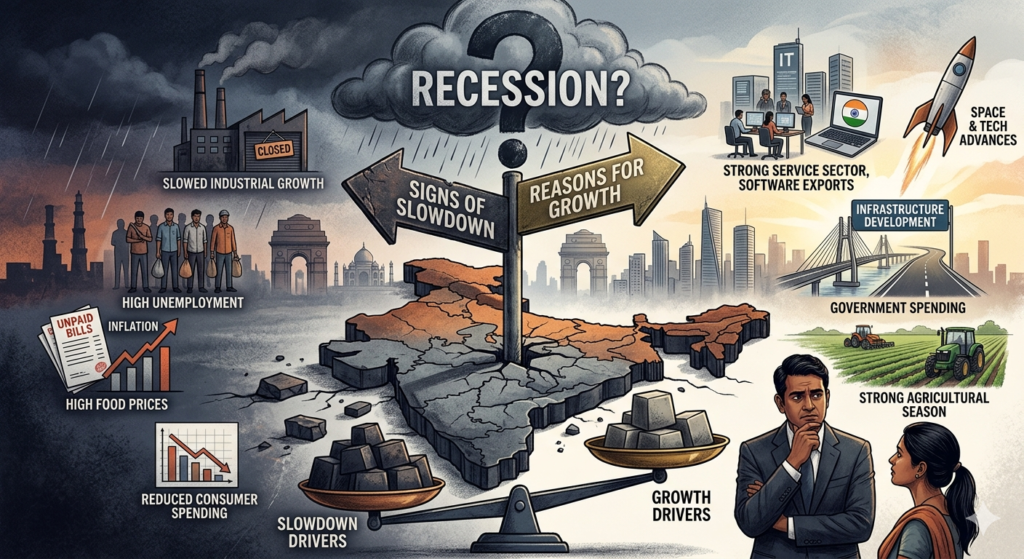
Some common signs of a recession include:-
Lower economic growth
Reduced consumer spending
Falling business investments
Rising unemployment
Declining industrial production
In simple words, a recession occurs when money circulates more slowly through the economy and people become cautious about spending.
A Simple Real-Life Example:-
Imagine a local shopping market where customers suddenly begin spending less money. Shopkeepers sell fewer products, manufacturers receive fewer orders, and businesses reduce hiring. As this process spreads across different sectors, overall economic activity slows down.
However, every slowdown is not a recession. Sometimes economies simply grow at a slower pace before returning to stronger growth.
Why Are People Talking About Recession?????
The discussion around recession has increased because people are noticing certain economic pressures in their daily lives.
(Rising Prices)
One of the most visible concerns is inflation. Prices of food items, transportation, fuel, electricity, and other necessities have increased over time.
Real-Life Observation:-
A family that once managed its monthly budget comfortably may now find itself spending more on groceries and household expenses. As a result, purchases such as electronics, furniture, or vacations may be postponed.
When many households behave this way, overall consumer demand can weaken.
(Job Market Concerns)
India has a large young population entering the workforce every year. While many employment opportunities are being created, competition remains high.
Young graduates often face challenges such as:-
Limited experience
Skill gaps
Intense competition
Mismatch between education and industry requirements
Because employment directly affects spending power, job creation remains a major economic priority.
(Global Economic Uncertainty)
India’s economy is connected with international markets through trade, investment, and financial activities.
Economic problems in major countries can influence India through:-
Lower export demand
Reduced foreign investment
Market uncertainty
For example, if foreign buyers purchase fewer products from Indian industries, manufacturing growth may slow.
Strengths That Support India’s Economy
While challenges exist, India also has several strong advantages that help protect the economy from severe downturns.
1. A Large Domestic Market:-
India’s biggest strength is its enormous consumer base.
Millions of people continue spending money on:-
Food
Healthcare
Education
Communication services
Transportation
This domestic demand helps keep businesses active even when global conditions become difficult.
Real-Life Example:-
Regardless of economic conditions, people continue buying medicines, paying school fees, using mobile services, and purchasing daily necessities. This creates continuous economic activity.
2. Rapid Infrastructure Development:-
Infrastructure projects continue to play an important role in economic growth.
Major investments are being made in:-
Highways
Railways
Airports
Metro systems
Industrial corridors
Such projects create employment while improving connectivity and productivity.
Real-Life Example:-
When a new metro line is constructed, workers, engineers, suppliers, transport companies, and nearby businesses all benefit from increased economic activity.
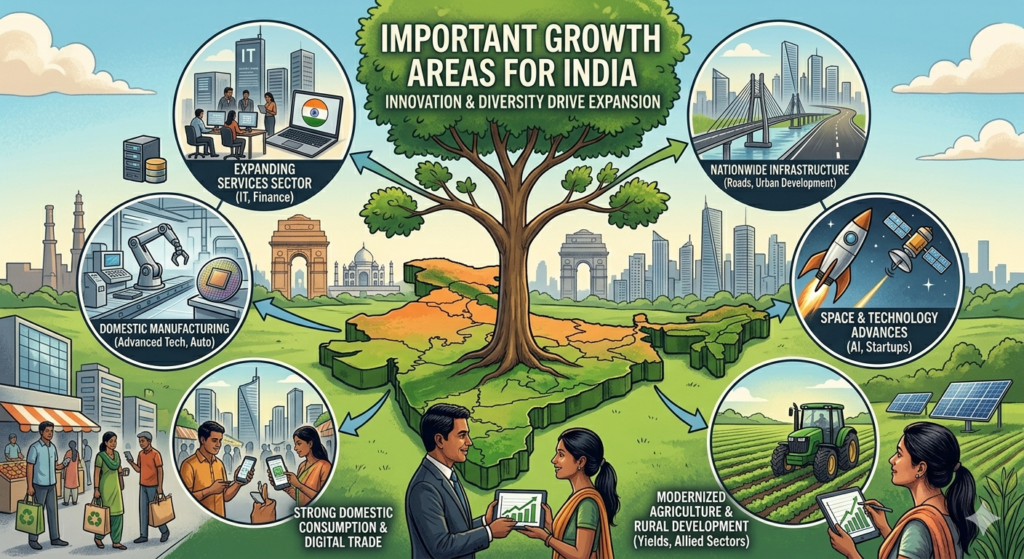
3. Growth of the Digital Economy:-
India has witnessed remarkable digital transformation over the last few years.
Important growth areas include:-
Digital payments
Online shopping
Digital banking
Information technology services
Artificial intelligence and innovation
Technology is creating new opportunities for businesses and workers alike.
Real-Life Observation:-
Today, even small shop owners can accept digital payments and sell products online, helping them reach customers beyond their local area.
4. Expanding Manufacturing Sector:-
Manufacturing has become an important focus area for economic development.
Growth is visible in sectors such as:-
Electronics production
Mobile phone manufacturing
Automobile components
Renewable energy equipment
A stronger manufacturing base helps generate employment and increase production capacity.
Challenges That Still Need Attention:-
Despite positive developments, some issues continue to create pressure on the economy.
(Inflation and Cost of Living)
When prices increase faster than incomes, families experience financial pressure.
Example:-
A household that spends more money on fuel, vegetables, electricity, and transportation may reduce spending on entertainment or luxury products.
Such changes affect business revenues and overall demand.
Uneven Growth Across Sectors:-
Not every industry grows at the same speed.
Some sectors perform strongly while others face challenges.
((Growing Sectors)
Technology
Digital services
Renewable energy
Infrastructure
(Sectors Facing Pressure)
Certain export-oriented industries
Small businesses
Some traditional manufacturing activities
This uneven growth sometimes creates confusion about the overall health of the economy.
Pressure on Small Businesses:-
Small and medium enterprises contribute significantly to employment and production.
However, many face challenges such as:-
Higher operational costs
Limited financial resources
Market competition
Supporting these businesses remains essential for long-term economic growth.
Is India Really Heading Towards Recession???
Looking at current conditions, India appears to be facing economic challenges rather than moving directly toward a recession.
Several factors support this conclusion:-
Economic growth continues.
Consumer demand remains relatively strong.
Infrastructure investments are ongoing.
Manufacturing activities are expanding.
Digital industries continue growing.
Financial institutions remain stable.
While growth may not be equally strong across all sectors, the overall economy continues to show resilience.
In simple terms, India is experiencing certain pressures, but the situation does not currently resemble a full-scale recession.
What Could Increase Future Risks????
Although the present outlook remains positive, some risks cannot be ignored.
Potential concerns include:-
Prolonged global economic weakness
Sharp increases in inflation
Significant declines in exports
Weak business confidence
Slower investment activity
If several of these problems occur together for a long period, economic growth could weaken more substantially.
What Can Help India Maintain Growth?????
Several steps can strengthen economic performance in the coming years.
(Creating More Employment)
Better employment opportunities increase household incomes and consumer spending.
(Supporting Small Businesses)
Providing easier access to finance can help businesses expand and hire more workers.
(Encouraging Innovation)
Investment in technology and research creates new industries and economic opportunities.
(Improving Skills)
Skill development programs can prepare young people for changing job market requirements.
(Maintaining Economic Stability)
Balanced economic policies can support growth while controlling inflation.
A Personal Observation:-
When we look around our own communities, we can see both opportunities and challenges. New businesses are opening, digital services are expanding, and infrastructure projects are improving connectivity. At the same time, many people remain concerned about prices and employment opportunities.
This mixed picture explains why discussions about recession continue. The economy is neither perfect nor collapsing. Instead, it is going through a phase where growth and challenges exist side by side.
Conclusion:-
The question of whether India is heading towards a recession does not have a simple answer. Rising prices, employment concerns, and global uncertainty have certainly created challenges. However, India’s strong domestic market, expanding infrastructure, growing digital economy, and improving manufacturing sector continue to provide important support.
At present, India appears to be facing a period of adjustment rather than a recession. Economic growth remains positive, and several sectors continue to perform well despite global difficulties. The country’s future will depend on its ability to create jobs, manage inflation, encourage innovation, and maintain investment momentum.
In conclusion, recession fears should not be ignored, but they should also not overshadow India’s strengths. The economy faces obstacles, yet it possesses the resources, talent, and opportunities needed to continue moving forward. If these strengths are effectively utilized, India can not only avoid recession risks but also build a more sustainable and inclusive economic future.