
Inflation and Price Stability
Introduction:-
Inflation and price stability are two important concepts in understanding the functioning of an economy. Every economy experiences changes in prices over time. When the overall prices of goods and services increase continuously, the situation is called inflation. On the other hand, when prices remain stable and increase at a controlled pace, it is known as price stability.
In a developing economy like India, inflation directly affects the daily life of people. Rising prices of food, fuel, housing, and transportation increase the cost of living and reduce the purchasing power of households. Therefore, controlling inflation and maintaining price stability becomes a major objective of economic policy.
For students preparing for competitive examinations, especially those studying economic governance and public policy, understanding inflation and price stability is very important because these concepts influence monetary policy, fiscal policy, and overall economic development.
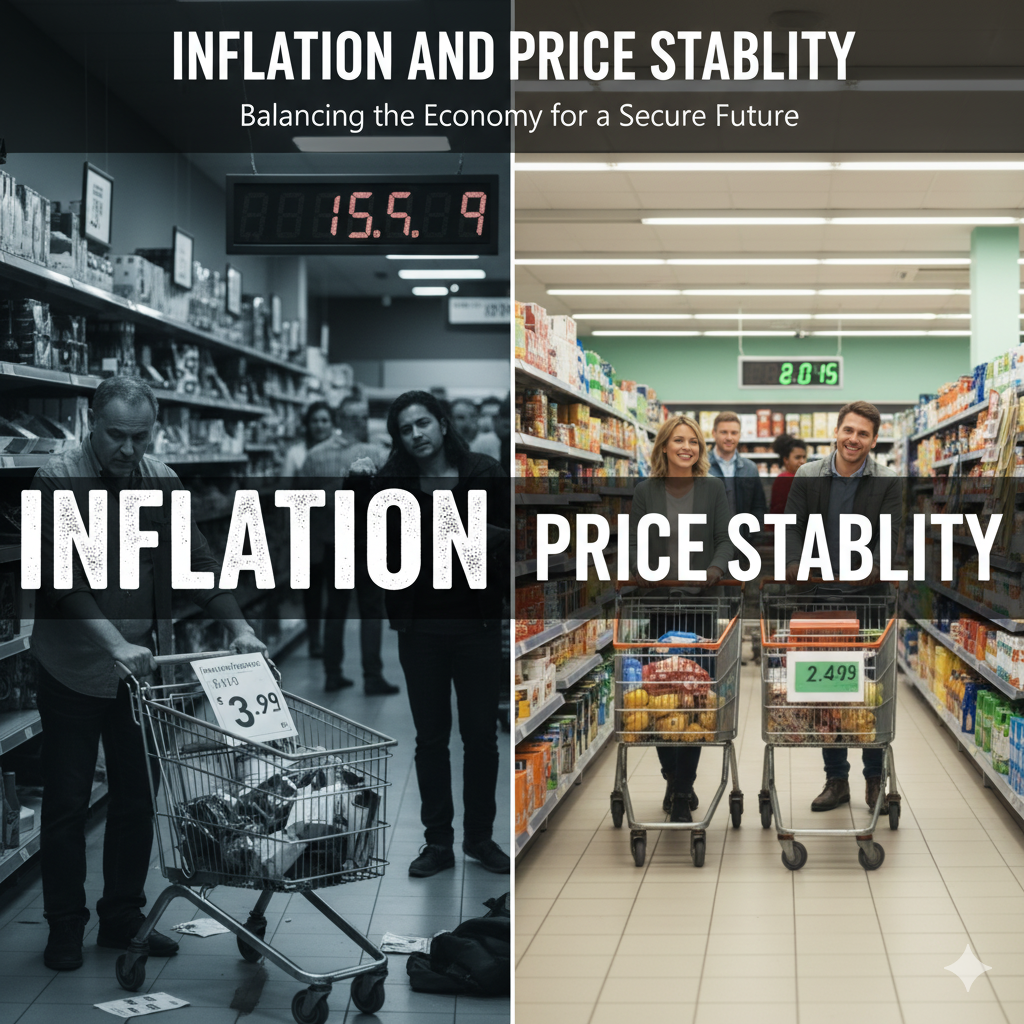
Understanding Inflation:-
Inflation refers to a sustained increase in the general price level of goods and services in an economy over a period of time. It means that the same amount of money can buy fewer goods and services than before.
For example, if the price of vegetables, cooking oil, fuel, and transport services increases, households need to spend more money to purchase the same quantity of goods.
Inflation is measured using price indices that track the changes in prices of a basket of commonly consumed goods and services. These indices help economists understand how the cost of living changes over time.
In recent years, the inflation rate in India has generally remained around 4–6 percent, although short-term fluctuations often occur due to food prices, fuel costs, and global economic conditions.
Moderate inflation is considered normal for a growing economy, but very high inflation can create instability and reduce economic welfare.
Types of Inflation:-
Inflation can occur due to different economic reasons. Economists generally classify inflation into several categories based on its causes.
Demand-Pull Inflation:-
Demand-pull inflation occurs when the demand for goods and services in an economy increases faster than their supply. When people have higher income and access to credit, they tend to spend more on consumption.
If production does not increase at the same pace, the increased demand pushes prices upward.
Common causes include:-
Increase in household income
Expansion of government expenditure
Rapid urbanization
Easy availability of bank credit
Demand-pull inflation is often seen during periods of strong economic growth.
Cost-Push Inflation:-
Cost-push inflation occurs when the cost of production increases. Producers increase the prices of goods to maintain their profit margins.
Important factors include:-
Increase in fuel and energy prices
Higher transportation costs
Rising wages
Expensive raw materials
For example, if global crude oil prices rise, transportation and manufacturing costs increase, which eventually raises the prices of many goods and services.
Structural Inflation:-
Structural inflation is more common in developing economies where structural weaknesses exist in the economic system.
These weaknesses include:-
Inefficient supply chains
Inadequate storage facilities
Agricultural dependence on monsoon
Regional imbalance in production
When supply systems are weak, even a small increase in demand can lead to significant price increases.
Current Inflation Trends:-
In recent years, inflation management has become an important policy priority in India. Economic authorities aim to maintain inflation at a moderate level to support growth while protecting consumers from excessive price increases.
The inflation targeting framework aims to keep inflation around 4 percent with a tolerance band of ±2 percent. This means that inflation ideally should remain between 2 percent and 6 percent.
Food items play a significant role in influencing inflation because they account for a large share of household expenditure. Seasonal changes, weather conditions, and agricultural production often lead to fluctuations in food prices.
Fuel prices also influence inflation because they affect transportation, manufacturing, and distribution costs across many sectors of the economy.
(Impact of Inflation on the Economy)
Inflation affects different sections of society in different ways. While moderate inflation can support economic activity, excessive inflation can create economic and social problems.
Impact on Household Consumption:-
When prices rise continuously, households must spend a larger portion of their income on basic necessities such as food, housing, and transport. This reduces their ability to spend on education, health, and other important needs.
Low-income families are affected the most because a large share of their income is spent on essential commodities.
Impact on Savings:-
High inflation reduces the real value of savings. If the interest earned on savings is lower than the inflation rate, the purchasing power of saved money declines over time.
This discourages people from saving and affects long-term financial security.
Impact on Investment:-
Stable prices encourage businesses to plan investments with confidence. However, when inflation becomes unpredictable, businesses face uncertainty regarding production costs and future profits.
As a result, investment decisions may be postponed, which can slow economic growth.
Impact on Income Distribution:-
Inflation can also increase inequality. People with fixed incomes, such as pensioners or salaried workers with limited income growth, suffer when prices rise rapidly.
At the same time, individuals owning assets like land, property, or commodities may benefit because asset prices often increase during inflation.
Meaning of Price Stability:-
Price stability refers to maintaining a stable and predictable level of prices in the economy. It means avoiding extreme situations of very high inflation or continuous fall in prices.
Stable prices help maintain the purchasing power of money and create a favourable environment for economic decision-making.
When prices remain stable:-
Consumers can plan their spending more effectively
Businesses can estimate future costs and profits
Investors can make long-term financial decisions
Price stability therefore becomes a key condition for sustainable economic growth.
Role of Monetary Policy:-
Monetary policy plays an important role in controlling inflation and maintaining price stability.
In India, monetary policy is managed by the Reserve Bank of India. Policy decisions related to interest rates and inflation management are taken by the Monetary Policy Committee.
Several policy tools are used to control inflation.
Interest Rate Policy:-
When inflation increases, interest rates may be raised to reduce borrowing and spending. Higher interest rates reduce demand in the economy and help control price increases.
Liquidity Management:-
Managing the amount of money circulating in the economy is another important tool. If excessive liquidity exists in the financial system, it may increase demand and contribute to inflation.
By adjusting liquidity levels, policymakers try to maintain economic balance.
Inflation Targeting:-
Inflation targeting provides a clear objective for economic policy. By maintaining inflation near the target level, authorities attempt to create stability and predictability in the economy.
Government Measures to Maintain Price Stability:-
Apart from monetary policy, several government measures also help control inflation and stabilize prices.
Strengthening Agricultural Production:-
Agriculture plays a major role in determining food prices. Improving irrigation facilities, better seeds, and modern farming techniques help increase production and reduce supply shortages.
Food Buffer Stocks:-
Maintaining buffer stocks of essential food grains helps stabilize prices during periods of supply shortages or crop failures. These stocks can be released into the market when prices rise sharply.
Improving Supply Chains:-
Efficient transportation, cold storage facilities, and better logistics reduce wastage and help maintain stable prices across markets.
Preventing Hoarding:-
Regulatory measures are sometimes used to prevent hoarding and artificial price increases in essential commodities.
Challenges in Maintaining Price Stability:-
Maintaining price stability in a large and diverse economy like India is a complex task.
Several factors make inflation management difficult:-
Dependence on monsoon for agricultural output
Fluctuations in global fuel prices
Supply chain disruptions
Rapid urbanization and rising consumption
International economic uncertainties
External economic shocks such as geopolitical tensions or global financial instability can also influence domestic price levels.
Importance of Price Stability for Economic Development:-
Price stability is essential for sustainable economic development. A stable price environment improves economic efficiency and encourages investment.
When inflation remains under control:-
Economic growth becomes more stable
Businesses expand production with confidence
Employment opportunities increase
Household welfare improves
For developing economies, maintaining price stability while supporting growth is one of the most important goals of economic policy.
Conclusion:-
Inflation and price stability are closely connected aspects of economic management. While moderate inflation is a natural feature of a growing economy, excessive inflation can harm consumers, reduce savings, and create economic uncertainty.
Maintaining price stability requires coordinated efforts between monetary authorities and the government. Effective monetary policy, improved supply management, and strong economic institutions are essential to control inflation and support long-term development.
For India, balancing inflation control with economic growth remains a key policy challenge. A stable price environment not only strengthens the economy but also protects the welfare of citizens.