
1. Introduction:- Trade as the Backbone of India’s Economy
1. No country in today’s world can grow in isolation. Every economy depends on trade to meet its needs and expand production.
2. India’s export and import structure explains what India sells to the world and what it buys in return.
3. This structure affects economic growth, foreign exchange reserves, employment generation, and price stability.
4. Understanding this topic is important for students, policy observers, and anyone trying to understand India’s economic direction.
2. Meaning of Export and Import Structure:-
1. Exports refer to goods and services produced within India and sold to foreign countries.
2. Imports refer to goods and services purchased by India from outside its borders.
3. The word structure means the composition, share, and pattern of different items in total trade.
4. It shows which sectors dominate India’s trade and which sectors depend on foreign supply.
3. General Features of India’s Trade Pattern:-
1. India’s trade has shifted from primary goods to diversified products.
2. Manufacturing and services now play a much larger role than in the past.
3. Imports are concentrated in energy, technology, and raw materials.
4. Exports are spread across goods and services, reducing over-dependence on any single sector.
4. Structure of India’s Exports:-
1. Engineering and Manufactured Goods:-
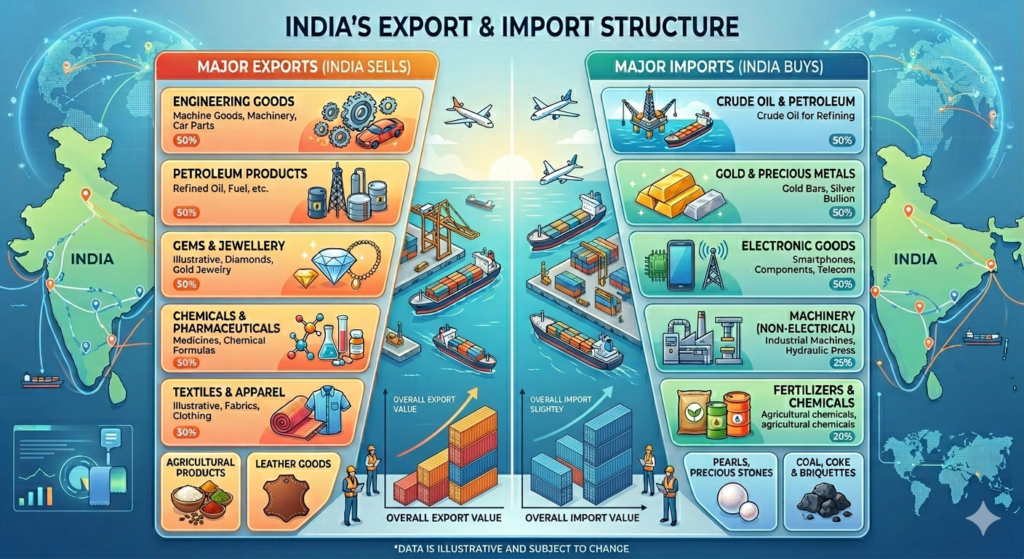
1. Engineering products form a major part of India’s exports.
2. These include machinery, transport equipment, auto components, and industrial tools.
3. Cost-effective production and skilled labour support this sector.
4. This category reflects India’s growing manufacturing capability.
2. Petroleum-Based Exports:-
1. India imports crude oil but exports refined petroleum products.
2. Large refining capacity allows India to add value before exporting.
3. These exports help partly balance the high oil import bill.
3. Pharmaceutical and Chemical Products:-
1. Medicines and chemical products are important export items.
2. Affordable pricing and large-scale production support global demand.
3. This sector also strengthens India’s role in global healthcare supply.
4. Gems, Jewellery, and Precious Items:-
1. Processed diamonds and jewellery contribute significantly to exports.
2. The sector provides employment to skilled artisans.
3. Export performance depends on global demand and price movements.
5. Agricultural and Food Exports:-
1. India exports cereals, spices, beverages, and processed food items.
2. These exports depend on climate conditions and domestic availability.
3. Value-added food exports are becoming more important than raw produce.
5. Structure of India’s Services Exports:-
1. Information and Digital Services
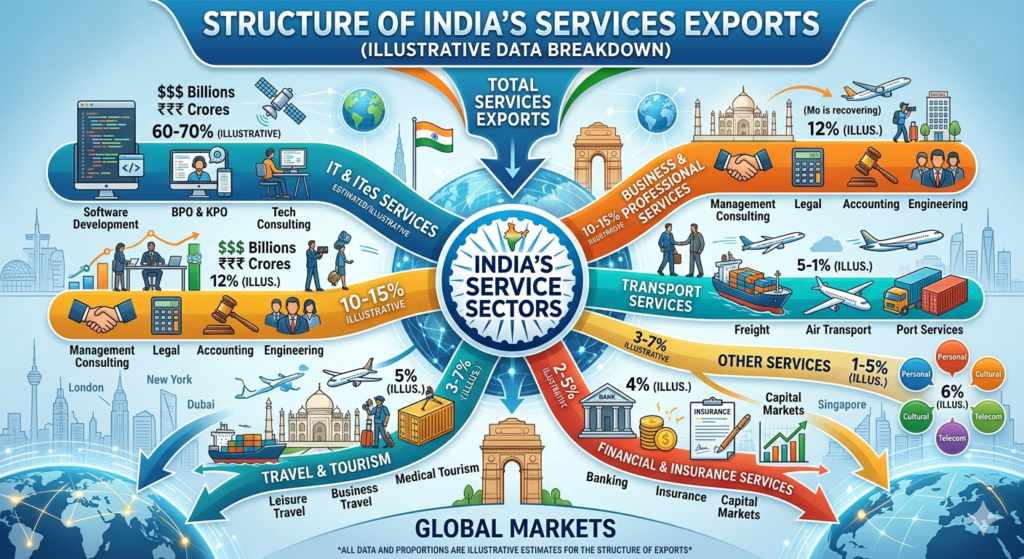
1. Software development and digital solutions form the largest part of services exports.
2. Indian professionals serve global clients through remote and on-site work.
3. This sector earns stable foreign exchange with low import dependence.
2. Business and Professional Services
1. These include consulting, research, design, and support services.
2. Language skills and technical knowledge support this growth.
3. These services strengthen India’s position in the global knowledge economy.
3. Travel and Tourism Services
1. Spending by foreign visitors is counted as services exports.
2. Growth in tourism supports employment in hospitality and transport.
6. Structure of India’s Imports:-
1. Energy Imports
1. Crude oil is India’s largest import item.
2. Limited domestic availability makes imports unavoidable.
3. Oil prices strongly influence trade deficit and inflation.
2. Capital Goods and Machinery
1. India imports advanced machines and industrial equipment.
2. These imports support infrastructure and manufacturing expansion.
3. They improve productivity but increase dependence on foreign technology.
3. Electronics and Technology Products
1. Electronic components and devices form a major import category.
2. Domestic production is rising but demand still exceeds supply.
4. Gold and Precious Metals
1. Gold is imported mainly for jewellery and investment.
2. Cultural demand keeps imports high despite price fluctuations.
5. Fertilisers and Chemical Inputs
1. Fertilisers are imported to support agricultural productivity.
2. These imports help maintain food security.
7. Trade Balance Situation:-
1. India generally experiences a trade deficit.
2. High energy and gold imports are major reasons.
3. Services exports help reduce overall external pressure.
8. Direction of India’s Trade:-
1. Trade partners are spread across multiple regions.
2. Diversification reduces risk from global shocks.
3. Emerging markets are becoming important destinations.
9. Recent Changes in Trade Structure:-
1. Greater focus on value-added exports.
2. Rising importance of digital services.
3. Efforts to strengthen domestic production.
4. Increasing role of supply chain resilience.
10. Government Efforts:-
1. Support for manufacturing and exports.
2. Infrastructure and logistics improvement.
3. Simplification of trade procedures.
4. Promotion of innovation and startups.
11. Key Challenges:-
1. Energy dependence.
2. Technology gaps.
3. Global uncertainty.
4. Cost competitiveness issues.
12. Conclusion:-
1. India’s export and import structure reflects economic transformation.
2. Exports generate growth, while imports meet essential needs.
3. A balanced and diversified trade structure is essential for long-term stability.
4. With continuous reforms, India can strengthen its global trade position.