
When we talk about global politics today, one partnership that clearly stands out is the relationship between India and the United States. This bond did not become strong overnight. It has slowly developed over years of discussions, cooperation, disagreements, and mutual understanding. But in 2026, especially after the announcement of the new Interim Trade Agreement framework, this relationship seems to have entered a more confident and mature phase.
The recent agreement between India and the USA is not just another diplomatic headline. It reflects a deeper economic and strategic understanding between two of the world’s largest democracies.
1. The 2026 Interim Trade Agreement:- What Is It Exactly
In February 2026, both countries announced a framework for an Interim Trade Agreement. It is important to understand that this is not the final comprehensive trade deal yet. Instead, it is like a structured roadmap — a starting point that prepares the ground for a larger Bilateral Trade Agreement in the future.
The main focus of this 2026 framework is to reduce trade tensions, improve market access, and gradually increase economic cooperation. It shows that both sides are willing to sit together and solve trade issues instead of allowing them to grow into bigger disputes.
2. Reduction in Tariffs: -A Big Relief for Exporters
One of the most talked-about features of this agreement is the reduction in tariffs. Earlier, many Indian products were facing higher duties in the American market due to previous trade disagreements. Under the new framework:-
Tariffs on several Indian goods are expected to come down to around 18%.
Sectors like textiles, engineering goods, gems and jewelry, and certain manufactured products may benefit.
For Indian exporters, this means better competitiveness in the US market. Lower tariffs usually mean products become more affordable and attractive for buyers.
At the same time, India has also agreed to review and reduce duties on selected American industrial goods. This creates a more balanced exchange instead of a one-sided arrangement.
3. Protection of Agriculture: -India’s Careful Approach
Trade agreements often raise concerns about farmers and small producers. India has been cautious in this area.
Under the 2026 framework, India has protected its sensitive agricultural sectors, especially dairy and staple food products. There have been no major concessions that could suddenly expose Indian farmers to heavy foreign competition.
This shows that while India wants global trade expansion, it is also mindful of domestic stability and rural livelihoods.
4. The $500 Billion Vision: – Ambition With Flexibility
Both countries have expressed a long-term ambition of expanding bilateral trade to 500 billion US dollars by 2030. Currently, trade between India and the USA has already crossed around 190 billion dollars, making the US one of India’s largest trading partners.
There was also mention of India intending to purchase up to 500 billion dollars worth of American goods over the coming years. These purchases could include:-
Energy supplies like crude oil and LNG
Defense equipment
Aviation technology
Advanced machinery
However, the wording was later clarified as an “intention” rather than a strict legal obligation. This makes the agreement more flexible and realistic rather than binding India to fixed numbers.
5. Defense Cooperation :- The Strategic Foundation
Trade may bring economic growth, but defense cooperation builds long-term trust. Over the past decade, India and the USA have significantly deepened military cooperation.
Key agreements like LEMOA, COMCASA, and BECA have strengthened coordination between the armed forces of both nations. These agreements allow logistical support, secure communication sharing, and intelligence cooperation.
Joint exercises such as Yudh Abhyas and the Malabar naval drills show that this is not just paperwork. It is practical cooperation on the ground and at sea.
The Indo-Pacific region has become strategically important in recent years, and both countries share a common interest in maintaining stability and freedom of navigation there.
6. Technology Partnership :-Looking Toward the Future
Perhaps the most forward-looking part of the India–USA relationship is technology cooperation.
Through initiatives like the Initiative on Critical and Emerging Technologies (iCET), both countries are working together in:-
Artificial Intelligence
Semiconductor manufacturing
Cybersecurity
Quantum computing
Space exploration
In today’s world, technology is directly connected to economic strength and national security. Semiconductor collaboration, in particular, has gained importance because global supply chains have shown weaknesses in recent years.
This cooperation is not just about business profits; it is about building resilience and reducing over-dependence on limited suppliers.
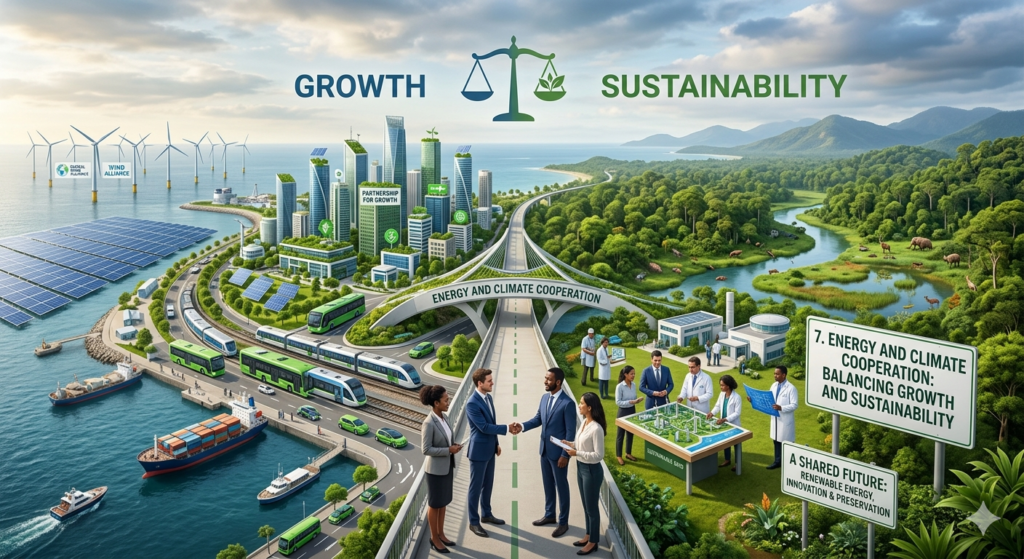
7. Energy and Climate Cooperation :- Balancing Growth and Sustainability
Energy trade between India and the USA has grown rapidly. The US has become a significant supplier of crude oil and liquefied natural gas to India. This helps India diversify its energy sources and reduce risks.
At the same time, both countries are also focusing on clean energy solutions. There is increasing collaboration in solar energy, green hydrogen, electric mobility, and climate finance.
This balanced approach — using traditional energy while investing in renewable sources — reflects practical thinking.
8. The Human Connection:- More Than Government Agreements
One of the strongest pillars of India–USA relations is the Indian diaspora in America.
Millions of people of Indian origin live in the United States. Indian students form one of the largest international student groups in American universities. Many major global companies are led by CEOs of Indian origin.
This human connection builds trust beyond official documents. It creates cultural familiarity and economic networks that naturally strengthen the partnership.
9. Challenges Still Exist:-
Despite strong cooperation, differences do arise.
There are discussions around trade imbalances, digital trade regulations, agricultural standards, and geopolitical approaches to certain global conflicts. However, what makes this relationship stable is the willingness on both sides to resolve issues through dialogue instead of confrontation.
Disagreements are handled through negotiation tables, not public hostility.
10. Conclusion :-A Partnership With Long-Term Potential
The 2026 Interim Trade Agreement is not just about lowering tariffs. It represents a growing level of comfort and strategic alignment between India and the United States.
India brings a large and growing market, a skilled workforce, and strategic regional importance. The United States brings advanced technology, investment capacity, and global influence. Together, they complement each other.
In my opinion, the strength of this partnership lies in its gradual and steady growth. It is not dramatic or sudden. It is built step by step — through trade, defense cooperation, technology sharing, and people-to-people connections.
If both countries continue with this balanced and practical approach, the India–USA partnership could easily become one of the most influential global relationships of the 21st century.