
A War Without Soldiers:-
In the modern world, power is not shown only through military strength. It is also displayed through economic decisions. Countries today fight silent battles using tariffs, trade rules, and market access. These battles are known as global trade wars. They do not make headlines like armed conflicts, but their impact slowly enters homes, businesses, and national economies.
Trade wars shape how countries grow, how industries survive, and how consumers spend. In the current global situation, where economies are already facing uncertainty, trade conflicts have become one of the most important challenges.
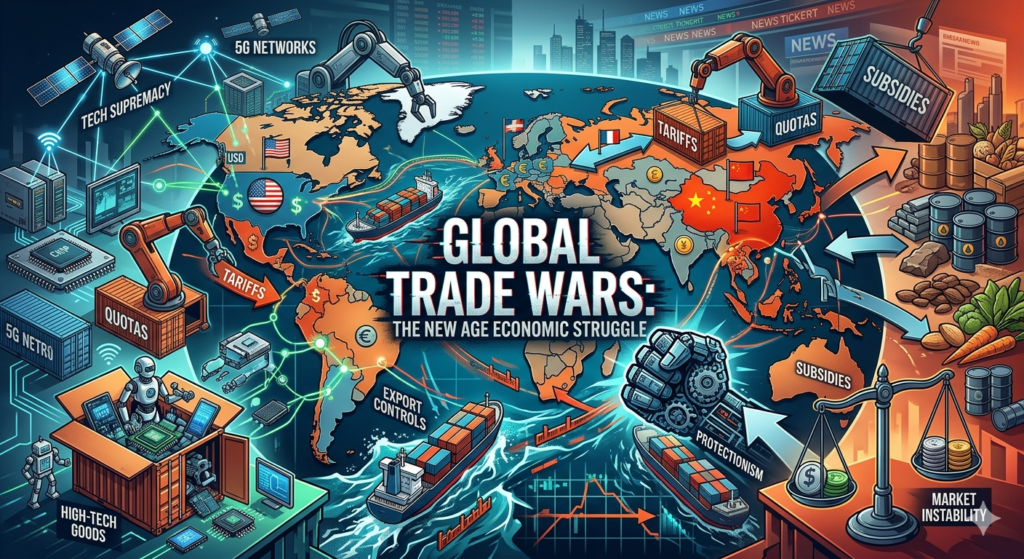
What Exactly Is a Trade War????
A trade war begins when a country tries to protect its economy by increasing taxes on imported goods or by placing restrictions on foreign products. The affected country usually responds with similar actions. This reaction creates a cycle of restrictions, turning trade into a tool of pressure.
At first glance, trade wars look like defensive steps. But once they escalate, they disturb normal trade relationships and create tension across global markets.
Why Are Trade Wars Increasing Today????
In recent times, trade wars have become more common due to multiple reasons. One major reason is economic competition. Countries want to secure their industries, jobs, and technological leadership. When they feel threatened, trade restrictions become an easy option.
Another important reason is the shift in global power. Emerging economies are growing faster, challenging traditional economic leaders. This competition creates friction. Political pressure inside countries also plays a role, as leaders often promise protection to local industries.
The Role of Self-Reliance Thinking:-
Many countries today are focusing on self-reliance. While building domestic capacity is important, extreme protectionism often leads to trade wars. Governments try to reduce dependence on foreign goods, especially in critical sectors like technology, energy, and manufacturing.
This approach sounds practical, but when multiple countries adopt the same strategy, global trade suffers. Instead of cooperation, suspicion increases.
How Trade Wars Affect the Global Economy????
Trade wars slow down global economic growth. When tariffs increase, the cost of production rises. Businesses face higher expenses, which reduce profits and investments. Expansion plans are postponed, and hiring slows down.
Uncertainty becomes the biggest enemy of growth. Investors hesitate to take risks, and markets react negatively. Over time, this uncertainty weakens confidence in the global economic system.
Impact on Prices and Inflation:-
One of the most visible effects of trade wars is rising prices. Imported goods become expensive due to higher taxes. These higher costs are usually passed on to consumers.
As prices increase, inflation pressure builds up. This reduces the purchasing power of people, especially affecting middle- and lower-income groups. Everyday items slowly become costlier, making life more expensive without any increase in income.
How Trade Wars Hurt Developing Countries????
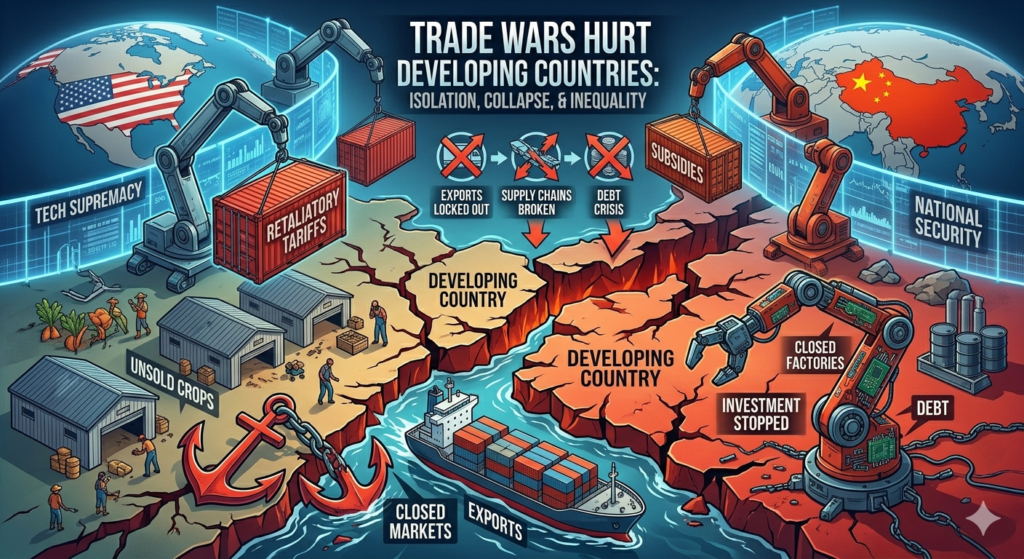
Developing economies often become indirect victims of trade wars. Even if they are not directly involved, reduced global trade affects them badly. Export demand falls, investment inflows slow down, and currency volatility increases.
Many developing nations depend heavily on exports for growth and employment. Trade disruptions reduce income opportunities and increase economic instability. For them, trade wars are problems created elsewhere but suffered at home.
Business World Under Pressure:-
Businesses prefer stability. Trade wars create the opposite environment. Sudden policy changes make planning difficult. Companies struggle to decide where to invest, whom to source from, and which markets to target.
Large corporations may shift supply chains or absorb losses, but small businesses often lack this flexibility. As a result, inequality within the business world increases.
Changing Global Supply Chains:-
Trade wars force companies to rethink supply chains. Many firms try to move production to new locations to avoid tariffs. While this creates new opportunities for some countries, it also increases costs and inefficiency.
Global supply chains, once built on efficiency, are now shaped by political and strategic considerations. This shift makes production slower and more expensive.
Technology as the New Battleground:-
In the current global environment, technology has become a central area of trade conflict. Control over advanced industries is seen as control over the future.
Restrictions on technology trade affect innovation and collaboration. When knowledge exchange slows down, progress in critical sectors also slows. This creates long-term consequences for global development.
Political Motives Behind Trade Wars:-
Trade wars are not purely economic. They often reflect political intentions. Governments use trade measures to show strength, gain leverage, or influence global negotiations.
However, using trade as a political weapon damages trust. Once trust is broken, rebuilding economic cooperation becomes very difficult.
Long-Term Consequences:-
If trade wars continue for a long time, they can permanently reshape global trade patterns. Countries may move toward regional trade arrangements instead of global integration.
This fragmentation reduces efficiency and limits growth opportunities. Smaller nations suffer the most, as they lose access to wider markets and fair competition.
Are There Any Real Winners????
Trade wars may create short-term benefits for certain industries. Domestic producers may enjoy reduced competition, and governments may collect more tariff revenue.
But these gains are temporary. In the long run, higher costs, reduced competition, and slower innovation harm the entire economy. The overall loss is usually greater than the short-term gain.
Current Global Situation:-
At present, the world economy is already facing challenges like slow growth, high costs, and financial uncertainty. Trade wars add another layer of risk.
Countries are trying to balance protection of national interests with the need for global cooperation. Finding this balance is one of the biggest challenges of the current era.
The Need for Cooperation:-
The solution to trade wars lies in dialogue and cooperation. Fair trade practices, transparency, and mutual respect can reduce conflict.
Instead of focusing on isolation, countries need to focus on shared growth. Cooperation creates stability, while trade wars create long-term uncertainty.
Conclusion:- A Defining Choice for the World
Global trade wars are shaping the future of the world economy. They influence growth, prices, jobs, and international relationships. While protectionism may appear attractive in the short term, its long-term consequences are damaging.
The world stands at a crossroads. One path leads to cooperation and shared prosperity, while the other leads to conflict and economic fragmentation. The choices made today will decide the economic direction of tomorrow.