
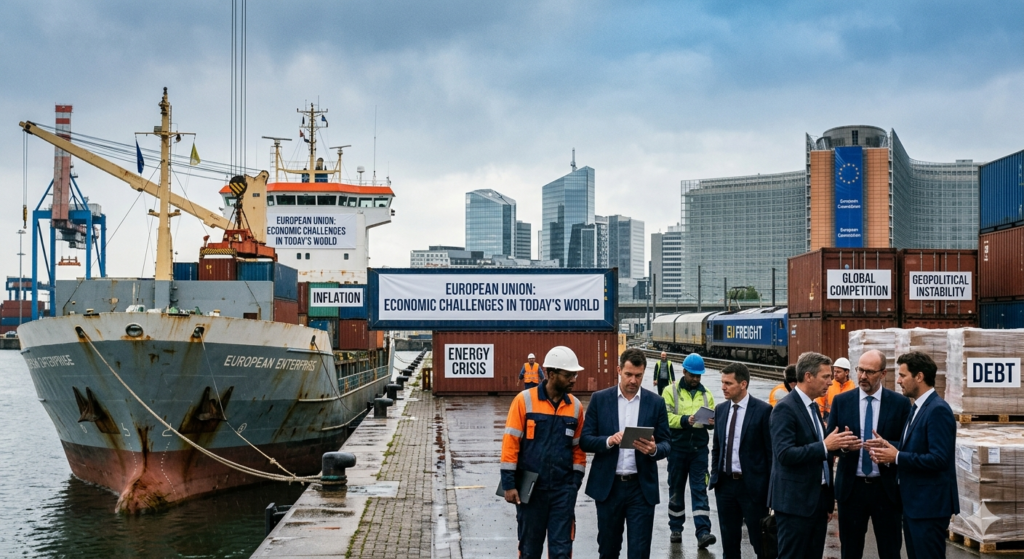
European Union:- Economic Challenges in Today’s World
The European Union (EU) is often seen as a symbol of economic strength, cooperation, and modern development. It connects many countries under one economic framework and creates a huge common market. For many years, the EU enjoyed steady growth, strong industries, and high living standards. However, the current global situation has exposed several economic challenges that the EU can no longer ignore.
These challenges are not sudden. They have developed slowly due to internal weaknesses, global shocks, and changing economic realities. Understanding these problems is important to know where the EU stands today and what it needs to do in the future.
1. Slow Growth:- A Major Concern
One of the biggest economic problems of the European Union is slow economic growth. Many EU countries are growing at a very low pace, while some are not growing at all.
The main reasons behind this slow growth include:
Aging population reducing the working workforce
Low productivity growth
Limited private and public investment
When economic growth remains weak, governments find it difficult to create jobs, increase incomes, and improve public services. Compared to other major economies, the EU’s growth speed appears less energetic.
2. Rising Prices and Daily Life Pressure:-
Inflation has become a serious issue across Europe. Prices of basic items such as food, electricity, fuel, and rent have increased sharply in recent years. This has directly affected common people.
High prices lead to:-
Reduced purchasing power
Increased household stress
Higher demand for government support
Although inflation has started to slow down in some areas, the damage to savings and daily budgets is still visible. Managing price stability without harming growth remains a tough task for policymakers.
3. Energy Problems and Economic Impact:-
Energy has turned into one of the most sensitive economic issues for the EU. Many European countries depend heavily on imported energy. This makes them vulnerable to global price changes and supply disruptions.
At the same time, the EU is moving towards clean and renewable energy. While this shift is important for the environment, it creates short-term economic challenges such as:-
High transition costs
Rising electricity prices
Pressure on energy-intensive industries
Balancing energy security, affordability, and sustainability is a major challenge for the EU economy.
4. High Public Debt Burden:-
Several EU member states are struggling with high levels of public debt. Governments borrowed heavily during economic crises to support businesses and citizens. Now, rising interest rates have made debt repayment more expensive.
This creates a difficult situation:-
Governments need to spend more on welfare and development
But high debt limits their spending capacity
Managing debt while supporting economic recovery has become a serious policy challenge.
5. Economic Gap Within the Union:-
The European Union is not economically uniform. Some countries are highly developed with strong industries and high incomes, while others still face unemployment and weak infrastructure.
gap leads to:-
Migration of workers from weaker economies to stronger ones
Regional inequality
Political dissatisfaction
Economic differences make it difficult to design common policies that suit all member states equally.
6. Pressure on European Industries:-
European industries are facing strong competition from other parts of the world. High production costs, strict regulations, and expensive energy make it harder for industries to remain competitive.
result:-
Some companies move production outside Europe
Industrial job creation slows down
Innovation investment reduces
Protecting industries while maintaining environmental and social standards is a delicate balance for the EU.
7. Labour Market Challenges:-
The EU faces a unique labour problem. While some countries struggle with unemployment, others face labour shortages. imbalance is due to:-
Aging population
Skill mismatch
Limited labour mobility
Many industries cannot find workers with the right skills, especially in technology and healthcare sectors. Improving skill training and workforce flexibility is essential for future growth.
8. Impact of Global Economic Uncertainty:-
The EU is deeply connected to the global economy. Any global crisis affects Europe directly. Trade disruptions, geopolitical tensions, and financial instability reduce exports and increase market uncertainty.
Global uncertainty results in:-
Reduced investor confidence
Slower trade growth
Economic instability
This high dependence on global conditions makes the EU economy sensitive to external shocks.
9. Lag in Digital and Technological Growth:-
Although the EU promotes digital development, it still lags behind major global technology leaders. Areas such as artificial intelligence, advanced chips, and large digital platforms need stronger support.
reasons include:-
Fragmented markets
High regulatory burden
Lower risk-taking in innovation
Without strong digital growth, long-term economic competitiveness becomes difficult.
10. Growing Social Spending Pressure:-
European countries provide strong social security systems, which improve quality of life. However, maintaining these systems is becoming increasingly expensive due to:-
Aging population
Rising healthcare costs
Economic slowdowns
Governments must find ways to protect social welfare without damaging financial stability.
11. Decision-Making Difficulties:-
The EU includes many independent nations with different economic priorities. Reaching agreement on major economic decisions often takes time.
Problems include:-
Conflicting national interests.
Slow policy implementation.
Limited flexibility during crises.
This reduces the speed and effectiveness of economic responses.
12. Future Path for the European Economy:-
Despite these challenges, the EU still has strong economic foundations::-
Large common market.
Skilled workforce.
Stable institutions.
To overcome current problems, the EU needs:-
Higher investment in innovation
Balanced energy policies
Stronger skill development
Better coordination among member states
With the right reforms, the EU can regain economic strength and stability.
Conclusion:-
The European Union is facing multiple economic challenges at the same time. Slow growth, inflation, energy issues, inequality, and global uncertainty have created pressure on its economic system. These challenges are serious but not permanent.
If the EU adopts timely reforms, encourages innovation, and strengthens cooperation among member states, it can overcome these difficulties. The future of the European economy depends on how effectively it adapts to a rapidly changing global environment.