
Water is something we use every day, but we rarely think about its economic value. We open a tap, use water for cooking, take a shower and move on with our day. For millions of farmers, however, water can decide whether a crop will survive or fail.
This is why water is becoming an important economic issue in India.
A river can pass through several states, but the water inside it cannot be divided as easily as a political boundary on a map. One state may need water for farming, another may need it for cities, while another may depend on the same river for industries or electricity.
When the available water is not enough for everyone, competition begins.
This competition can turn into a water conflict.
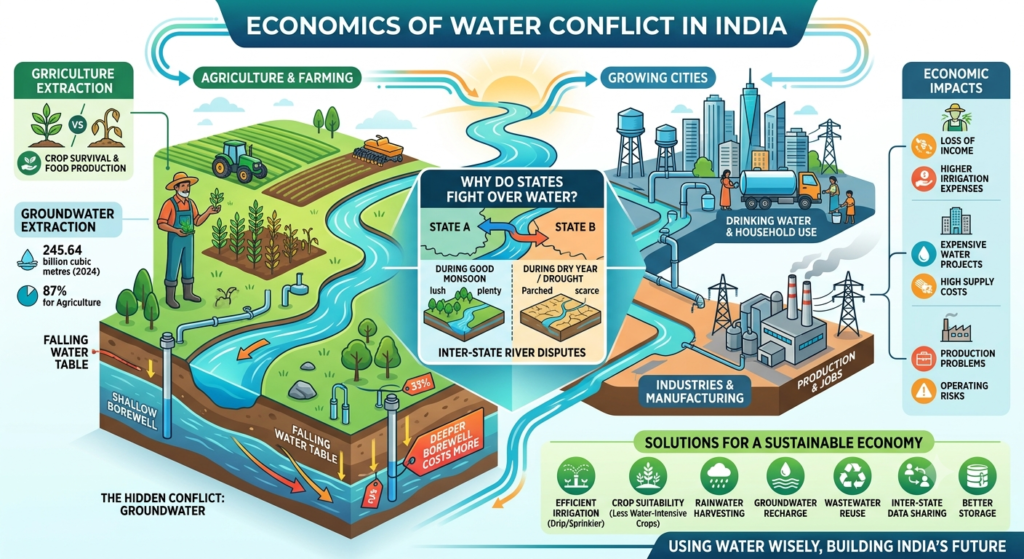
Water Is More Than a Natural Resource:-
Water supports almost every part of the economy.
It is needed for:-
farming and food production
drinking and household use
factories and industries
electricity generation
fisheries
tourism
construction and services
India’s agricultural sector is especially dependent on water. Groundwater is a major source of irrigation, and the latest national groundwater assessment estimated annual groundwater extraction at 245.64 billion cubic metres in 2024. Agriculture accounted for around 87% of this extraction.
When water becomes scarce, the problem does not stay inside a river or a well. It can affect the cost of farming, farmer income, food supply and eventually the wider economy.
Why Do States Fight Over Water????
India has many rivers that cross state boundaries.
The problem starts when different states have different demands.
Imagine a river flowing from State A into State B. State A may say that it needs enough water for its farmers and cities. State B may say that the river also supports its farmers and people.
Both sides have a genuine need.
The situation becomes more difficult when rainfall is poor.
During a good monsoon, there may be enough water to satisfy different demands. During a dry year, however, every release of water becomes important.
This is one reason inter-state river disputes can continue for many years.
The Farmer Sees Water Differently:-
For a policymaker, water may be measured in billions of cubic metres.
For a farmer, water can be measured in something much simpler:-
“Will my crop survive???”
A farmer spends money on seeds, fertilisers, labour, electricity and machinery. If irrigation water does not arrive at the right time, much of this investment can be lost.
This creates a direct connection between water and income.
For example, if a farmer expects irrigation water but receives it late, the crop may grow poorly. The farmer may then earn less and may also have difficulty repaying loans or meeting the cost of the next season.
So, a water conflict can become a livelihood conflict.
The Cauvery Example:-
The Cauvery dispute shows how complicated water sharing can become.
The river supports agriculture in both Karnataka and Tamil Nadu. Farmers in the two states depend on water at different times and for different agricultural needs.
When rainfall is normal, the pressure may be manageable. But when rainfall is low and reservoirs have less water, the question of how much water should be released becomes much more sensitive.
For one side, releasing water can mean protecting downstream crops.
For the other side, releasing water can mean reducing the water available for its own farmers and people.
This is why river disputes are not simply about numbers. Behind every number are farms, families, crops and incomes.
The Problem We Cannot See:- Groundwater
Some water conflicts happen without any argument between states.
They happen below the ground.
India depends heavily on groundwater for farming and other uses. But when groundwater is taken out faster than nature can replace it, the water table falls.
The 2024 assessment showed that India’s overall stage of groundwater extraction was about 60.47%, but the situation varies greatly across regions. Some areas have reached very high levels of extraction.
The economic effect can be understood easily.
A farmer may first use a shallow borewell.
Later, the water level falls.
A deeper borewell is needed.
Then more electricity or fuel may be required to pump the water.
The farmer’s cost increases.
So a falling water table can quietly become a rising farming cost.
Crops Can Also Increase Water Pressure:-
The kind of crop grown in a region matters.
Some crops need much more irrigation than others. Farmers may continue growing such crops because they already have buyers, markets, processing facilities and knowledge about cultivation.
Simply telling farmers to change crops is not a complete solution.
Suppose a farmer is asked to move from a familiar water-intensive crop to another crop. The farmer will naturally ask:-
Will the new crop give a good income???
Who will buy it??
What will happen if its price falls???
Are suitable seeds available??
Will there be government support???
Without answers to these questions, changing crop patterns can be difficult.
Therefore, India’s water policy must also consider farmer economics.
Cities Are Adding New Pressure:-
India’s cities are expanding.
More people mean more demand for drinking water, housing, offices, restaurants, industries and public services.
When a city’s local water sources are not enough, authorities may have to bring water from distant rivers, reservoirs or other sources.
Pipelines need to be built. Water has to be treated and pumped. Storage systems have to be maintained.
During serious shortages, some families may also depend on private tankers, which can make water more expensive for ordinary households.
This creates another difficult question:-
How should India balance the water needs of growing cities with the needs of rural communities??
Industries Also Depend on Water:-
Water is an important input for many industries.
It can be required for cooling, cleaning, processing and manufacturing.
If a factory faces a serious water shortage, production can be affected. Higher water costs can also increase the cost of making goods.
This can have a wider effect because industries provide jobs and support many small businesses and suppliers.
Therefore, reliable water availability is also important for economic growth.
The Hidden Cost of a Water Conflict:-
The economic cost of water conflict is not always visible.
A conflict may lead to:-
For farmers
lower crop production
loss of income
higher irrigation expenses
For cities
expensive water projects
higher supply costs
pressure on household budgets
For industries
production problems
higher operating costs
uncertainty about future investment
For governments
spending on infrastructure
monitoring and management
dispute-resolution processes
This means that poor water management can become expensive for everyone.
Climate Change Can Make the Situation Harder:-
Rainfall is another important part of the story.
A region may receive heavy rain for a short period and still face water shortage a few months later.
Why????
Because not all rainwater is stored.
Some water flows away quickly. Some can be lost through floods. If groundwater recharge and storage are poor, the region may again depend heavily on wells and reservoirs.
Longer dry periods can increase this pressure.
This is why rainwater harvesting, groundwater recharge and better storage are becoming more important for India’s economic security.
What Can Be Done????
India does not need to look at water only as something to be supplied. It also needs to focus on using less water for the same result.
Some practical steps can help:-
promote efficient irrigation methods
encourage suitable crops according to local water conditions
improve rainwater harvesting
recharge groundwater
repair leaking water systems
reuse treated wastewater
protect lakes and wetlands
improve water storage
share reliable water data between states
support farmers who shift towards suitable less-water-intensive crops
The idea is simple:-
Save water without reducing people’s ability to earn.
That is the most important part.
A Different Way to Look at Water:-
India’s water problem is often described as a shortage problem.
But it is also a management problem.
A region may have water during one season and shortage during another. Another region may have groundwater but use it faster than it can be naturally replaced.
So the real question should not only be:-
“How much water do we have??”
We should also ask:-
“How are we using it??”
If the same amount of water can produce more crops, support more people and reduce waste, the economic value of that water becomes much higher.
Conclusion:- (The Best Water Conflict Is the One We Prevent)
India’s future water problem may not always begin with a big river dispute.
It may begin much more quietly.
A farmer may notice that his old borewell is no longer giving enough water. A city may find that its reservoir is falling faster every year. A factory may face repeated water shortages. A family may have to spend more money to get basic water.
These small problems can become bigger economic problems if they are ignored.
India therefore needs to change the way it thinks about water.
Water should not be seen only as something that states fight over. It should be seen as a resource that connects farmers, cities, industries, jobs, food and the environment.
The answer is not simply to find more water.
The better answer is to waste less, share more fairly, use water carefully and plan before a crisis arrives.
If India can make every drop more useful without taking away the livelihood of another person, water can become a source of cooperation instead of conflict.
And perhaps that is the biggest economic lesson of India’s water story:-
The future will not belong to the region that controls the most water. It will belong to the region that learns to use its water wisely.