
Every morning in India does not look the same for everyone. In one home, a person starts the day with online meetings, good salary, and financial security. In another, someone wakes up unsure whether they will find work that day or not. This difference is not just a coincidence – it is the result of inequality.
India is growing fast as an economy. There is progress in technology, infrastructure, and global position. But at the same time, the gap between rich and poor is also increasing. This gap is what economists call inequality, where income, wealth, and opportunities are not equally shared among people.
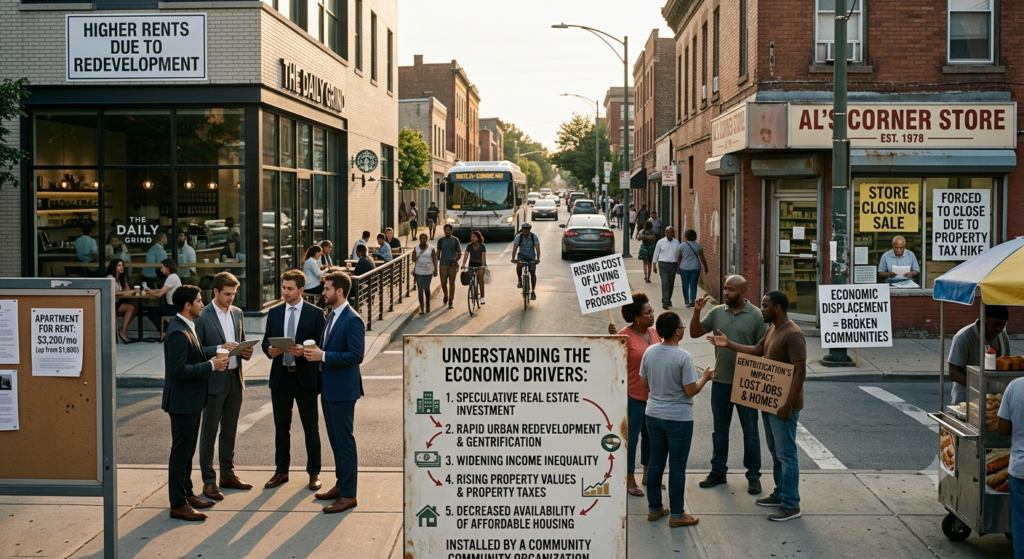
Understanding Inequality in Real Sense:-
Inequality is not only about money. It is about the quality of life people live. It includes access to education, healthcare, jobs, and even basic facilities. Two individuals may work equally hard, but their outcomes can be very different depending on their background.
Recent economic patterns (around 2024–25) show a clear trend – the top 10% of the population controls a very large share of income and wealth, while the bottom 50% has a much smaller share. This means that economic growth is benefiting some groups much more than others.
Current Situation of Inequality in India:-
India’s GDP is increasing, and new sectors like digital services, finance, and startups are growing rapidly. However, this growth is not reaching everyone equally.
A large part of the population is still dependent on informal work. Around 80–85% of workers are in informal jobs where there is no job security, fixed salary, or social protection. These workers include daily wage labourers, small farmers, delivery workers, and street vendors. Their income is uncertain and often not enough to meet rising expenses.
On the other hand, people in high-skill sectors such as IT, management, and large businesses are experiencing faster income growth. This creates a widening gap between different groups in the economy.
At the same time, inflation has increased the cost of living. Prices of food, fuel, and essential goods have risen in recent years. Poor households are affected the most because they spend a larger part of their income on these basic needs.
Forms of Inequality in India:-
Income Inequality:-
There is a clear difference between high earners and low earners. Some people earn in lakhs every month, while others struggle to earn daily wages.
Wealth Inequality:-
Wealth is even more unevenly distributed. A small section of society owns most of the land, property, and financial assets. This allows them to earn more income over time.
Rural-Urban Divide:-
Cities offer better opportunities, jobs, and facilities compared to villages. Rural areas often depend on agriculture, which is uncertain and low-paying.
Regional Differences:-
Some states develop faster due to better infrastructure and investment, while others lag behind. This creates imbalance in growth.
Gender Inequality:-
Women face lower wages and fewer job opportunities. Even today, female participation in the workforce is much lower compared to men.
Why Inequality Continues to Grow????
There are several economic reasons behind this issue:-
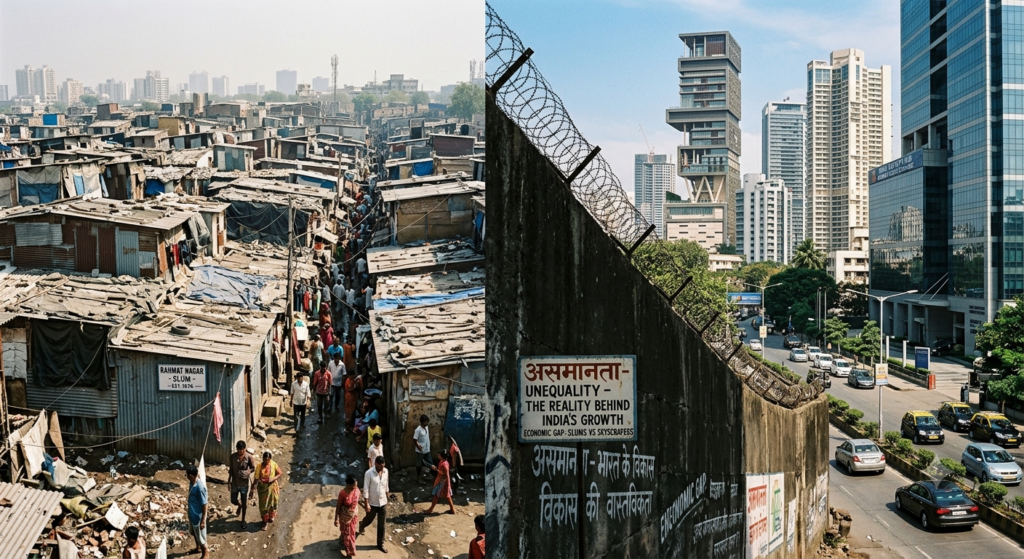
Unequal Education System:-
Quality education is still not equally available. Private schools provide better facilities, while many government schools lack proper resources. This creates a gap in future opportunities.
Skill Gap in Workforce:-
The modern economy needs technical and digital skills. People without these skills are forced into low-paying jobs.
Dependence on Informal Sector:-
Most jobs in India are informal. These jobs do not provide stability or growth.
Impact of Technology:-
Technology benefits skilled workers more. Automation and digital systems reduce opportunities for low-skilled workers.
Limited Access to Opportunities:-
A person’s background, location, and financial condition often decide their chances in life.
(A Practical Example)
Imagine two students with equal talent. One studies in a well-equipped school with internet, coaching, and guidance. The other studies in a rural school with limited teachers and no digital access. Over time, the first student is more likely to get a high-paying job, while the second may struggle. This shows that inequality is not about effort alone, but about the opportunities available.
Impact of Inequality on Economy:-
Inequality affects not just individuals, but the entire economy:-
Reduced Economic Demand:-
When a large population earns less, their spending capacity is low. This reduces demand for goods and services.
Increase in Poverty:-
Even with economic growth, many people remain poor due to unequal distribution of income.
Social Instability:-
A large gap between rich and poor can create dissatisfaction and tension in society.
Loss of Talent:-
Many capable individuals cannot succeed due to lack of resources, which is a loss for the country.
Efforts to Reduce Inequality:-
In recent years, several steps have been taken:-
Direct transfer of money to bank accounts
Employment programs in rural areas
Subsidies on essential goods
Skill development initiatives
Expansion of digital and banking services
These measures have helped improve conditions, especially for low-income groups. However, the impact is still uneven and needs improvement.
What More Can Be Done???
To reduce inequality effectively, stronger and long-term steps are needed:-
Improve quality of public education
Create more jobs in manufacturing and rural sectors
Provide skill training based on modern needs
Increase women’s participation in workforce
Strengthen social security for informal workers
Control rising prices to protect poor households
Economic growth should focus not only on increasing income but also on distributing it fairly.
Conclusion:-
India’s progress is real, but it is not equally shared. Inequality remains one of the biggest challenges for the country. A strong economy is not defined only by growth rate, but by how evenly its benefits reach the people.
If development reaches every section -from big cities to small villages, from skilled workers to daily labourers – then growth becomes meaningful. Otherwise, the gap will continue to widen.
In simple words, the future of India depends not just on how fast it grows, but on how fairly it grows.