
The Economy Needs More Than Money:-
When we think about the economy, words like GDP, jobs, income, inflation and investment usually come to mind.
But there is something less visible that also affects the economy – public trust.
Public trust means people have confidence in public institutions, government services, rules and the way decisions are taken. It does not mean that people must agree with every government decision. It simply means they believe that the system is working through clear rules and that institutions can be trusted to do their job.
This matters economically because every day, people and businesses make decisions based on how much they trust the system around them.
Why Trust Has an Economic Value???
Imagine two shopkeepers,
The first shopkeeper knows how to get a licence, how much it will cost and how long the process normally takes.
The second shopkeeper faces unclear rules, repeated paperwork and uncertainty about approvals.
Even if both have the same amount of money, their business experience will be very different.
The first person can focus on the business.
The second person has to spend time dealing with uncertainty.
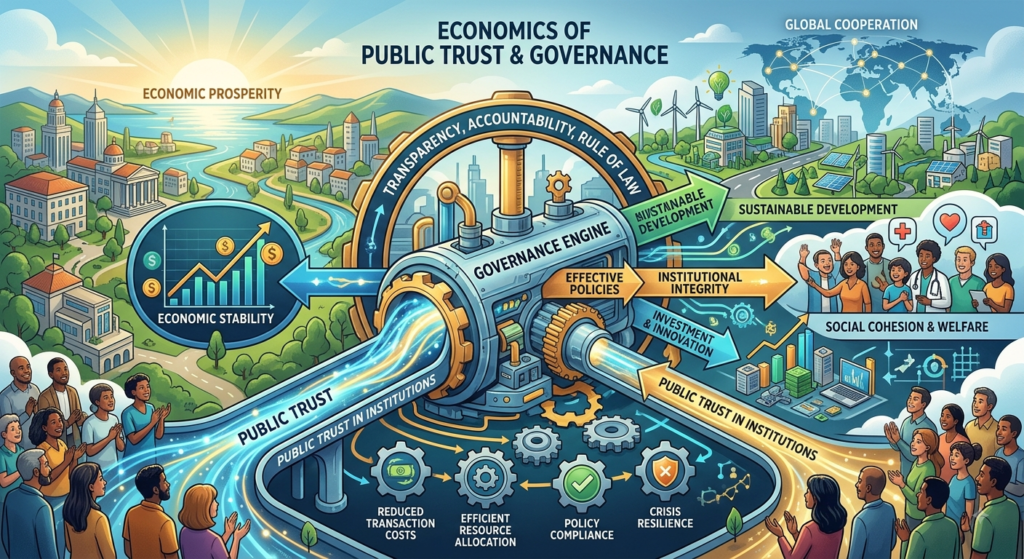
This shows an important point:-
When governance is simple and predictable, economic activity becomes easier.
Trust can reduce:-
Unnecessary delays
Repeated paperwork
Disputes
Business uncertainty
Administrative costs
Time wasted on unclear procedures
So, trust may not appear directly in a GDP calculation, but it can influence the decisions that create economic activity.
Governance Is Part of the Economic System:-
Governance is not limited to government offices.
It affects roads, schools, hospitals, public transport, taxation, business permissions, welfare schemes and many other areas.
Good governance means that public institutions are able to:-
Make clear rules
Deliver services properly
Use public money carefully
Respond to complaints
Maintain accountability
Provide information
Apply rules fairly
When these things work well, people spend less time fighting the system and more time working, studying, investing and building businesses.
That is where governance starts becoming an economic force.
Example From Everyday Life:-
Suppose a small entrepreneur wants to open a food-processing unit.
The person needs electricity, land, workers, transport, finance and several approvals.
Now imagine that the rules are clearly explained and the process can be tracked.
The entrepreneur can calculate:-
How much money is needed
How long the process may take
When production can begin
How many workers may be required
But if the process is unpredictable, the entrepreneur may postpone the project.
One delayed project can mean:-
(Less investment – fewer jobs – lower local business activity)
This is why governance can influence the economy even when it does not look like an economic policy.
Trust and the Tax System:-
Taxes provide governments with money for public services and development.
But taxation is not only about collecting money. It is also about the relationship between citizens and the state.
People are more likely to cooperate with rules when they believe the system is fair and public money is being used responsibly.
For example, a person may be more comfortable paying taxes when they can see functioning public infrastructure and services around them.
This creates a possible cycle:-
Better governance – greater trust – better compliance – stronger public revenue – better services
Of course, trust alone cannot solve tax evasion. Strong laws and enforcement are also necessary.
But trust can make the relationship between citizens and government healthier.
What Happens When Trust Falls???
Low trust can create a very different economic environment.
People may become less willing to take long-term decisions.
Businesses may become cautious about investment.
Citizens may hesitate to use public systems.
People may depend more on personal contacts instead of formal procedures.
This can increase what economists call transaction costs – the extra time, effort and money needed to complete an activity.
For a large economy, even small inefficiencies repeated millions of times can become a serious economic burden.
Corruption and the Cost of Weak Governance:-
Corruption can damage trust because people begin to feel that rules are not equally applied.
It can also create economic losses.
For example, imagine two businesses competing for the same opportunity. One follows the official process, while another gets an unfair advantage through improper influence.
The problem is not only unfairness.
It can also reduce healthy competition.
Businesses may become less interested in improving quality and productivity if they believe that success depends mainly on connections.
The 2025 Corruption Perceptions Index gave India a score of 39 out of 100 and placed it 91st among 182 countries. This is a perception-based measure of public-sector corruption, not a count of individual corruption cases, so it should be understood in that context.
The larger lesson is that transparent institutions are important for economic confidence.
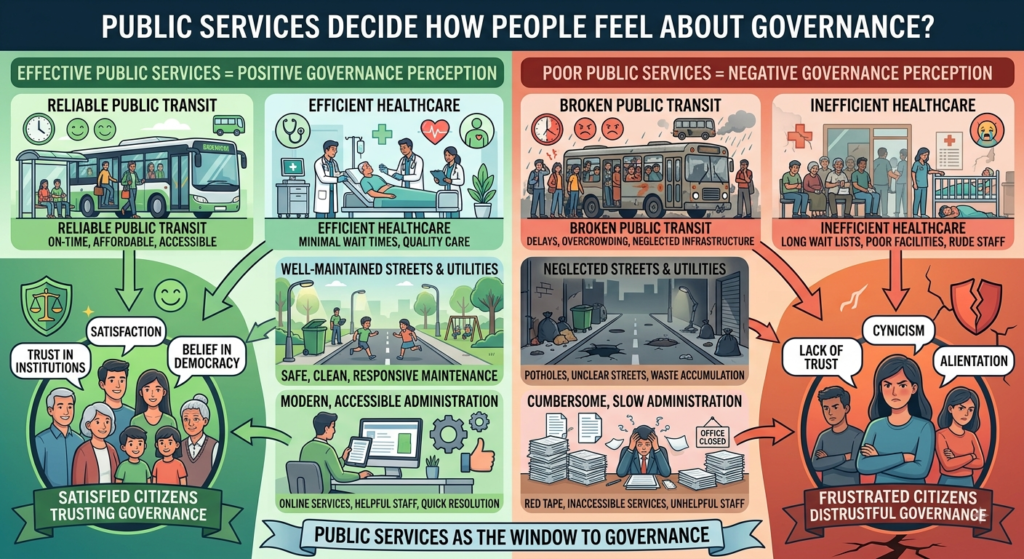
Public Services Decide How People Feel About Governance???
For an ordinary person, governance is often experienced through small daily interactions.
Think about a student applying for a scholarship.
Think about a family trying to access a public hospital.
Think about a farmer applying for a government benefit.
Think about someone getting a certificate or document.
If the process is clear, quick and respectful, the person leaves with greater confidence in the system.
If the same person has to make several visits, understand confusing forms or wait without information, frustration grows.
This is why good governance is not only about big policies. It is also about everyday experiences.
Digital Governance:- Faster, But Not Automatically Better
Technology has changed the relationship between citizens and government.
Online applications, digital payments, electronic records and direct transfers can reduce paperwork and make services easier to access.
A person may be able to complete a process from home instead of travelling to an office.
That can save:-
Time
Transport costs
Work hours
Paperwork
Physical visits
But digital governance has one important condition:- the system must be easy to use.
If a website is confusing or a person does not know why an application was rejected, technology can create a new kind of problem.
Therefore, good digital governance should combine technology with proper human support.
Trust Matters for Investment:-
Investment is based on expectations about the future.
A business owner does not invest only because today’s market looks good. They also think about what the next five or ten years may look like.
They want to know:-
Will rules remain reasonably predictable????
Can contracts be enforced???
Can disputes be resolved???
Are approvals transparent???
Can the business plan its costs???
When institutions are reliable, businesses can make longer-term plans with greater confidence.
This can encourage:-
Investment – production – employment – income – consumption.
That is how institutional trust can indirectly support economic growth.
India’s Growth Story Needs Strong Institutions:-
India’s latest GDP series uses 2022–23 as the base year. Under the latest provisional estimates, real GDP growth for 2025–26 is 7.6%. The same estimates show private final consumption expenditure growing by 7.7% in real terms during 2025–26, while gross fixed capital formation grew by 7.1%.
These numbers show strong economic activity.
But GDP growth alone cannot tell us everything about the quality of governance.
A growing economy also needs:-
Reliable institutions
Better public services
Fair competition
Transparent rules
Productive public spending
Strong accountability
The real challenge is to make economic growth meaningful in people’s everyday lives.
Trust Becomes Most Important During a Crisis:-
Public trust becomes especially valuable during difficult situations.
During floods, major natural disasters, economic shocks or other emergencies, governments need people to follow instructions and cooperate quickly.
If people trust official communication, cooperation can be easier.
If trust is weak, rumours and confusion can spread faster.
This can affect:-
Transport
Markets
Supply chains
Businesses
Workers
Emergency services
In this way, trust can act like a form of economic protection during a crisis.
How Can Public Trust Be Improved?????
Building trust does not require one huge reform. It often starts with simple improvements.
1. Keep rules simple:-
People should be able to understand what they need to do without unnecessary confusion.
2. Make government services easier:-
A simple service should not require repeated visits and excessive paperwork.
3. Improve accountability:-
When public money or authority is misused, there should be proper action.
4. Explain important decisions:-
Clear communication can reduce confusion and rumours.
5. Protect public money:-
Government spending should focus on useful outcomes rather than unnecessary waste.
6. Strengthen complaint systems:-
A grievance system is valuable only when citizens receive a meaningful response.
7. Give businesses predictable rules:-
Businesses need reasonable stability to make long-term investments.
The Real Link Between Trust and Development:-
The connection can be understood through a simple chain:-
Good governance
|
Greater public trust
|
Better cooperation and compliance
|
Lower uncertainty
|
More investment and productive activity
|
More jobs and income
|
Stronger economy
This chain is not automatic. Many other factors affect economic growth. But strong governance can create a better environment in which economic activity can grow.
Conclusion:-
Public trust is easy to ignore because it does not have a price tag.
You cannot see trust in a bank account or measure it like the production of a factory.
Still, it affects real economic decisions.
A citizen decides whether to use a public service.
A business owner decides whether to invest.
A worker decides whether to spend time learning new skills.
A taxpayer decides whether to follow the rules.
All these decisions are influenced, at least partly, by confidence in the system.
For India, the future of development is therefore not only about achieving higher GDP growth. It is also about creating institutions that people can understand, use and trust.
A strong economy needs money, markets and infrastructure. But it also needs something less visible – confidence that the system will work fairly and effectively.
That is why public trust should be seen not only as a social value, but also as an economic asset.