
Introduction:-
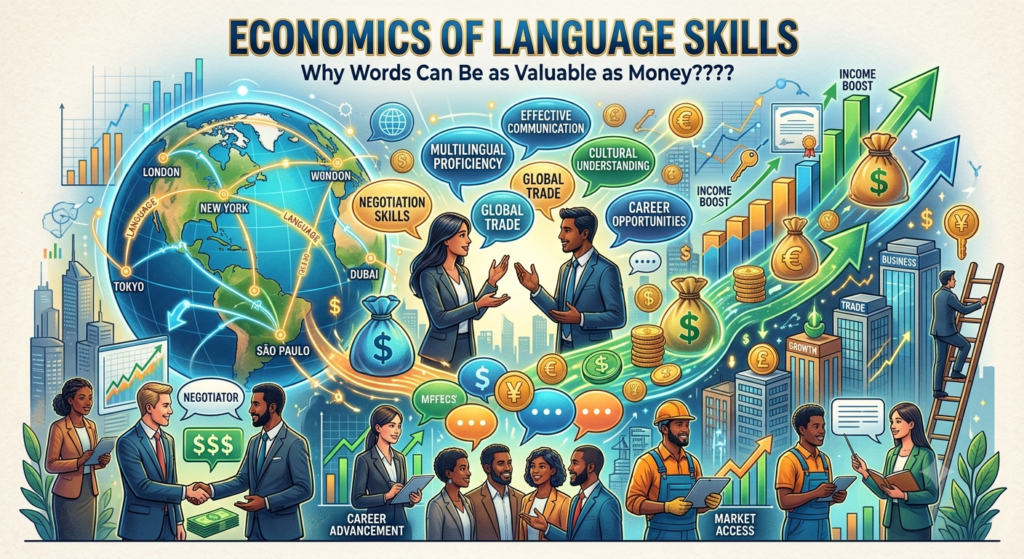
When people think about economics, they usually think about money, trade, industries, and markets. Very few people think about language. However, language skills have become one of the most important economic assets in the modern world.
The ability to speak, write, read, and understand a language can influence education, employment, income, and even business success. In today’s global and digital economy, communication is no longer just a social skill. It is an economic skill that can create opportunities and improve living standards.
Whether a person is a student, job seeker, entrepreneur, or professional, language skills can play a major role in shaping their future. This is why economists and policymakers increasingly recognize the economic value of language.
Understanding Language Skills:-
Language skills refer to a person’s ability to communicate effectively. These skills include:-
Reading and understanding information
Writing clearly and correctly
Speaking confidently
Listening carefully
Using language in different situations
A person may have excellent technical knowledge, but without communication skills, it can be difficult to share ideas, work in teams, or connect with customers.
Language acts as a bridge between knowledge and opportunity.
Language Skills as Human Capital:-
Economists often use the term “human capital” to describe the knowledge and skills that increase a person’s productivity.
Language skills are a part of human capital because they help people:-
Learn new things faster
Understand information easily
Communicate ideas clearly
Build professional relationships
Solve problems effectively
Just as education improves a person’s value in the labor market, strong language skills also increase economic value.
(A Simple Example)
Imagine two graduates applying for the same job.
Both have similar academic qualifications, but one communicates confidently while the other struggles to express ideas.
In most cases, the candidate with better communication skills is more likely to impress the interviewer and secure the position.
This shows how language can influence economic opportunities.
(The Link Between Language Skills and Employment)
Today’s workplaces depend heavily on communication.
Employees regularly interact through:-
Emails
Reports
Meetings
Presentations
Online platforms
Because of this, employers often look for candidates who can communicate effectively.
Strong language skills are especially important in sectors such as:-
Information Technology
Banking
Education
Healthcare
Tourism
Marketing
Customer Service
Even highly skilled workers need communication abilities to succeed in modern workplaces.
(Real-Life Example)
A customer service executive must solve customer problems every day. If the executive communicates politely and clearly, customers are more satisfied and the company benefits.
In this case, communication directly contributes to business performance.
How Language Skills Affect Income????
Language skills can influence earning potential.
People who communicate effectively often have better chances of:-
Getting promoted
Leading teams
Managing projects
Negotiating salaries
Handling clients
As employees move into higher positions, communication becomes even more important.
A manager, for example, spends much of the day communicating with employees, customers, and business partners.
(Everyday Observation)
A salesperson who explains a product clearly is more likely to make a sale than someone who cannot communicate its benefits properly.
Better communication often leads to better results, which can lead to higher earnings.
(The Growing Value of English and Other Languages)
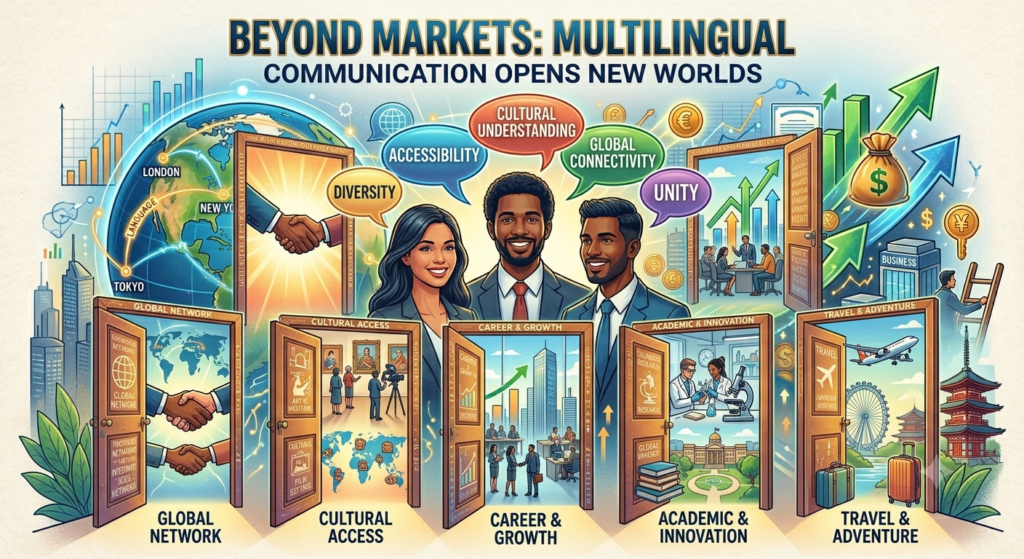
Globalization has increased the demand for multilingual workers.
People who can communicate in multiple languages often gain access to:-
International jobs
Global business opportunities
Foreign clients
International education programs
Cross-border collaborations
In many industries, knowing more than one language provides a competitive advantage.
(Example)
A tourism professional who can speak Hindi, English, and another foreign language can communicate with a wider range of visitors and improve customer experiences.
This skill can create more employment opportunities and increase income.
Language Skills in the Digital Economy:-
The digital economy has transformed the way people work.
Today, millions of people earn income through:-
Freelancing
Online teaching
Content creation
Digital marketing
Remote jobs
E-commerce
Success in these areas depends heavily on communication.
A freelancer with strong writing skills can create better proposals, communicate effectively with clients, and build long-term professional relationships.
Similarly, bloggers and content creators rely on language to attract and engage audiences.
(Real-Life Example)
A person running an educational blog needs clear and simple language to explain ideas. Readers are more likely to return when content is easy to understand.
Good communication can therefore increase audience growth and income.
(The Role of Language Skills in Education)
Education and language are closely connected.
Students use language to:-
Read textbooks
Understand lessons
Complete assignments
Write examinations
Conduct research
Strong language skills improve learning outcomes because students can understand and express ideas more effectively.
On the other hand, weak language skills can create learning difficulties even for intelligent students.
This is why language education remains a key part of human development.
Why Businesses Need Good Communicators????
Businesses depend on communication at every stage of operation.
Effective communication helps businesses:-
Build customer trust
Improve teamwork
Reduce misunderstandings
Increase productivity
Strengthen brand image
Poor communication can lead to:-
Customer dissatisfaction
Workplace conflicts
Delayed projects
Financial losses
(Example)
A company launching a new product must explain its features clearly. If customers do not understand the message, sales may remain low regardless of product quality.
This demonstrates how language can influence business success.
Language Skills and Entrepreneurship:-
Entrepreneurs need communication skills to turn ideas into successful businesses.
They must communicate with:-
Customers
Suppliers
Investors
Employees
Government agencies
Strong communication helps entrepreneurs present their ideas, attract customers, and build professional networks.
(Real-Life Example)
Many small business owners use social media to promote products. Those who write clear and engaging content often attract more customers than those who communicate poorly.
In this way, language becomes a business tool.
Challenges Faced by Many People:-
Despite the importance of language skills, many people still face barriers.
Common challenges include::-
Limited access to quality education
Lack of reading habits
Fear of speaking publicly
Poor communication training
Limited exposure to different languages
These challenges can reduce employment opportunities and slow economic progress.
Addressing them requires investment in education and skill development programs.
How Individuals Can Improve Their Language Skills??
Improving language skills does not always require expensive courses.
Simple daily habits can make a big difference:-
Read books regularly
Write short articles or journals
Learn new vocabulary every day
Listen to educational podcasts
Participate in discussions
Practice public speaking
Communicate confidently
Small improvements over time can create significant economic benefits.
(Example)
A student who spends thirty minutes every day reading and writing can gradually develop stronger communication skills and improve future career prospects.
The Future of Language Skills:-
The future economy will be driven by technology, innovation, and global connectivity.
While machines and artificial intelligence can automate many routine tasks, effective communication remains a uniquely human strength.
Future workplaces will continue to value people who can:-
Explain ideas clearly
Collaborate with diverse teams
Build relationships
Communicate across cultures
As a result, language skills are likely to become even more important in the coming years.
Conclusion:-
Language skills are much more than a means of communication. They are a powerful economic resource that influences education, employment, income, entrepreneurship, and national development.
In today’s interconnected world, people who communicate effectively often gain better opportunities and achieve greater professional success. Whether it is a student preparing for a career, an employee seeking promotion, or an entrepreneur building a business, language skills can create a strong foundation for growth.
The economics of language skills reminds us that words have value. Just as financial investments generate returns, investing time in improving communication can produce long-term economic benefits for individuals and society as a whole.