
Introduction:-
In today’s world, creativity is becoming one of the most valuable resources in the economy. Earlier, economic growth mainly depended on land, labor, and capital. Today, ideas, innovation, and creative thinking also play a major role in creating wealth and opportunities. A simple idea can become a successful business, create jobs, and improve people’s lives.
Creativity is not limited to artists, musicians, or writers. It is useful in every field, including business, technology, education, healthcare, agriculture, and marketing. The economics of creativity explains how creative ideas generate economic value and contribute to growth and development.
As economies become more knowledge-based and technology-driven, creativity is becoming a key factor behind success. Countries, businesses, and individuals that encourage creative thinking often gain a competitive advantage in the modern economy.
What Is the Economics of Creativity????
The economics of creativity studies how ideas, imagination, and innovation contribute to economic activities. It focuses on the process through which creative thinking becomes products, services, businesses, and industries.
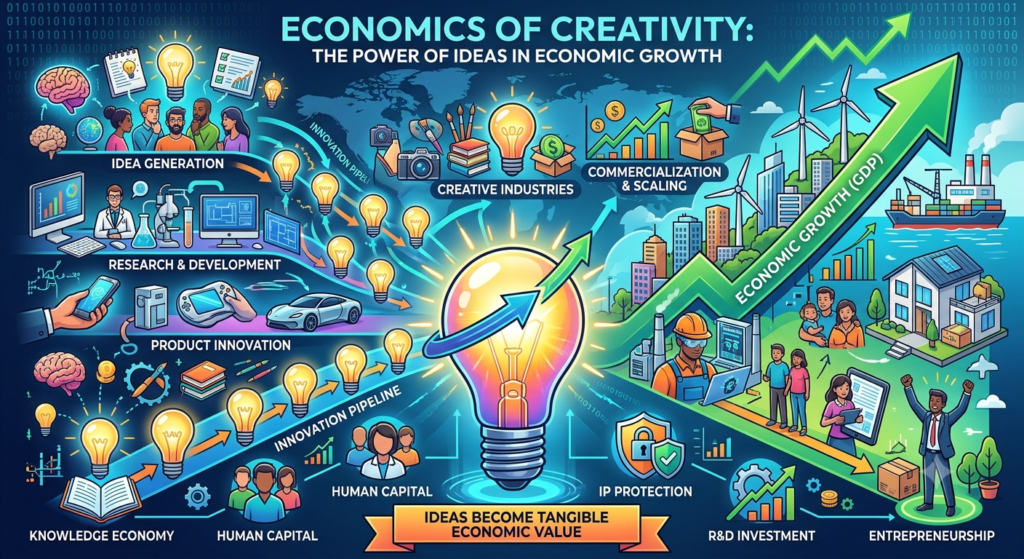
Creativity creates economic value by:-
Developing new products and services
Improving existing processes
Solving business challenges
Increasing productivity
Supporting entrepreneurship
Creating employment opportunities
Unlike physical resources, creative ideas can continue generating value for a long time. A successful idea can benefit millions of people and produce income for years.
Why Creativity Matters in the Modern Economy???
The modern economy is highly competitive and constantly changing. Businesses must continuously adapt to changing customer preferences and technological developments.
1. Creativity Encourages Innovation:-
Innovation often starts with a creative idea. Businesses that introduce innovative products and services are more likely to attract customers and increase profits.
Example:- Online food delivery applications were developed because entrepreneurs identified a need for convenient food ordering. Today, these services support thousands of jobs and businesses.
2. Creativity Improves Problem-Solving:-
Every industry faces challenges. Creative thinking helps individuals and organizations find efficient solutions.
Example:- During supply chain disruptions, many businesses used digital tools and local suppliers to maintain operations.
3. Creativity Creates Competitive Advantage:-
Companies that offer unique products, better customer experiences, or innovative marketing strategies often perform better than competitors.
Creativity as an Economic Resource:-
Economists traditionally recognized land, labor, and capital as the main factors of production. However, in the modern economy, creativity is increasingly viewed as a valuable resource.
Creative ideas help generate:-
New technologies
Business innovations
Digital products
Intellectual property
Brand value
Many successful businesses today are valued more for their ideas and innovation than for their physical assets.
For example:-a software company may own limited physical resources but generate billions in value because of its innovative products and services.
The Rise of Creative Industries:-
Creative industries are sectors where creativity and talent play a major role in production.
These industries include:-
Film and entertainment
Music
Publishing
Advertising
Fashion
Graphic design
Gaming
Architecture
Animation
Digital content creation
Recent estimates suggest that creative industries support around 50 million jobs globally. In some countries, these industries contribute more than 7% of national economic output. This shows the growing importance of creativity in economic development.
The expansion of internet access and digital platforms has further accelerated the growth of creative industries.
The Role of Technology in the Creative Economy:-
Technology has transformed the way creative work is produced, distributed, and consumed.
Today, creative individuals can:-
Sell products online
Reach global audiences
Build personal brands
Work remotely
Start businesses with lower investment
Digital technology has made creativity more accessible than ever before.
Real-Life Example:-
A graphic designer living in a small town can now work for international clients through online platforms. Without relocating, the designer can earn income from customers across the world.
This demonstrates how technology helps creativity generate economic opportunities.
Creativity and Entrepreneurship:-
Many successful businesses begin with a creative idea.
Entrepreneurs use creativity to identify problems and develop innovative solutions.
Creative entrepreneurs often:-
Discover market gaps
Develop unique products
Improve customer experiences
Create new business models
Example:-
A young entrepreneur notices that students struggle to find affordable study materials. The entrepreneur creates a digital platform that provides educational resources at lower prices.
The result:-
Students gain access to learning materials.
The entrepreneur earns revenue.
New employment opportunities are created.
This example shows how creativity can create value for both businesses and society.
Economic Benefits of Creativity:-
Creativity provides advantages at different levels of the economy.
Benefits for Individuals
More career opportunities
Higher earning potential
Better adaptability
Stronger problem-solving abilities
Benefits for Businesses
Increased innovation
Higher productivity
Better customer satisfaction
Stronger market position
Benefits for Society
Job creation
Improved quality of life
Faster technological progress
Better solutions to social challenges
Benefits for National Economies
Economic diversification
Increased exports
Higher competitiveness
Sustainable long-term growth
These benefits explain why many governments support innovation and creative industries.
Creativity and Employment Generation:-
One of the most important contributions of creativity is job creation.

Creative industries generate employment for:-
Artists
Designers
Writers
Software developers
Content creators
Marketing professionals
Animators
Architects
Globally, creative industries support millions of workers and continue creating new employment opportunities as digital markets expand.
The rise of social media, online learning, and digital entertainment has further increased demand for creative professionals.
The Growing Importance of Digital Creativity:-
Digital creativity has become a major part of the modern economy.
Examples :-
Online videos
Podcasts
Mobile applications
Digital marketing
Virtual learning platforms
E-books
Graphic design services
Recent global estimates show that creative services exports have reached approximately 1.4 trillion dollars, highlighting the increasing economic importance of digital creativity.
As internet access continues to expand, digital creativity is expected to become even more significant.
Challenges in the Creative Economy:-
Despite its benefits, the creative economy faces several challenges.
1. Intellectual Property Issues:-
Creative work can be copied without permission. Protecting original ideas is essential for encouraging innovation.
2. Income Uncertainty:-
Many creative professionals experience irregular earnings because market demand can change quickly.
3. Limited Access to Resources:-
Some talented individuals lack funding, training, or technology needed to develop their ideas.
4. Rapid Technological Change:-
New technologies require creators to continuously update their skills.
Addressing these challenges can strengthen the creative economy and support long-term growth.
The Role of Education in Encouraging Creativity:-
Education is one of the most effective ways to develop creative skills.
Modern education increasingly focuses on:-
Critical thinking
Innovation
Collaboration
Problem-solving
Practical learning
Students who develop creative abilities are often better prepared for future careers and business opportunities.
Educational institutions can help create a workforce capable of adapting to changing economic conditions.
Artificial Intelligence and Creativity:-
Artificial intelligence is changing many creative industries.
AI tools can assist with:-
Content creation
Graphic design
Research
Video editing
Marketing
However, human creativity remains essential.
AI can support creative work, but imagination, emotions, cultural understanding, and original thinking are still uniquely human strengths.
The future economy will likely reward people who can combine creativity with technology.
Everyday Creativity and Economic Value:-
Creativity is not limited to famous entrepreneurs or artists.
People use creativity in everyday life.
Examples :-
A teacher creating engaging classroom activities
A farmer adopting innovative farming techniques
A shop owner improving customer service
An employee finding ways to increase workplace efficiency
These small improvements may appear simple, but together they contribute significantly to economic growth.
Future of the Creative Economy:-
The importance of creativity is expected to increase in the coming years because of:-
Digital transformation
Artificial intelligence
Remote work
Online businesses
Innovation-driven industries
As routine tasks become automated, creative thinking will become one of the most valuable skills in the labor market.
Countries that encourage innovation, research, entrepreneurship, and creative education are likely to experience stronger economic growth in the future.
Conclusion:-
Creativity has become a powerful force in the modern economy. It drives innovation, supports entrepreneurship, creates employment, and improves productivity. From technology and education to entertainment and business, creativity influences almost every sector of economic activity.
The economics of creativity shows that ideas can be as valuable as physical resources. A single innovative idea can create jobs, generate income, solve problems, and contribute to long-term economic development. As the world becomes increasingly digital and knowledge-driven, creativity will continue to play a central role in shaping economic success. Individuals, businesses, and nations that invest in creativity today will be better prepared for the opportunities and challenges of tomorrow.