
Introduction:-
We often think that India’s market is affected only by events happening inside the country. In reality, the world has become highly connected. A major event in one country can influence businesses, investors, consumers, and markets in many other countries, including India.
Today, countries trade with each other, invest in each other’s economies, share technology, and depend on global supply chains. Because of this connection, global events can create opportunities as well as challenges for India. Whether it is a rise in oil prices, a slowdown in a major economy, a new trade agreement, or a technological breakthrough, the impact can be seen in Indian markets within a short time.
Understanding these global influences helps us understand why prices change, why stock markets move up and down, and why businesses sometimes grow quickly or face difficulties.
Understanding Global Events:-
Global events are important developments that affect many countries at the same time. These events may be economic, political, technological, environmental, or social.
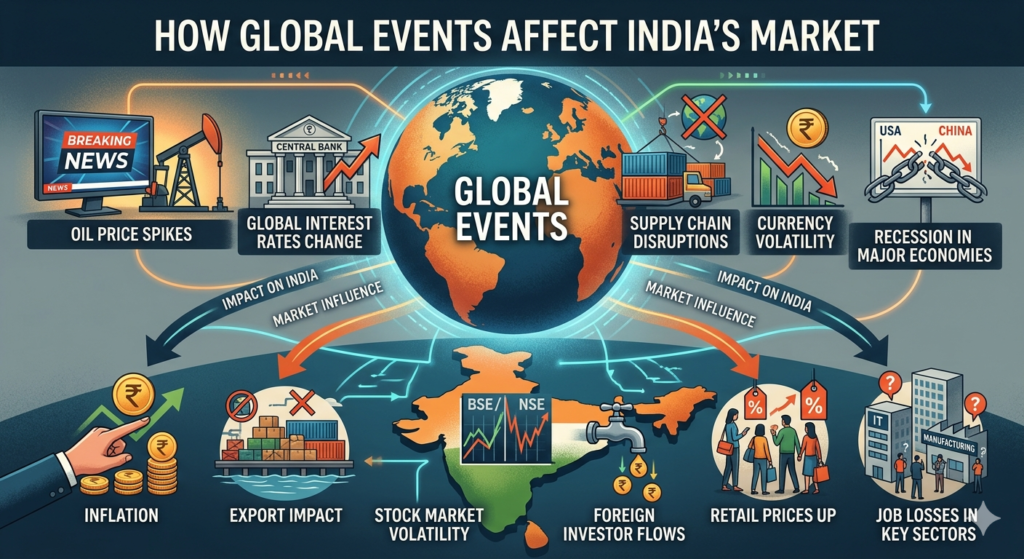
Some common examples include:-
International conflicts and tensions
Changes in crude oil prices
Economic growth or slowdown in major countries
Global health emergencies
Climate-related disasters
Technological innovations
Trade agreements between nations
Changes in global interest rates
Since India is one of the world’s largest economies, such events often influence its market performance.
Impact on the Indian Stock Market:-
The stock market is usually one of the first areas to react to global developments.
When positive news comes from around the world, investors become more confident and invest more money in businesses. This often pushes stock prices higher.
However, when there is uncertainty or fear in global markets, investors may become cautious. As a result, stock prices can fall even if the Indian economy remains stable.
Real-Life Example:-
Imagine that a major economy reports strong growth and increasing consumer spending. Investors may expect Indian companies to receive more export orders in the future. This positive expectation can increase demand for Indian stocks.
Effects on the Stock Market:-
Higher market volatility
Changes in investor confidence
Increase or decrease in stock prices
Movement of foreign investment
Why Oil Prices Matter for India????
Oil is one of the most important commodities for any economy. India imports a large portion of its crude oil requirement from other countries.
When global oil prices increase:-
Transportation costs rise
Manufacturing becomes more expensive
Fuel prices may increase
Inflation pressure grows
When oil prices decrease:-
Import expenses reduce
Businesses save money
Consumers may benefit from lower costs
Economic growth gets support
Real-Life Example:-
Suppose a delivery company operates thousands of vehicles across India. If international oil prices rise sharply, fuel expenses increase immediately. To manage costs, the company may increase delivery charges, which can eventually raise the prices of goods purchased by consumers.
Effect on Foreign Investment:-
Foreign investors play an important role in India’s economy. They invest money in Indian companies, industries, and financial markets.
When global conditions are stable:-
More investment enters India
Businesses receive additional funding
Market sentiment improves
During periods of uncertainty:-
Investors may move money to safer assets
Market performance can weaken
Business expansion plans may slow down
Why This Is Important????
Foreign investment helps create jobs, supports innovation, and encourages business growth. Therefore, changes in global investor confidence can directly affect India’s market.
Impact on the Value of the Indian Rupee:-
The Indian Rupee is influenced by international financial conditions.
If foreign investors bring more money into India, demand for the Rupee increases and the currency may strengthen.
If investors withdraw money during uncertain times, demand for the Rupee may decrease and the currency may weaken.
(When the Rupee Becomes Weak)
Imports become expensive
Fuel costs may rise
Electronic products may cost more
Inflation pressure increases
(When the Rupee Becomes Strong)
Imports become cheaper
Businesses importing raw materials benefit
Inflation may remain under control
Global Events and International Trade:-
India trades with many countries around the world. Therefore, international developments have a direct effect on exports and imports.
Impact on Exports:-
If other countries experience economic difficulties, demand for Indian products may decline.
Industries that can be affected include:
Information technology services
Pharmaceuticals
Textiles
Engineering goods
Impact on Imports:-
Global disruptions can make imported goods more expensive or difficult to obtain.
Real-Life Example:-
Suppose an important manufacturing region in another country faces a natural disaster. Factories may stop production, reducing the supply of components used by Indian industries. This can slow production and increase business costs.
Impact on Inflation and Daily Life:-
Inflation refers to the overall increase in prices of goods and services.
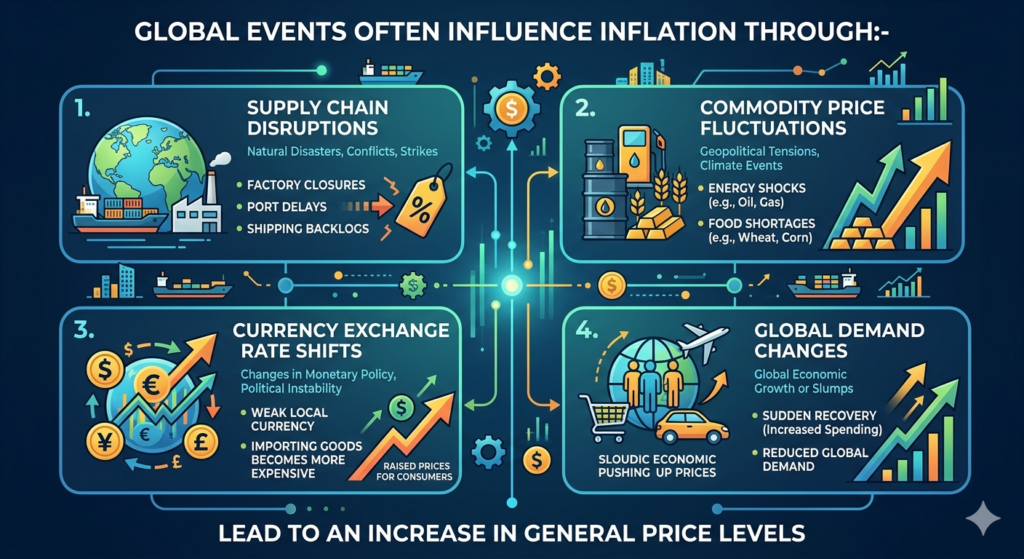
Global events often influence inflation through:-
Rising fuel prices
Higher transportation costs
Supply shortages
Increased import expenses
How It Affects Ordinary People
When inflation rises:-
Household expenses increase
Savings lose purchasing power
Daily necessities become costlier
Real-Life Example:-
If international shipping costs increase, imported products become more expensive. Businesses may pass these costs to consumers, resulting in higher prices in local markets.
Impact on Employment and Businesses:-
Global events can create both opportunities and challenges for Indian businesses.
(Positive Effects)
When global demand increases:-
Export orders grow
Businesses expand production
New jobs are created
(Negative Effects)
When major economies slow down:-
Export demand may fall
Company profits may decrease
Hiring may become slower
Real-Life Example:-
An Indian software company serving international clients may receive more projects when businesses worldwide increase spending. However, during economic uncertainty, many companies reduce their technology budgets, affecting new projects and employment opportunities.
Technology:- A Global Opportunity for India
Not all global events create problems. Technological progress often creates new opportunities.
Advancements in areas such as:-
Artificial Intelligence (AI)
Digital payments
Renewable energy
Cloud computing
Automation
are helping businesses become more efficient and competitive.
Example::-
The growth of digital technology has enabled Indian startups to serve customers across different countries and attract investment from international markets.
Current Global Trends Affecting India in 2026:-
Several global developments continue to influence India’s market in 2026:-
Changes in energy prices
Artificial Intelligence expansion
International trade partnerships
Supply chain diversification
Climate-related challenges
Global interest rate movements
Many companies are now looking to diversify their manufacturing locations instead of depending on a single country. This trend creates opportunities for India to attract investment and strengthen its position in global trade.
How Investors and Businesses Can Prepare?????
To reduce the impact of global uncertainty, investors and businesses should remain prepared.
(For Investors)
Invest for the long term
Diversify investments
Avoid emotional decisions
Stay informed about global developments
(For Businesses)
Build stronger supply chains
Explore new markets
Improve efficiency
Adopt modern technology
These steps can help manage risks and improve stability during uncertain times.
Conclusion:-
Global events have a significant influence on India’s market because the country’s economy is closely connected with the rest of the world. Changes in oil prices, foreign investment, trade conditions, technology, and international economic trends can affect stock markets, businesses, employment, inflation, and consumer spending.
Some global events create challenges, while others open doors for growth and innovation. The key lies in understanding these changes and adapting effectively. As India continues to strengthen its role in the global economy, awareness of global events will remain essential for businesses, investors, and policymakers.
In simple words, what happens in the world does not stay limited to one country. Its impact often reaches India as well, shaping the future of markets, businesses, and everyday life.