
Introduction:- When Politics Shapes Prices
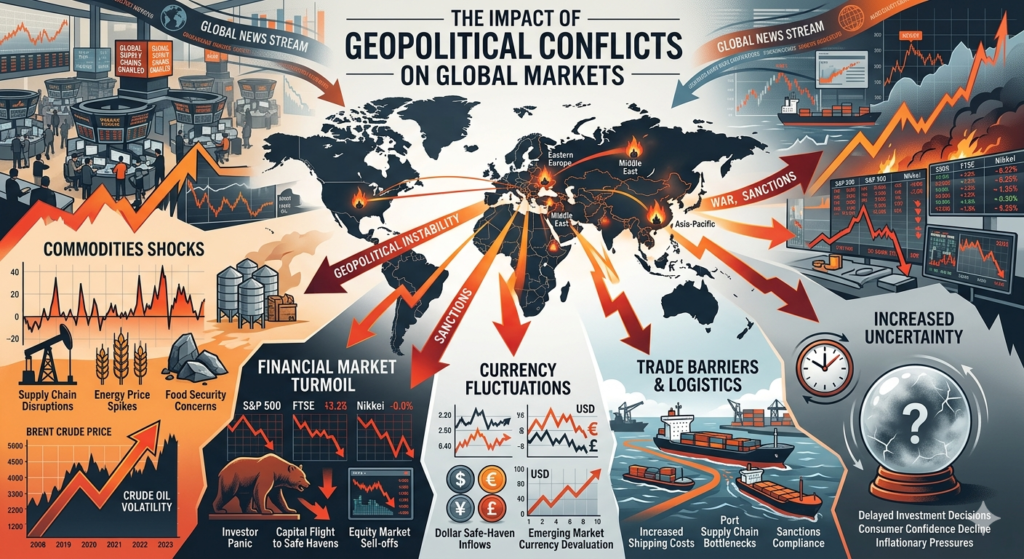
Markets are often seen as spaces driven by numbers, profits, and economic data. In reality, markets are deeply influenced by political stability and global relations. Geopolitical conflicts disturb this balance. They introduce fear, uncertainty, and sudden changes into an otherwise predictable economic environment. In the present global scenario, geopolitical tensions have become more frequent and complex, making markets highly sensitive to political developments.
Unlike natural disasters, geopolitical conflicts are human-made and often prolonged. Their impact does not remain limited to the countries directly involved. Through trade, finance, energy flows, and investor sentiment, these conflicts affect markets across the world.
Why Markets React Strongly to Geopolitical Tensions????
Markets operate on expectations about the future. Geopolitical conflicts damage these expectations.
The main reasons for strong market reactions are:-
Uncertainty about policy decisions
Fear of supply disruptions
Risk of economic slowdown
Possibility of escalation
Even without immediate economic damage, the perception of risk is enough to move markets sharply.
Investor Behaviour in Times of Conflict:-
Investor psychology plays a crucial role during geopolitical tensions.
(Rising Risk Aversion)
When conflicts intensify, investors try to protect their capital rather than seek higher returns. This leads to:-
Reduced investment in equities
Preference for safer assets
Withdrawal of funds from unstable regions
(Short-Term Focus)
Long-term investment strategies often give way to short-term decisions. This increases speculative activity and market volatility.
Equity Markets:- Volatility Becomes the Norm
Stock markets are usually the first to react to geopolitical shocks.
(Immediate Impact)
Sudden decline in market indices
Increased daily price fluctuations
Sharp fall in sectors linked to global trade
Industries dependent on international movement, imports, or exports are affected the most.
(Sectoral Differences)
While many sectors suffer, some benefit from conflict-driven demand:-
Defence and security-related industries
Technology linked to data protection
Energy producers
This uneven impact reshapes market structure rather than causing uniform damage.
Commodity Markets Under Geopolitical Stress:-
Commodities are highly sensitive to conflicts because production and transport are geographically concentrated.
(Energy Prices)
Geopolitical tensions involving key regions create fear of supply shortages. This results in:-
Rapid increase in energy prices
Higher transportation and production costs
Global inflationary pressure
Rising energy prices affect households, industries, and government finances.
(Agricultural Commodities)
Conflicts disrupt farming, storage, and distribution systems. The consequences include:-
Increase in food prices
Pressure on importing nations
Greater food insecurity
These effects are more severe in developing economies.
Currency Markets and Capital Flows:-
Currencies reflect both economic strength and political stability.
(Currency Depreciation)
During geopolitical instability:-
Foreign investors withdraw capital
Demand for local currency falls
Exchange rates weaken
This increases import costs and worsens inflation.
(Strengthening of Safe Currencies)
Currencies of politically stable economies attract global capital. While this benefits those economies, it creates imbalance in global trade.
Bond Markets and Borrowing Conditions:-
Bond markets respond differently compared to equity markets.
(Search for Stability)
Investors move towards government bonds of stable economies, leading to:-
Rising bond prices
Falling yields
(Pressure on Vulnerable Economies)
Countries facing geopolitical risk experience:-
Higher borrowing costs
Difficulty in accessing global capital
Increased debt stress
This limits their ability to support growth during crises.
Sanctions and Economic Disruptions:-
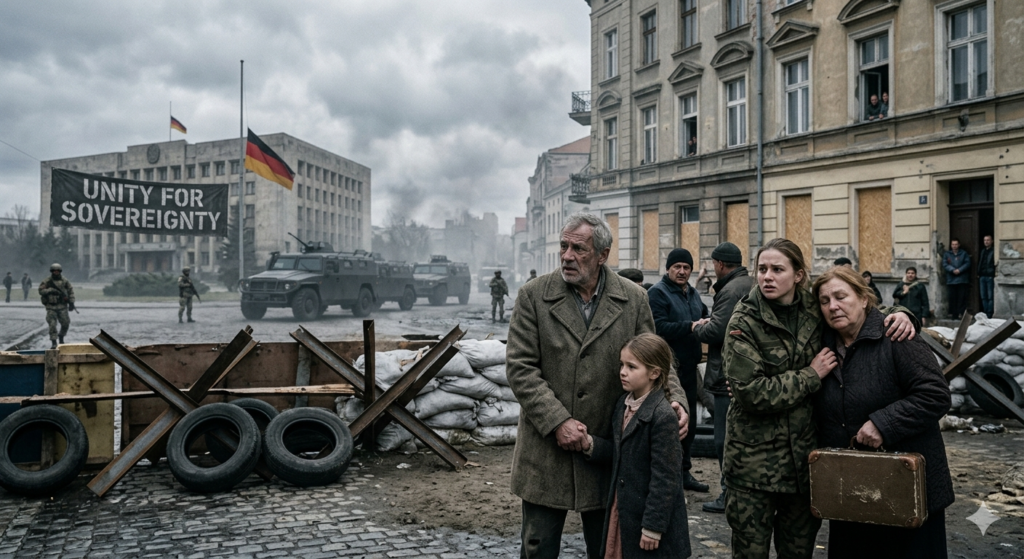
Sanctions have become a major economic tool during geopolitical conflicts.
(Impact on Markets)
Sanctions restrict:-
Trade flows
Financial transactions
Technology access
This reduces investor confidence and disrupts market functioning.
(Wider Global Effects)
Sanctions also affect global companies and supply chains. As a result, markets become fragmented rather than integrated.
Disruption of Trade and Supply Chains:-
Modern supply chains are designed for efficiency, not conflict.
(Immediate Consequences)
Shipping delays
Rerouting of trade paths
Rising logistics costs
These factors increase prices for consumers and reduce profit margins for businesses.
(Strategic Shift by Businesses)
Companies now focus on:-
Diversifying suppliers
Reducing dependence on single regions
Increasing domestic production
While this improves security, it raises long-term costs.
Impact on Emerging Economies:-
Emerging economies are more vulnerable to geopolitical shocks.
(Economic Challenges)
Capital outflows
Currency depreciation
Rising inflation
Slower growth
Limited financial buffers make adjustment difficult.
(Social Consequences)
Market instability leads to:-
Job losses
Reduced purchasing power
Rising inequality
Thus, financial stress turns into social stress.
Role of Technology in Market Reactions:-
Technology has accelerated the impact of geopolitical conflicts on markets.
(Faster Information Flow)
News spreads instantly
Markets react within minutes
Emotional responses dominate fundamentals
(Increased Volatility)
Automated trading systems amplify small signals, making markets more unstable during conflicts.
Policy Response by Governments and Central Banks:-
Authorities attempt to control market instability through various measures.
(Common Tools)
Liquidity support
Currency market intervention
Use of strategic reserves
Trade diversification policies
However, policy actions can only reduce damage, not eliminate it entirely.
Long-Term Structural Changes in Markets:-
Repeated geopolitical conflicts are reshaping global markets.
(Emerging Trends)
Decline in unrestricted globalization
Rise of regional economic groupings
Focus on strategic and critical sectors
Integration of national security into economic planning
Markets are adjusting to a world where political risk is permanent.
Conclusion:- Markets in a Politically Uncertain World
Geopolitical conflicts have become a defining factor of modern markets. Their impact is not temporary but structural. Prices, investment decisions, trade flows, and growth prospects are increasingly shaped by political developments rather than purely economic fundamentals.
In this environment, understanding geopolitical risk is essential for investors, policymakers, and economies. Markets will continue to reflect the fragile balance between cooperation and conflict. The ability of nations to manage geopolitical tensions will play a crucial role in determining future market stability and global economic health.