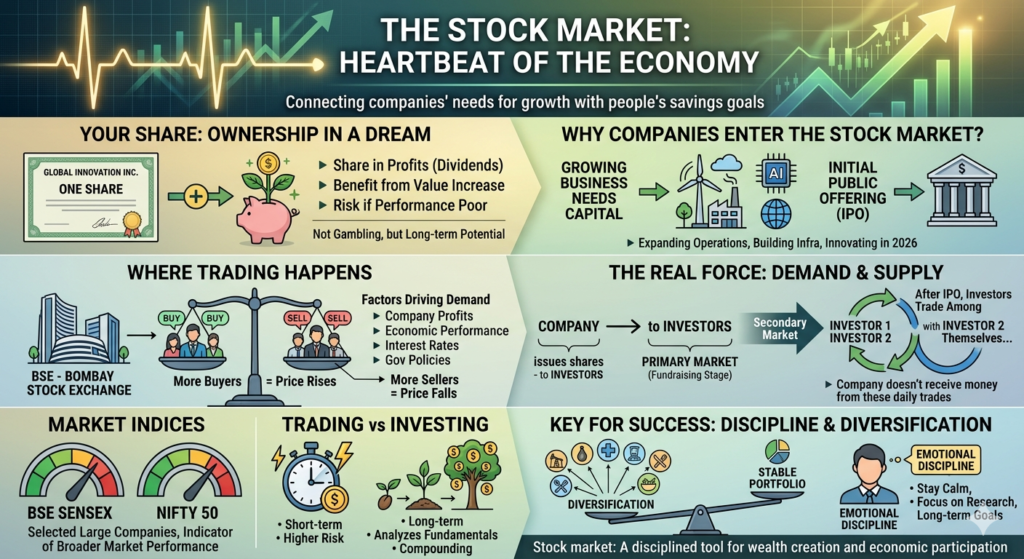
The stock market is not just a place where numbers move up and down on a screen. It is the heartbeat of the economy. It connects companies that need money to grow with people who want to grow their savings.
In 2026, global stock markets handle transactions worth trillions of dollars daily. Participation has expanded rapidly, especially due to digital platforms. In India, demat accounts have crossed 15 crore, showing that investing is no longer limited to big institutions. Ordinary individuals are now active participants.
The stock market reflects confidence, fear, growth, risk, and expectations about the future. When markets rise, it usually shows optimism. When they fall, it signals caution.
2. A Share:- Your Small Ownership in a Big Dream
A share represents a small unit of ownership in a company. When you buy shares, you become a part-owner of that business.
means:-
You share in the company’s profits (through dividends, if declared).
You benefit if the company’s value increases.
You also face risk if the company performs poorly.
Buying shares is not gambling if done with research. It is believing in a company’s long-term potential.
3. Why Companies Enter the Stock Market???
Every growing business needs capital. Companies may want to:-
Expand operations
Build infrastructure
Invest in innovation
Enter international markets
Strengthen their financial position
Instead of borrowing from banks, companies can raise funds by offering shares to the public. This process is called an initial public offering (IPO).
In 2026, sectors like renewable energy, artificial intelligence, digital finance, healthcare, and infrastructure continue to attract strong investor interest.
4. Where Does Trading Actually Happen????
In India, trading mainly takes place on two major exchanges:
Bombay Stock Exchange
National Stock Exchange
These exchanges provide a transparent and regulated platform where buyers and sellers trade electronically. Prices change every second based on market demand and supply.
5. The Real Force Behind Price Movements:- Demand and Supply
The most basic rule of the stock market is simple:-
If more people want to buy a share, its price rises.
If more people want to sell, its price falls.
But what drives this demand????
Company profits and future growth
Economic performance
Interest rates and inflation
Government policies
Global developments
In 2026, markets are highly sensitive to interest rate decisions, global trade conditions, and geopolitical events. However, in the long run, consistent company performance matters the most.
6. The Economy and the Market:- Two Sides of the Same Coin
The stock market reflects economic health.
When the economy grows:-
Businesses earn more
Employment increases
Consumer spending rises
Share prices often move upward
When the economy slows:-
Profits decline
Investment reduces
Markets may fall
Interestingly, markets move based on expectations. If investors believe the economy will improve next year, markets may rise even before the recovery begins.
7. Primary Market vs Secondary Market:- Understanding the Flow
The stock market works in two main stages:-
Primary Market – The Fundraising Stage
Here, companies sell shares directly to investors to raise money.
Secondary Market – The Trading Stage
After shares are issued, investors trade among themselves. The company does not receive money from these daily trades. Prices fluctuate based on buying and selling activity.
Most daily transactions happen in the secondary market.
8. Market Indices:- Measuring Overall Performance
Instead of tracking each company individually, investors often look at indices.
In India, two major indices are:-
BSE Sensex
Nifty 50
These indices represent selected large companies. If they rise, it indicates strong performance in the broader market. If they fall, it suggests weakness.
Indices help investors quickly understand the overall market direction.
9. Risk and Reward:- The Fundamental Truth
The stock market offers higher return potential than many traditional savings options. However, higher returns always come with higher risk.
Common risks include:-
Market-wide decline
Company-specific problems
Economic slowdown
Global uncertainties
In 2026, markets remain dynamic due to global inflation adjustments and policy changes. Short-term volatility is normal. Long-term discipline is crucial.
10. Trading vs Investing:- Choosing Your Path
There is a major difference between trading and investing.
Trading focuses on short-term price movements. It requires quick decisions and carries higher risk.
Investing focuses on long-term growth. Investors analyze company fundamentals and hold shares for years. Compounding helps wealth grow steadily over time.
Historical patterns show that patient long-term investors generally perform better than frequent traders reacting emotionally.
11. Diversification:- The Smart Protection Strategy
One of the most important principles in investing is diversification.
Instead of investing all money in one company, spreading it across sectors reduces risk. If one investment performs poorly, others may balance the overall portfolio.
Diversification does not remove risk completely, but it makes investing more stable.
12. Emotional Discipline:- The Hidden Key to Success
Emotions strongly influence market behavior.
Fear causes panic selling.
Greed leads to overbuying at high prices.
Successful investors stay calm. They focus on research, data, and long-term goals instead of short-term noise.
13. Market Trends in 2026:- What Shapes Today’s Movement
As of 2026, stock markets are influenced by:-
Stabilizing inflation in major economies
Gradual adjustments in interest rates
Rapid growth in digital and renewable sectors
Rising retail participation
Strong focus on sustainable investments
Technology has made investing faster and more accessible. Mobile platforms allow real-time transactions, making markets more connected than ever.
14. Final Reflection:- Why Understanding the Stock Market Matters???
The stock market is not a shortcut to instant wealth. It is a disciplined system that rewards patience, research, and smart decision-making.
Understanding how it works helps individuals make informed financial choices. It builds confidence and encourages long-term planning.
In today’s world, financial literacy is essential. The stock market, when approached with knowledge and strategy, becomes a powerful tool for wealth creation and economic participation.
Learning its basics is not just about investing money — it is about understanding how businesses grow and how economies move forward.