
China and India:-Two Economies, Two Different Journeys
China and India are often compared because they are neighbors, population giants, and rising economic powers. Yet, when we look closely, their economic journeys are very different. One followed the path of factories and exports, while the other moved forward through services and domestic demand. This article compares the Chinese and Indian economies in a clear, simple, and original manner, focusing on present-day realities.
1. Understanding the Scale of Both Economies:-
The first visible difference between China and India is the size of their economies.
China’s economy is much larger, with total production close to 19 trillion US dollars. India’s economy has crossed 4 trillion US dollars, which is a major achievement but still far behind China in absolute terms.
This gap exists because China began economic reforms earlier and pushed industrial growth aggressively. India’s rise has been gradual, shaped by democratic decision-making and social diversity. Size alone, however, does not tell the full story.
2. Speed of Growth:- Who Is Moving Faster Today????
Economic growth is not just about size; it is also about speed.
At present:-
India is growing at a faster pace, close to 7 percent annually.
China’s growth has slowed to around 5 percent.
India’s faster growth reflects strong domestic consumption, infrastructure expansion, and a growing urban middle class. China, on the other hand, is entering a mature stage of development where rapid growth is naturally harder to maintain.
Simply put, China is ahead, but India is catching up faster.
3. Income Levels and Everyday Life:-
When we compare income at the individual level, the picture changes again.
An average citizen in China earns much more than an average citizen in India. This difference affects daily life — housing, transport, healthcare, and spending capacity.
China’s higher income levels are the result of decades of industrial employment and urbanization. India still has a large rural population and a significant informal sector, which keeps average incomes lower.
However, rising salaries in Indian cities and expanding job opportunities suggest gradual improvement.
4. How Each Economy Is Built from Inside????
The internal structure of both economies shows their true character.
China’s Economic Structure:-
China is heavily industry-driven. Large factories produce goods on a massive scale. Manufacturing forms the backbone of its economy, supported by strong infrastructure and logistics.
India’s Economic Structure:-
India relies more on the service sector. Software services, finance, communication, and professional services contribute a large share to national income. Manufacturing is growing, but services still dominate.
This difference explains why China is strong in physical goods, while India is strong in knowledge-based work.
5. Role in World Trade:-
China’s presence in global trade is massive. Goods made in Chinese factories reach almost every part of the world. Export earnings support employment, investment, and foreign exchange stability.
India’s role in global trade is smaller but changing. While physical exports are limited, India earns heavily through service exports, especially digital and professional services.
China’s strength lies in volume and scale, while India’s strength lies in skill-based exports.
6. Employment Reality in Both Countries-
Employment patterns reveal important contrasts.
In China:-
Most workers are part of the formal economy.
Factory jobs and urban employment are common.
Automation is slowly reducing traditional industrial jobs.
In India:-
A large number of people work in the informal sector.
Agriculture still employs many people.
Job creation often struggles to keep pace with population growth.
India’s main challenge is creating enough stable and skilled jobs, while China’s challenge is adjusting to a changing industrial landscape.
7. Poverty and Social Development:-
China has been very successful in reducing extreme poverty over the years. Large-scale employment programs, urban migration, and government support systems helped lift millions into better living conditions.
India has also reduced poverty, but progress has been uneven. Population size, regional differences, and informal employment slow down the process.
Education, healthcare access, and basic services are improving in India, but the journey is still ongoing.
8. Government Spending and Debt:-
Managing public finances is crucial for economic stability.
China’s government debt remains relatively controlled. Strong state influence over financial institutions helps manage borrowing efficiently.
India’s government debt is higher as a share of national income. Social spending, infrastructure needs, and development programs require large public investment.
India balances growth needs with fiscal discipline, while China focuses on state-led financial control.
9. Population as an Economic Factor:-
Population structure plays a silent but powerful role.
China is facing an ageing population. The number of working-age people is slowly declining, increasing pressure on productivity and social security systems.
India has a young population. A large section of citizens is entering working age every year. This can be a major advantage if education, skills, and jobs grow together.
India’s population can be a strength or a burden — the outcome depends on policy choices.
10. Technology and Innovation:-
China invests heavily in advanced technology, including modern manufacturing, clean energy, and large infrastructure systems. Innovation is often supported by state planning and large-scale investment.
India’s innovation strength lies in people-driven sectors — software, startups, and digital platforms. Creativity, adaptability, and cost efficiency define India’s innovation model.
China leads in hardware and production technology, while India leads in digital services and human capital.
11. Current Economic Pressures:-
Every economy faces challenges.
China struggles with slower growth, lower consumer spending, and debt stress in certain sectors.
India faces issues like job creation, income inequality, and dependence on imports for energy and technology.
Both economies must reform continuously to sustain long-term growth.
12. Possibilities:-
China will remain a major global economy but with moderate growth.
India has the potential to rise rapidly if it maintains growth momentum and improves job quality.
India’s future depends on strengthening manufacturing, improving education, and expanding infrastructure. China’s future depends on innovation, efficiency, and domestic consumption.
Conclusion:-( Not a Race, But Two Different Models)
The comparison between China and India is not about who is better; it is about how differently growth can happen.
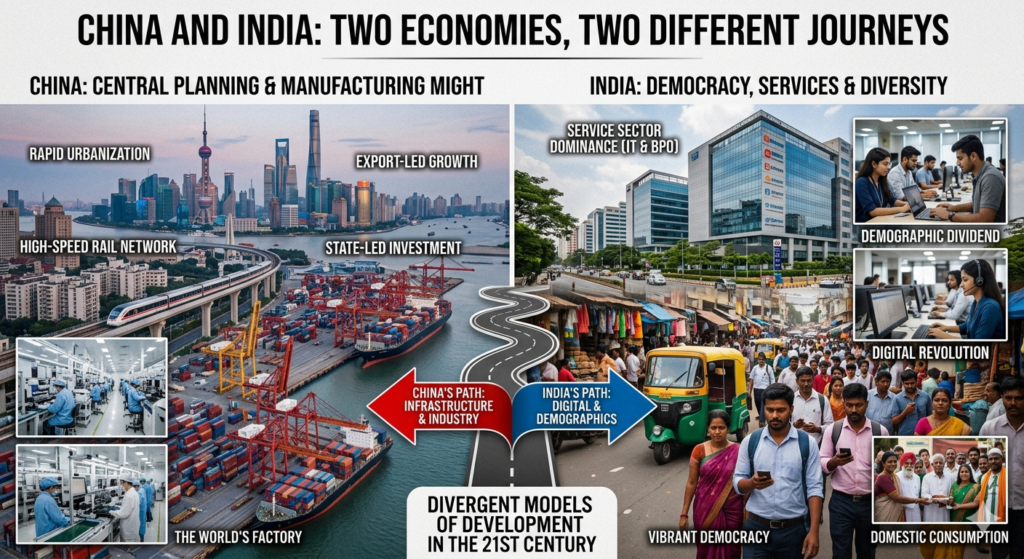
China represents a model built on factories, exports, and state planning.
India represents a model driven by services, democracy, and domestic demand.
China leads today in size and income, while India holds promise for tomorrow with its growth speed and young population.
Together, these two economies are reshaping Asia and influencing the global economic balance in their own unique ways.