
Introduction:- When Growth Becomes Fragile???
Economic growth is often taken for granted until it begins to slow down across borders. A global recession is not announced suddenly; it creeps in quietly through falling demand, cautious investors, shrinking jobs, and anxious governments. In the current phase of the world economy, signals of stress are visible almost everywhere—advanced economies are struggling to maintain momentum, developing nations face external pressures, and global cooperation appears weaker than before. The discussion on global recession has therefore moved from academic circles to policy corridors.
For an aspirant of civil services, global recession is not merely an economic term but a phenomenon that connects economics with governance, diplomacy, and social stability.
Understanding Global Recession Beyond Textbook Definitions:-
A global recession refers to a prolonged and widespread decline in economic activity across most major economies of the world. It goes beyond two quarters of negative growth in a single country and reflects a synchronized slowdown in global output, trade, and income levels.
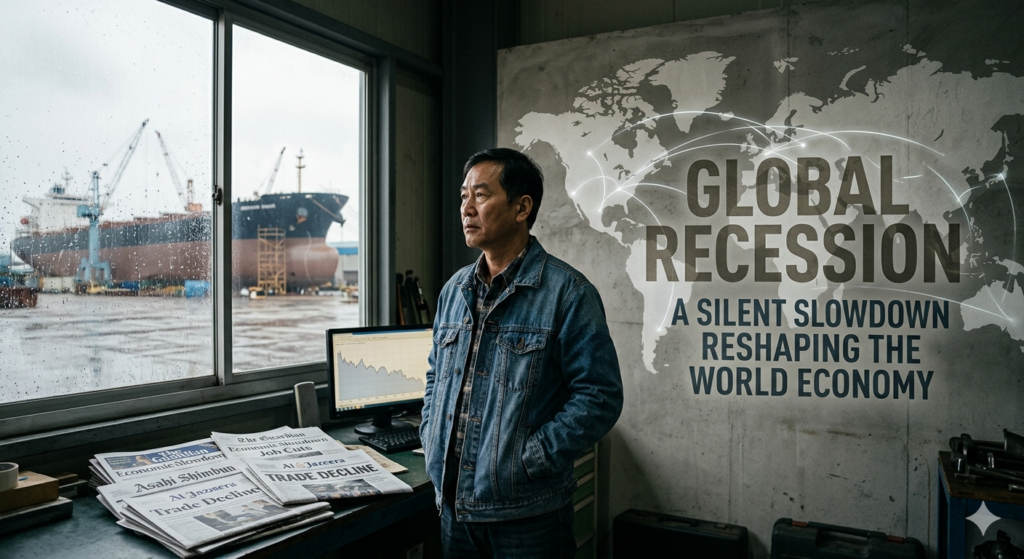
What makes a recession “global” is???:-
Simultaneous economic contraction in multiple regions.
Sharp decline in cross-border trade and investments.
Weak confidence among consumers and investors.
Stress in financial systems.
Thus, a global recession is more about interconnected weakness rather than isolated failure.
Why Is the World Facing Recessionary Pressures Today????
The current economic slowdown is the result of layered shocks rather than one sudden crisis.
Inflation and the Cost of Living Crisis:-
High inflation reduced real incomes across countries. Households began spending more on essentials, leaving less room for discretionary consumption. This weakened demand, especially in service and manufacturing sectors.
Interest Rate Tightening:- (A Necessary but Costly Tool)
Central banks responded to inflation by raising interest rates sharply. While inflation moderation was necessary, the side effects were unavoidable:
Higher cost of borrowing.
Reduced private investment.
Slowdown in housing and infrastructure sectors.
This policy trade-off slowed economic momentum globally.
Geopolitical Uncertainty and Economic Fragmentation:-
Conflicts and geopolitical rivalries disrupted global supply chains. Energy markets became volatile, food security concerns intensified, and trade routes faced uncertainties. Countries increasingly prioritised strategic interests over economic efficiency.
Rising Global Debt Burden:-
Many nations borrowed heavily during crisis periods. With rising interest rates and weaker currencies, debt servicing became difficult, particularly for developing and vulnerable economies.
How Does a Global Recession Spread Across Countries????
A global recession spreads through interconnected channels rather than direct contagion.
Major transmission routes include:-
Trade slowdown:- Export-oriented economies face demand contraction
Financial volatility:- Capital flows become unpredictable
Confidence erosion:- Businesses delay investments, consumers cut spending
Labour market stress:- Job creation slows while informal employment rises
These channels ensure that no economy remains completely isolated.
Regional Impact:- (Unequal but Universal)
Developed Economies:-
Advanced economies face stagnation, declining productivity, and pressure on social welfare systems. Ageing populations further complicate recovery.
Emerging Economies:-developing nations face
Export contraction.
Exchange rate volatility.
Rising inflation and unemployment.
Growth engines weaken due to dependence on global demand and capital flows.
Vulnerable and Low-Income Countries:-
For poorer nations, recession translates into:-
Food and fuel insecurity.
Reduced development assistance.
Fiscal stress limiting welfare spending.
Thus, the weakest economies bear the heaviest social cost.
The Human Face of a Global Recession:-
Economic slowdown affects more than GDP figures.
Rising income inequality.
Informal sector expansion
Reduced access to health and education.
Social unrest and political instability.
A prolonged recession can reverse years of development progress, making recovery socially expensive.
India in the Shadow of Global Recession:-
India’s economy shows relative resilience due to its large domestic market and reform-driven growth. However, it cannot remain untouched by global slowdown.
Key challenges for India include:-
Weak export demand.
Volatile foreign investment flows.
Pressure on currency and external balances.
Stress in IT and service exports.
At the same time, India’s demographic advantage and consumption-led growth provide a strong internal cushion.
India’s Policy Response:- (Stability with Reform)
India’s approach reflects a balance between short-term support and long-term transformation.
Demand Support Measures:-
Increased public capital expenditure.
Infrastructure-led growth strategy.
Support to MSMEs and employment-intensive sectors
Structural Strengthening:-
Manufacturing promotion.
Digital public infrastructure expansion.
Logistics and supply chain reforms.
Global Engagement:-
Diversification of trade partners.
Strategic economic diplomacy
Active role in multilateral forums
These steps aim to convert global uncertainty into domestic opportunity.
Role of Global Institutions During Economic Slowdown:-
International institutions are expected to act as stabilisers during recessions.
Their role includes:-
Emergency financial support
Debt restructuring assistance
Policy coordination
Crisis monitoring and advisory
However, effectiveness depends on cooperation among major economies, which remains limited in a polarised world order.
Learning from Past Global Recessions:-
History provides valuable lessons:-
Excessive dependence on debt-driven growth. increases vulnerability.
Delay in policy action worsens economic damage.
Social protection systems are crucial.
Global cooperation accelerates recovery.
Ignoring these lessons risks repeating economic cycles.
The Way Forward:-( Rethinking Global Growth)
The current slowdown presents an opportunity to rethink growth strategies.
Future priorities should include:-
Resilient supply chains.
Sustainable and inclusive development.
Balanced fiscal and monetary coordination.
Strengthened multilateralism.
For developing nations, focus must remain on domestic capacity-building rather than external dependence.
Conclusion:-(From Crisis to Course Correction)
A global recession is not merely an economic downturn but a test of governance, cooperation, and resilience. While cyclical slowdowns are inevitable, their long-term impact depends on policy choices and institutional strength. For India and the world, the challenge lies in managing immediate risks while preparing for a more stable and inclusive economic future.