
Non-Performing Assets (NPA):- (A Silent Stress on the Banking System)
Banks play a crucial role in the functioning of any economy. They collect savings, provide loans, support businesses, and help individuals fulfill their financial needs. However, when borrowers fail to repay loans on time, banks face serious difficulties. One of the most important challenges faced by banks today is the problem of Non-Performing Assets, commonly known as NPAs.
NPAs are not just a banking issue;- they affect economic growth, credit availability, and financial stability. Understanding NPAs is essential to understand how a country’s financial system works and why banking discipline matters.
1. Meaning of Non-Performing Assets:-
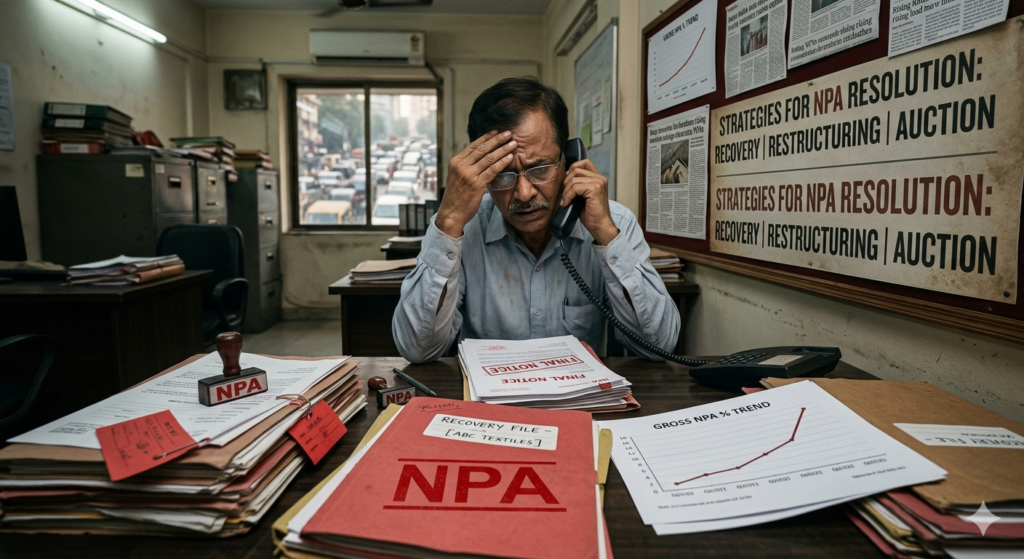
A Non-Performing Asset is a loan or advance where the borrower has stopped making payments of interest or principal for a continuous period. When repayment does not happen for a defined time, the loan no longer generates income for the bank and is therefore classified as non-performing.
In simple words:-
An NPA is a loan that does not bring any return to the bank.
Banks depend on interest income to survive. When loans turn into NPAs, banks lose income and face financial stress.
2. Classification of NPAs:-
Banks divide NPAs into different categories to understand the level of risk involved.
Standard Assets:-
These are loans where repayments are happening regularly. They carry very low risk.
Sub-Standard Assets:-
These loans have started showing repayment problems. Recovery is possible but requires attention.
Doubtful Assets:-
In these cases, repayment is uncertain. The longer the loan remains unpaid, the higher the risk of loss.
Loss Assets:-
These are loans where recovery is nearly impossible. Banks accept that the money is unlikely to return.
This classification helps banks manage risk and take corrective steps at the right time.
3. Why NPAs Are a Serious Concern???
NPAs create multiple problems within the banking system and the wider economy.
Impact on Bank Profits:-
When loans stop earning interest, bank profits decline. Lower profits reduce the bank’s ability to expand services or absorb future losses.
Restriction on New Lending:-
Banks with high NPAs become cautious. They reduce lending to avoid further risk, which affects businesses and individuals who depend on credit.
Weak Financial Stability:-
High NPAs weaken the balance sheets of banks. This creates fear among depositors and investors.
Burden on the Economy:-
When banks struggle, economic activities slow down. Investment reduces, employment opportunities decline, and growth becomes sluggish.
4. Main Causes Behind Rising NPAs:-
NPAs do not arise overnight. Several factors contribute to their growth.
Poor Loan Assessment:-
If loans are approved without proper evaluation of repayment capacity, defaults become likely.
Economic Slowdown:-
When economic activity slows, businesses earn less revenue and fail to meet loan obligations.
Corporate Mismanagement:-
Some companies misuse borrowed funds or expand aggressively without proper planning, leading to repayment failure.
Agricultural Uncertainty:-
Weather conditions, crop failure, and price instability often affect farmers’ ability to repay loans.
Intentional Default:-
In some cases, borrowers have the capacity to repay but choose not to, taking advantage of system weaknesses.
5. How NPAs Affect Common People::-
Many believe NPAs concern only banks, but their effects reach ordinary citizens as well.
Loan interest rates may increase
Education and housing loans become harder to get
Small businesses struggle to obtain finance
Public funds may be used to support stressed banks
Thus, NPAs indirectly impact living standards and economic opportunities.
6. Recent Improvements and Present Scenario:-
In recent years, banks have taken serious steps to control NPAs. Better monitoring, stricter lending norms, and focused recovery efforts have helped reduce the overall stress in the system.
Banks have become more careful while giving loans, especially large ones. Systems are now in place to identify early warning signs before loans turn bad. As a result, asset quality has improved compared to earlier years.
However, challenges still exist. Some sectors and smaller borrowers continue to face financial pressure, and any economic disturbance can create fresh stress.
7. Methods Used to Control and Reduce NPAs:–
Banks and financial institutions use several strategies to manage NPAs effectively.
Stronger Credit Evaluation:-
Banks now examine income sources, business models, and repayment history before approving loans.
Early Detection Mechanisms:-
Warning signals such as delayed payments are identified early to prevent full-scale default.
Loan Restructuring:-
Genuine borrowers facing temporary difficulties are given revised repayment terms.
Recovery Through Assets:-
Banks recover money by selling assets kept as security against loans.
Write-Offs:-
In cases where recovery is impossible, loans are removed from active accounts to clean balance sheets.
These measures help banks stay financially stable and continue lending responsibly.
8. Challenges That May Arise in the Future:-
Even though NPAs are under better control, future risks cannot be ignored.
Rising unsecured loans may increase default risk
Small enterprises remain sensitive to market changes
Global uncertainties can affect repayment capacity
Rapid credit expansion without caution may revive NPA problems
Continuous vigilance is required to prevent past mistakes from repeating.
9. NPAs as a Reflection of Financial Discipline:-
NPAs reflect how responsibly loans are given and repaid. A healthy banking system depends on trust, discipline, and accountability from both lenders and borrowers.
When borrowers repay on time and banks lend carefully, NPAs remain low. This balance supports sustainable economic growth.
10. Conclusion:- (Managing NPAs for a Strong Economy)
Non-Performing Assets are an unavoidable part of banking, but they must be controlled within safe limits. Complete elimination of NPAs is unrealistic, but effective management is essential.
A strong banking system requires:-
Responsible lending
Honest borrowing
Continuous monitoring
Timely corrective action.
If these principles are followed, NPAs will remain manageable, banks will remain stable, and the economy will continue to grow smoothly.
In the long run, NPAs are not just a banking issue—they are a test of financial discipline and economic maturity.