
Bank Scams and Their Multi-dimensional Impacts:-
Banks form the backbone of any economy, acting as custodians of public money, engines of credit creation, and instruments for economic stability. However, the modern banking ecosystem is increasingly under threat from scams that undermine public trust, disrupt financial systems, and cause severe economic and social repercussions. These scams, ranging from cyber fraud to insider collusion, not only result in direct monetary losses but also have far-reaching consequences for governance, regulation, and economic confidence. This article presents an analytical perspective on bank scams, their forms, and their multi-layered impacts.
1. Understanding Bank Scams:-
A bank scam is essentially any deliberate act of deception that illegally appropriates funds or manipulates financial processes for personal or organizational gain. While popularly associated with cyber hacks or ATM frauds, bank scams can also occur through fake accounts, forged documents, loan irregularities, and collusion with bank insiders.
Traditionally, bank frauds were largely physical: forged cheques, counterfeit currency, and unauthorized withdrawals. The digital revolution has transformed these crimes into complex, technologically sophisticated operations that are often invisible until large sums vanish or regulatory audits are conducted.
2. The Digital Revolution and Its Dark Side:-
The rise of digital banking has made financial transactions seamless, but it has also expanded the attack surface for scammers. Online banking platforms, mobile applications, and real-time payment systems have become prime targets.
a) Cyberfrauds and Online Deceptions:-
Cyberfrauds now form the bulk of banking scams. These crimes often involve phishing, malware attacks, identity theft, and fraudulent fund transfers. Sophisticated fraudsters exploit both technology and human psychology to deceive customers and employees alike.
For example, a single fraudulent transaction through a compromised corporate account can siphon crores before detection. Increasingly, scammers are exploiting multiple layers of authentication, remote banking access, and digital wallets to execute large-scale theft.
b) Organized Networks and Layered Scams:-
Modern scams often involve networked operations rather than isolated incidents. Fraudsters establish mule accounts, fake corporate entities, and multiple intermediaries to move money across accounts, masking their tracks. Detection is challenging, and by the time authorities intervene, millions are often lost.
3. Traditional Scams:-( Forged Documents and Insider Collusion)
Despite the rise of digital frauds, traditional scams continue to persist.
a) Forged Documents and False Accounts:-
Many scams are executed by creating fake identities or forging corporate documents. Fraudsters open bank accounts in the name of nonexistent companies or manipulate account statements to secure loans. These scams often go undetected until due diligence or regulatory audits reveal discrepancies.
b) Collusion and Abuse of Trust:-
Some bank scams involve insiders exploiting their position of authority. Employees may manipulate accounts, issue unauthorized loans, or divert depositor funds. Such insider collusion often magnifies the impact of fraud because it exploits both the operational framework and the trust placed in banking personnel.
4. Scope and Scale of Modern Bank Scams:-
Recent trends indicate that while the number of scam cases may be stabilizing due to stricter regulations, the monetary value of individual scams is rising sharply. Large-scale frauds, especially those involving corporate accounts or high-value loans, account for the majority of financial losses.
This trend highlights two important points:-
Technological sophistication of fraudsters is increasing.
Regulatory and institutional frameworks are struggling to keep pace with evolving methods of deception.
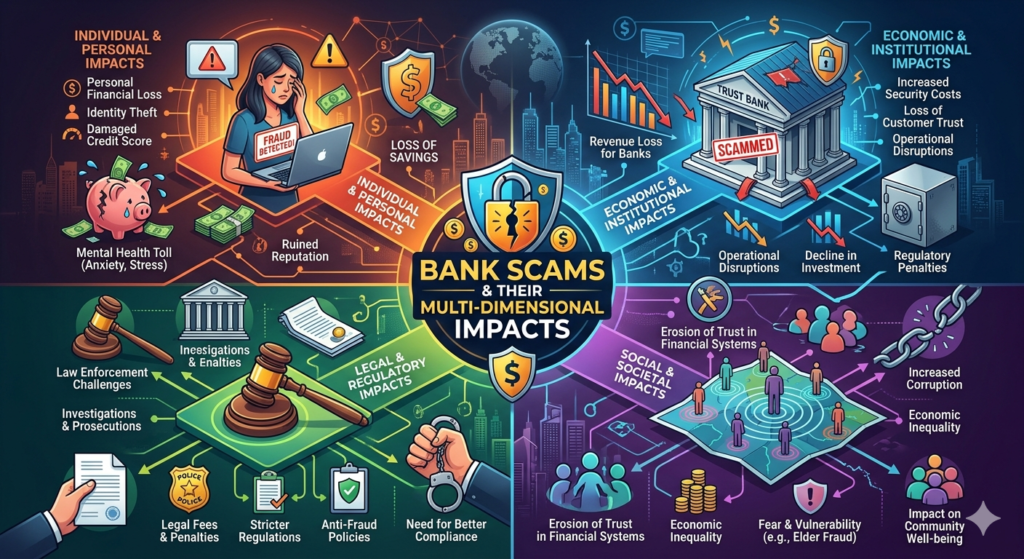
5. Impacts on Individuals:- Beyond Monetary Loss
Bank scams affect individuals in multiple ways:-
a) Financial Losses:-
For ordinary account holders, scams can wipe out life savings, erode creditworthiness, and lead to long-term financial instability. In high-value scams, victims may face losses running into crores.
b) Psychological and Social Impact:-
Beyond financial damage, scams inflict a psychological toll. Victims often experience stress, anxiety, and a diminished sense of security. Loss of trust in banks can discourage people from using digital banking platforms, thereby slowing financial inclusion efforts.
6. Impacts on Banks and the Financial Ecosystem:-
Bank scams reverberate through the financial system, affecting institutions and broader economic structures.
a) Erosion of Public Trust:-
Trust is the lifeblood of banking. Scams, whether internal or external, erode public confidence, leading to reduced deposits and cautious lending. A single high-profile fraud can damage the reputation of an entire institution.
b) Operational and Regulatory Burden:-
Banks must invest heavily in compliance, risk management, and fraud detection systems. They also face regulatory scrutiny, penalties, and mandatory reporting requirements. These additional costs divert resources from core banking functions.
c) Capital Erosion and Lending Constraints:-
Large scams often require banks to write off substantial amounts, weakening their capital base. To safeguard financial stability, banks may tighten lending norms, which can restrict credit availability for small businesses and individuals.
7. Macroeconomic Consequences:-
Bank scams do not only affect individuals or banks; they have broader economic implications.
a) Investor Confidence:-
Frequent and high-value bank scams can shake investor confidence, affecting both domestic and foreign investment. Stock prices of financial institutions often react sharply to reported frauds.
b) Economic Growth and Entrepreneurship:-
When banks tighten credit in response to fraud-related losses, it impacts businesses, particularly start-ups and small and medium enterprises (SMEs). This can slow job creation, innovation, and overall economic growth.
c) Policy and Governance Implications:-
Persistent banking fraud compels regulators to tighten norms, enforce stricter reporting standards, and mandate robust cybersecurity protocols. While necessary, these measures are often reactive, indicating a need for proactive governance and predictive monitoring.
8. Strategies to Combat Bank Scams:-
Tackling bank scams requires multi-pronged action:–
a) Technological Vigilance:-
Banks must adopt real-time transaction monitoring, artificial intelligence-based anomaly detection, and predictive analytics to detect unusual account activity promptly.
b) Public Awareness Campaigns:-
Educating customers about phishing, identity theft, and suspicious financial practices can empower individuals to act as the first line of defense.
c) Strengthening Regulatory Oversight:-
Stronger coordination between banks, regulatory bodies, and law enforcement agencies is crucial. Sharing fraud patterns and intelligence across institutions can prevent the spread of large-scale scams.
d) Internal Governance and Ethics:-
Banks must prioritize internal audits, employee training, and ethical frameworks. Reducing opportunities for collusion and ensuring accountability is essential to prevent insider fraud.
9. Conclusion:-
Bank scams are a multi-dimensional threat, blending traditional fraud with digital sophistication. Their impacts extend far beyond financial losses, affecting trust, operational stability, economic growth, and social confidence in banking systems.
While regulatory interventions and technological safeguards are improving detection and recovery, the growing sophistication of scammers necessitates continuous vigilance, public awareness, and ethical governance. Preventing bank scams is not merely a financial challenge; it is a societal imperative, requiring collective action from individuals, institutions, and policymakers alike.
Only through proactive strategies, transparency, and awareness can the integrity of the banking system be preserved, ensuring that banks remain secure pillars of the economy.