
Introduction:- (Two Institutions, One Global Responsibility)
The global economy today is facing multiple pressures—slowing growth, rising public debt, climate-related disasters, geopolitical tensions, and financial volatility. In such an environment, international financial institutions play a stabilising and supportive role. Among them, the World Bank and the International Monetary Fund (IMF) remain the most influential.
Background:- Why Were These Institutions Created????
The origins of the World Bank and IMF lie in the economic devastation caused by the Second World War. The international community realised that economic instability could easily translate into political conflict. Therefore, a structured global financial system was needed.
Both institutions were established in 1944.
Their aim was to promote economic cooperation, stability, and recovery.
Over time, their functions expanded to address development, poverty, and financial crises.
International Monetary Fund (IMF):- Ensuring Economic Stability
Core Purpose:-
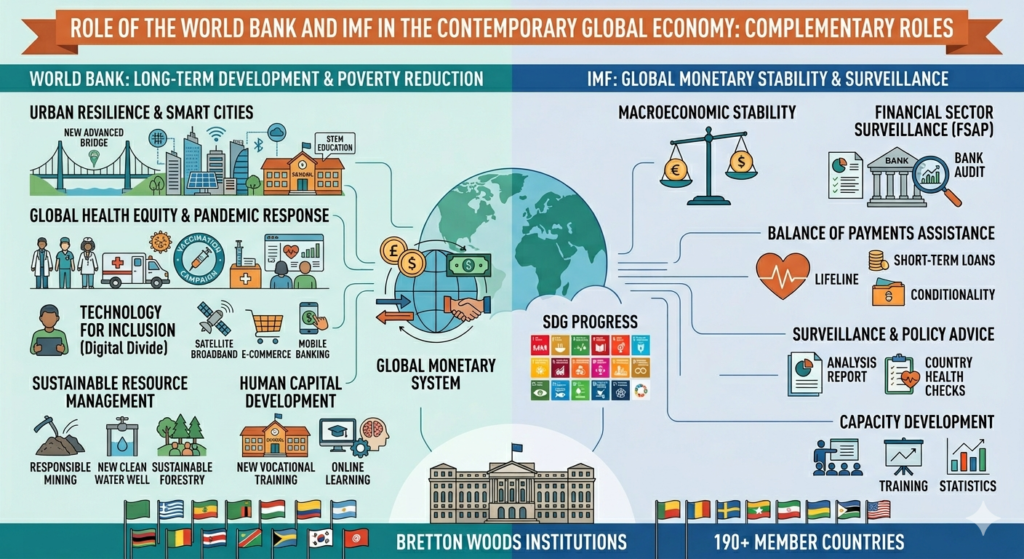
The IMF’s primary responsibility is to maintain global monetary and financial stability. It focuses on macroeconomic issues that affect a country’s ability to engage smoothly in international trade and finance.
Major Functions of the IMF:-
1. Crisis Management and Lending:-
Provides financial assistance to countries facing balance of payments problems.
Helps nations stabilise their currency and restore investor confidence.
Loans are usually short to medium term in nature.
2. Economic Surveillance:-
Regular assessment of national economies.
Monitors inflation, fiscal deficit, exchange rate policies, and external debt.
Helps identify vulnerabilities before they turn into crises.
3. Policy Guidance and Reform Support:-
Advises governments on economic reforms.
Focus on fiscal discipline, financial sector strength, and macroeconomic balance.
Recent approach is more flexible compared to earlier rigid models.
4. Capacity Building:-
Trains policymakers, central bankers, and finance officials.
Improves data quality, taxation systems, and public financial management.
IMF in the Present Global Scenario:-
In recent years, the IMF has played a crucial role in:-
Supporting countries affected by pandemic-induced economic shocks.
Addressing debt stress due to global inflation and rising interest rates.
Expanding emergency financing instruments.
Encouraging protection of social spending during economic adjustment.
This reflects a shift from pure austerity towards growth-sensitive stabilisation.
Criticism and Limitations of the IMF:-
Despite its importance, the IMF has faced criticism:-
Loan conditionalities sometimes limit policy autonomy.
Austerity measures can affect welfare spending.
Voting power is uneven, favouring developed economies.
However, reforms are underway to make the institution more inclusive and responsive.
World Bank: -Driving Long-Term Development
Core Objective:-
The World Bank’s mission is centered on reducing poverty and promoting sustainable development. Unlike the IMF, it works with a long-term vision and focuses on structural transformation.
Key Roles of the World Bank:-
1. Financing Development Projects
The World Bank provides funding for:-
Education and healthcare improvement.
Infrastructure such as roads, energy, and water supply.
Urban development and rural connectivity.
These investments strengthen the productive capacity of economies.
2. Poverty Reduction and Social Development:-
Supports programs aimed at employment generation.
Focus on nutrition, education access, and social protection.
Special emphasis on vulnerable and marginalised groups.
3. Knowledge and Policy Support:-
Conducts research and publishes development reports.
Helps governments design effective policies.
Acts as a global knowledge hub on development issues.
4. Climate Action and Sustainability:-
In the current decade, the World Bank has increased its focus on:-
Climate-resilient infrastructure.
Renewable energy projects.
Disaster risk reduction and adaptation strategies.
This aligns development goals with environmental sustainability.
World Bank Group:- A Multi-Dimensional Institution
The World Bank operates through different arms:-
IBRD – for middle-income countries.
IDA – for poorest and most vulnerable nations.
IFC – promotes private sector growth.
MIGA – provides investment risk guarantees.
This structure allows customised solutions for diverse economic conditions.
IMF and World Bank:-(A Comparative Understanding)
(IMF)
Focus: Stability
Nature: Monetary institution
Time frame: Short-term
Concern: Balance of payments and currency stability
(World Bank)
Focus: Development
Nature: Development institution
Time frame: Long-term
Concern: Poverty reduction and growth
Together, they address both economic shocks and structural weaknesses.
(India’s Engagement with the Two Institutions)
IMF and India:-
India is no longer a borrower from the IMF.
IMF assessments still influence global perception of India’s economy.
India advocates for reforms and greater voice for developing countries.
World Bank and India:-
India is a major partner in development projects.
Cooperation in health, infrastructure, logistics, and climate sectors.
Relationship has evolved into a strategic. development partnership.
Relevance for Developing Economies.
For developing countries:-
IMF provides stability during economic distress.
World Bank supports long-term growth and institution-building.
Both help integrate economies into the global system.
Their role is particularly important where domestic resources are limited.
Challenges Ahead:-
Both institutions face emerging challenges:-
Rising global debt levels.
Climate-induced economic disruptions.
Demand for fairer governance and voting reforms.
Need for faster and more flexible responses.
Addressing these issues is crucial for their future relevance.
Conclusion:- (Institutions Adapting to a Changing World)
The World Bank and IMF are not perfect institutions, but they remain central pillars of the global economic framework. Their roles have expanded from post-war recovery to managing modern challenges such as inequality, climate change, and financial instability.
the key insight is that these institutions are evolving rather than declining. Their effectiveness depends on reforms, cooperation, and alignment with national development priorities.