
Introduction:- (Two Mornings, One Country)
(Imagine two mornings in India.)
In one part of the city, a young worker wakes up before sunrise. He walks a long distance to fill water from a tanker, gets ready in a small crowded room, and then spends hours in traffic just to reach his workplace.
In another part of the same city, a professional starts the day by booking a cab through a mobile app, travels on smooth roads, and reaches an air-conditioned office on time.
Both are citizens of the same city, yet their experiences are completely different. This contrast defines the reality of urbanization in India. Cities are growing, but not everyone is growing with them. This is why the idea of smart cities has become important, not just to make cities modern, but to make them fair and livable.
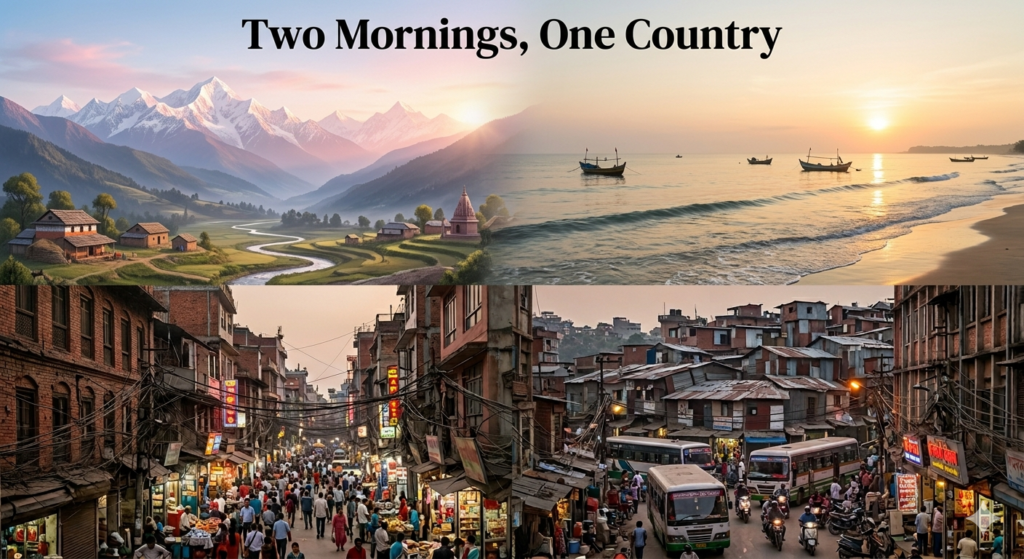
Understanding Urbanization Beyond Numbers:-
Urbanization is often explained as an increase in the urban population, but in reality, it is a deeper social and economic change. It reflects the shift from agriculture-based livelihoods to industry and service-based work.
People move to cities because they want better opportunities. Villages may not provide enough income, quality education, or healthcare. Cities, on the other hand, promise a better future.
Today, more than one-third of India’s population lives in urban areas, and this share is steadily increasing. However, cities are not expanding in a planned manner. They are growing faster than their ability to provide basic services.
When Growth Becomes a Burden???
Urban growth becomes a problem when it is not supported by proper planning.
Take the example of housing. As more people come to cities, the demand for houses increases. But since affordable housing is limited, many people end up living in slums or informal settlements. These areas often lack clean water, sanitation, and proper electricity.
Transport is another major issue. A person may spend two to three hours daily just traveling to work. This not only wastes time but also reduces productivity and increases stress.
Water shortages are becoming common in many cities, especially during summer. People depend on private tankers, which increases their expenses.
Pollution is another serious concern. Air quality in cities is deteriorating due to vehicles, industries, and construction activities. Waste management systems are often unable to handle the growing amount of garbage.
These problems show that urbanization without planning leads to pressure on resources and a decline in the quality of life.
The Idea of Smart Cities:- (A Practical Approach)
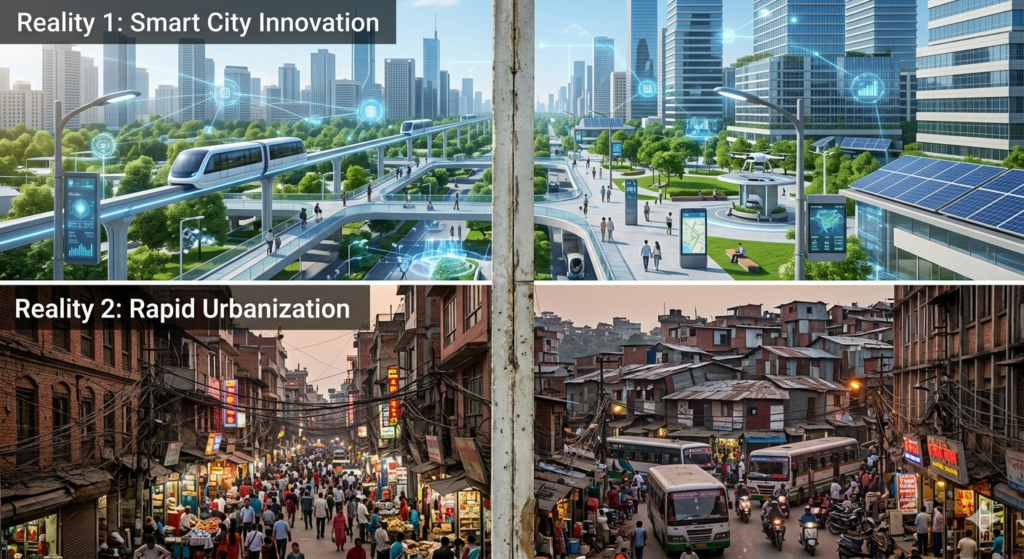
A smart city is not just a city with advanced technology. It is a city that works efficiently and responds to the needs of its people.
The idea is simple. A person living in a smart city should not struggle for basic needs. Water should be available, transport should be reliable, and public spaces should be clean and safe.
Technology supports this process, but it is not the main goal. The main focus is on improving daily life.
What Makes a City Smart in Real Life???
To understand smart cities better, it is useful to look at practical situations.
In a smart city, public transport is reliable. Buses and metro systems are well-connected, reducing the need for private vehicles. This helps in reducing traffic and pollution.
Waste is collected regularly and managed properly. Segregation and recycling become part of daily life, making the city cleaner.
Water supply systems are efficient. Leakages are minimized, and water is distributed fairly.
Government services are easily accessible. A person can register complaints or apply for services without unnecessary delays.
Safety is also improved through better lighting, surveillance, and quick response systems.
All these changes may look simple, but together they make a big difference in the quality of life.
India’s Experience with Smart Cities:-
India has taken steps to improve urban areas through planned initiatives. Many cities have started working on better infrastructure and service delivery.
Some cities have improved their waste management systems. Others have focused on redesigning roads and public spaces. Digital platforms are being used to make governance faster and more transparent.
However, the progress is uneven. Some parts of cities have improved significantly, while others still struggle with basic problems. This shows that development needs to be more inclusive.
Smart city development should not create islands of development. It should benefit all sections of society.
Role of Technology:- (A Supporting Tool)
Technology can make urban systems more efficient when used properly.
For example, traffic signals can be adjusted based on real-time conditions to reduce congestion. Online systems can help people access services without visiting government offices.
Sensors can detect problems in water supply or electricity systems, allowing quick action.
However, it is important to remember that not everyone is comfortable with digital technology. Therefore, systems should be designed in a way that they are easy to use for all citizens.
Urbanization and Economic Growth:-
Cities are the centers of economic activity. They generate a large share of income and provide employment opportunities.
Industries, businesses, and services are concentrated in urban areas because of better infrastructure and connectivity. This leads to higher productivity and economic growth.
At the same time, unplanned urbanization can reduce efficiency. Traffic congestion, pollution, and poor infrastructure can slow down economic activities.
Therefore, managing urban growth properly is important for sustaining economic development.
Environmental Impact of Urban Growth:-
Urbanization has a direct impact on the environment. Construction activities reduce green cover, and natural resources are used extensively.
Cities generate a large amount of waste and pollution. Air pollution affects health, while water pollution harms ecosystems.
Many cities are also facing higher temperatures due to excessive construction and lack of green spaces.
Smart cities try to address these issues by promoting sustainable practices. These include better public transport, use of renewable energy, and protection of green areas.
Development should not come at the cost of environmental damage.
Social Inclusion:- (The Real Test of Smartness)
A city cannot be called smart if it only benefits a small section of society.
There should be affordable housing for all. Access to education, healthcare, and basic services should be available to every citizen.
Safety and dignity are equally important. Public spaces should be inclusive and secure.
If the gap between rich and poor continues to grow, the idea of a smart city loses its meaning.
Challenges in Building Smart Cities:-
There are several challenges in achieving the goal of smart cities.
Funding is a major issue, as large-scale projects require significant investment. Coordination between different government departments is often weak, leading to delays.
Planning is sometimes short-term, without considering future needs. Maintenance of infrastructure is also neglected.
These challenges highlight the need for better governance and long-term thinking.
The Way Forward:- (Thinking Before Building)
The future of urban development depends on better planning and execution.
Cities should focus on improving existing systems rather than only building new ones. Small improvements in water supply, transport, and waste management can create a big impact.
Local governments should be empowered to take decisions. Citizen participation should be encouraged, as people understand their problems best.
Sustainability should be at the center of planning. Resources should be used carefully to ensure long-term benefits.
Conclusion:- (One City, Equal Experience)
Let us go back to the two mornings we imagined at the beginning.
The goal of urban development should be to reduce the gap between these two experiences. A city should not offer comfort to one group and struggle to another.
Urbanization is necessary and will continue to grow. The real challenge is to make cities places where everyone can live with dignity, safety, and opportunity.
A truly smart city is not defined by technology or infrastructure alone. It is defined by how equally it serves its people.
If cities are planned with care and managed with responsibility, they can become spaces where growth is not limited to buildings, but reaches every individual who lives in them.