
Introduction:-
If India is growing, it is because its villages are still standing strong. And if villages are standing strong, it is because of farmers. But the truth is, the same farmers who feed the country often struggle to feed their own families properly.
This is where the idea of agriculture reforms becomes important. We often hear about reforms, policies, and schemes, but the real question is — are these changes actually improving farmers’ income???
Over the last few years, many steps have been taken to improve the condition of farmers. Some changes are visible, while some are still in progress. This topic is not just about policies, it is about real lives, real struggles, and real hopes.
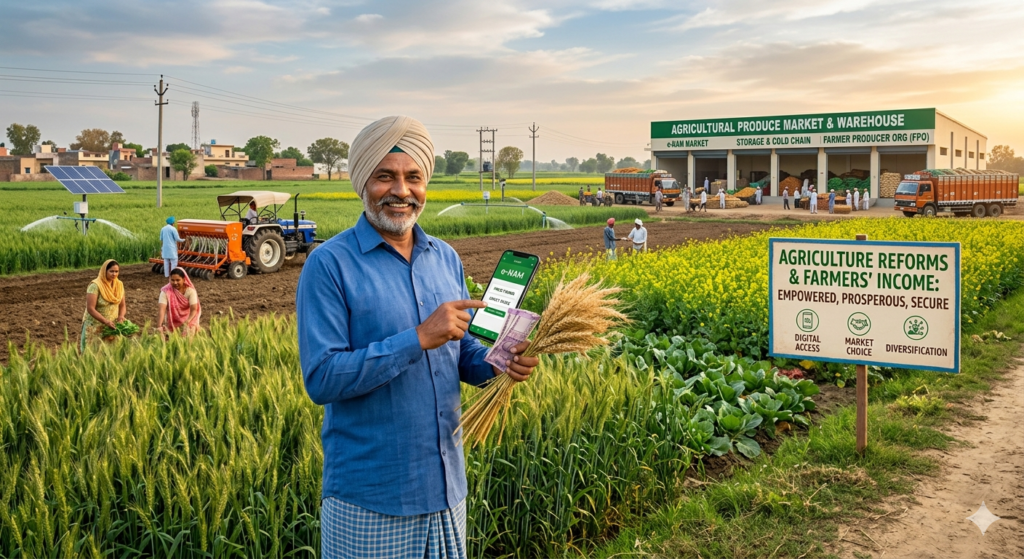
The Reality of Farmers’ Income:-
At first glance, it may seem like agriculture is doing well. Production has increased, and new technologies are being used. But if we look deeper, the situation is still challenging.
Most farmers in India have very small land holdings. With limited land, income also becomes limited. Even if they work hard throughout the year, the earnings are often not enough.
Another major issue is uncertainty. Farming depends heavily on weather. Sometimes there is too much rain, sometimes too little. Either way, crops get damaged and income suffers.
Also, farmers do not always get the right price for their crops. Many times, they are forced to sell at lower prices because they do not have storage facilities or direct access to markets.
Why Agriculture Reforms Were Needed???
These problems did not start recently. They have been there for years. That is why reforms became necessary.
The main goal of agriculture reforms is simple – to make farming profitable and less risky. Farmers should not just produce more, they should also earn more from what they produce.
Reforms are trying to solve multiple problems at once. They focus on increasing productivity, improving market access, reducing costs, and providing financial support.
Improvement in Production:-
One clear change we can see today is the increase in agricultural production. Farmers are now using better seeds, improved fertilizers, and modern machines.
Irrigation facilities have also improved in many areas, which reduces dependence on rainfall. Because of this, overall crop production has increased in recent years.
But here is something important – more production does not always mean more income. If prices are low, farmers still do not benefit much. That is why reforms are also focusing on other areas.
Changing the Way Farmers Sell:-
One of the biggest challenges for farmers has always been the market system. In many cases, farmers depend on middlemen to sell their crops. This reduces their profit.
Reforms are trying to change this system by giving farmers more freedom and better access to buyers. The idea is to create a system where farmers can sell directly and get fair prices.
In some places, digital platforms are also helping farmers connect with buyers. This is a small but important step towards improving income.
Technology is Slowly Entering Fields:-
Earlier, farming was mostly based on traditional knowledge. But now, technology is slowly becoming a part of agriculture.
Farmers are using mobile phones to check weather updates, market prices, and new farming methods. Even simple information like the right time to sow seeds can make a big difference.
In some areas, advanced tools and data are also being used. These changes may look small, but they are helping farmers make better decisions and reduce losses.
Moving Beyond Traditional Crops:-
Another important change is diversification. Earlier, farmers mainly focused on crops like wheat and rice. But now, many are exploring other options.
Fruits, vegetables, dairy, and fisheries are becoming popular. These activities often provide better income compared to traditional crops.
For example, dairy farming gives regular income, while crops are seasonal. This helps farmers maintain financial stability throughout the year.
Government Support Making a Difference:-
In recent years, support for farmers has increased. Financial help, insurance, and easy loans have reduced some pressure.
Direct income support schemes have provided relief to small farmers. Crop insurance has helped in managing losses due to natural disasters.
Efforts are also being made to improve rural infrastructure. Better roads, storage, and transport systems help farmers reduce wastage and reach markets faster.
All these steps may not solve every problem, but they are definitely helping farmers in many ways.
So, Has Income Really Increased????
This is the most important question. The answer is not very simple.
Yes, in many cases, farmers’ income has increased. Those who adopted new techniques, used technology, or shifted to high-value activities have benefited more.
But at the same time, many farmers are still struggling. Small farmers, especially, face difficulties due to lack of resources and awareness.
So, we can say that progress is happening, but it is not equal for everyone.
Challenges That Still Need Attention:-
Even after so many reforms, some challenges continue:-
Small land size limits growth
Weather conditions are becoming more unpredictable
Market prices are still unstable
Cost of farming is rising
Lack of awareness among farmers
These issues show that reforms alone are not enough. Proper implementation and awareness are equally important.
What More Can Be Done???
If we really want to improve farmers’ income, we need to take some strong steps.
First, farmers should get better and direct access to markets. This will help them earn fair prices.
Second, farmers should be encouraged to work in groups. This can reduce costs and increase their strength in the market.
Third, more focus should be given to irrigation so farmers are less dependent on rainfall.
Fourth, food processing industries should be promoted. This will increase the value of agricultural products.
And finally, farmers should be trained in modern techniques so they can improve productivity and income.
The Bigger Impact on Society:-
Agriculture reforms are not just about farmers. They affect the entire country.
When farmers earn more, their families live better. Children get better education, health improves, and rural areas develop.
This also strengthens the economy because agriculture supports many other sectors.
So, improving farmers’ income is not just a rural issue, it is a national priority.
Conclusion:-
Agriculture reforms are slowly changing the situation of farmers in India. There has been progress in production, technology, and support systems.
But the reality is, many farmers are still waiting for a stable and secure income.
The real success of these reforms will be seen only when every farmer feels that farming is not a burden, but a profitable and respected profession.
In simple words, agriculture reforms will truly succeed when farmers no longer struggle for survival, but move forward with confidence and dignity.