
Introduction:-
India is moving fast toward becoming a global manufacturing hub. For many years, the country depended heavily on imports, especially in sectors like electronics and pharmaceuticals. To change this situation, the government introduced the Production Linked Incentive (PLI) Scheme.
This scheme is not just a policy-it is a smart strategy to increase production, create jobs, and attract investment. It focuses on rewarding companies that manufacture more in India. In simple words, more production means more benefits.
Today, the PLI scheme is playing a key role in strengthening India’s economy and making it more self-reliant.
What is the PLI Scheme????
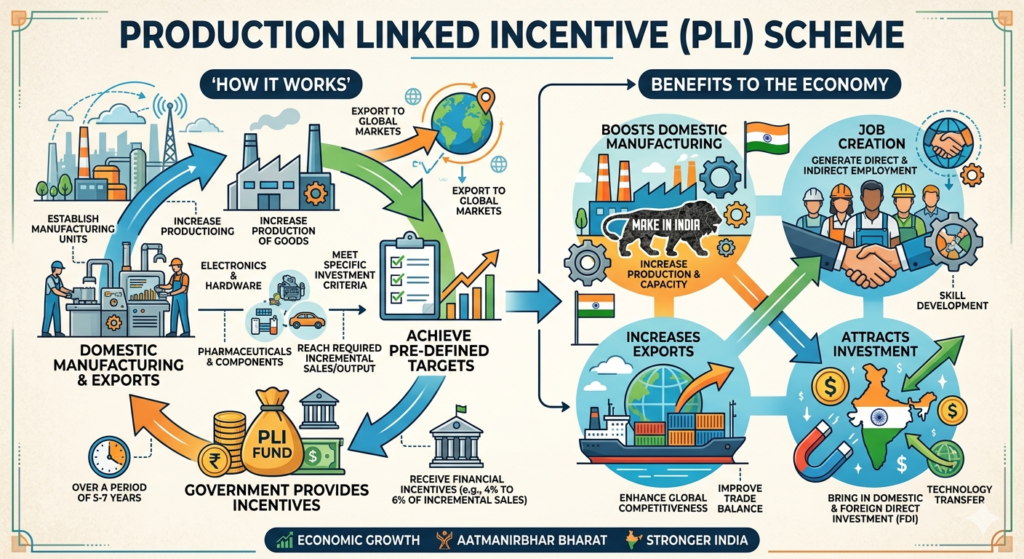
The Production Linked Incentive Scheme is a government program that gives financial rewards to companies based on their production performance. Companies receive incentives only when they achieve higher production and sales targets.
This approach ensures that:-
Companies stay focused on results
Government money is used effectively
Growth happens in a structured way
The scheme encourages both Indian and foreign companies to manufacture in India and expand their operations.
Why was the PLI Scheme Introduced????
Before this scheme, India faced several challenges in manufacturing:-
High dependence on imports
Limited participation in global supply chains
Low manufacturing output compared to other countries
Lack of large-scale industries
The PLI scheme was introduced to solve these problems and make India a strong player in global manufacturing.
Another important reason is the changing global environment. Many companies are now looking for new manufacturing locations, and India wants to take this opportunity.
(Key Features of the PLI Scheme)
1. Performance-Based Incentives:-
Companies get incentives only after achieving production targets. This makes the scheme efficient and result-oriented.
2. Focus on Priority Sectors:-
The scheme covers important sectors like:-
Electronics
Pharmaceuticals
Automobiles
Textiles
Telecom
Renewable energy
These sectors have high potential for growth, exports, and job creation.
3. Time-Bound Benefits:-
The incentives are provided for a limited period. This pushes companies to grow faster and become competitive.
4. Support for Global and Domestic Companies:-
Both Indian and foreign companies can benefit from this scheme, which helps attract investment into India.
(Major Sectors Showing Growth)
Electronics:-
India has seen a sharp rise in mobile phone manufacturing. Many global companies are now producing devices in India, which has also increased exports.
Pharmaceuticals:-
The scheme supports the production of important raw materials and medicines, reducing dependence on imports.
Automobile Sector:-
There is a strong push toward electric vehicles and advanced technology, which is important for the future.
Textiles:-
Focus is on high-value products like technical textiles and man-made fibers.
Renewable Energy:-
The scheme encourages manufacturing of solar panels and batteries, supporting clean energy goals.
(Benefits of the PLI Scheme)
1. Growth in Manufacturing:-
The scheme has increased production capacity across different sectors. New factories are being set up, and existing ones are expanding.
2. Job Creation:-
With more production units, employment opportunities are rising, especially for young people.
3. Increase in Exports:-
Higher production leads to more exports, improving India’s position in global trade.
4. Investment Boost:-
Both domestic and foreign investors are showing interest in India’s manufacturing sector.
5. Move Toward Self-Reliance:-
By producing more goods within the country, India reduces its dependence on imports.
(Current Trends and Progress)
At present, the PLI scheme is showing positive results:-
Manufacturing activity is increasing in many sectors
Mobile phone exports have grown significantly
Investment in new technologies is rising
Focus on green and sustainable industries is increasing
The government is also continuously reviewing the scheme to improve its performance and make it more effective.
(Challenges in Implementation)
Despite its success, the scheme faces some challenges:-
1. Strict Targets:-
Some companies find it difficult to meet production targets in the beginning.
2. Infrastructure Issues:-
In some regions, lack of proper infrastructure can slow down manufacturing growth.
3. Global Competition:-
Other countries are also offering incentives to attract companies.
4. Dependence on Imports:-
Certain industries still depend on imported raw materials, which can affect production.
(Steps Taken to Improve the Scheme)
To overcome these challenges, several efforts are being made:-
Development of better infrastructure
Simplification of rules and processes
Promotion of skill development
Support for innovation and technology
These steps are helping in making the scheme more effective and inclusive.
Future Importance of the PLI Scheme:-
The PLI scheme has a strong role in India’s future growth. It supports the vision of making India a global manufacturing leader.
In the coming years, it can:-
Increase exports significantly
Promote high-tech industries
Strengthen economic stability
Create large-scale employment
It also helps India become more self-reliant and competitive in the global market.
Conclusion:-
The Production Linked Incentive Scheme is a major step toward transforming India’s manufacturing sector. It encourages companies to produce more, invest more, and grow faster.
While challenges exist, the overall impact of the scheme is positive and promising. With continuous improvements and proper implementation, it can become one of the strongest pillars of India’s economic growth.
In simple words, the PLI scheme is not just about incentives-it is about building a stronger, more independent, and future-ready India.