
Introduction:-
In today’s world, if a country wants fast and sustainable growth, manufacturing becomes its strongest foundation. An economy cannot rely only on services or agriculture for long-term stability. Real strength comes when factories are active, production increases, and large-scale employment is created.
Manufacturing growth is not just about producing goods. It is a complete process that generates jobs, increases income, improves technology, and makes a country more self-reliant. That is why today almost every nation is focusing on strengthening its manufacturing sector.
At the global level, major changes are happening. Supply chains are shifting, companies are looking for new production locations, and this is creating a huge opportunity for countries to expand their manufacturing base. With the right approach, manufacturing can take an economy to the next level.
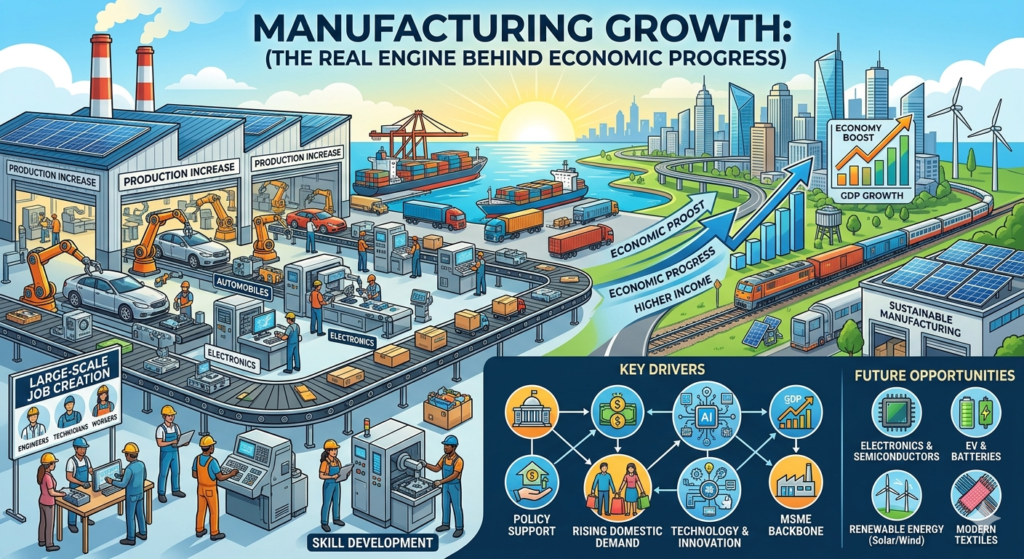
What is Manufacturing Growth
Manufacturing growth simply means an increase in the production of goods such as cars, electronics, machines, textiles, and everyday products. But it is not only about increasing quantity. Improving quality, reducing costs, and increasing efficiency are equally important.
When industries produce more and there is strong demand for their products in the market, the manufacturing sector grows. This growth directly affects the overall economic performance of a country.
Current Position of Manufacturing:-
At present, the manufacturing sector is showing gradual improvement. Industries such as electronics, automobiles, chemicals, and renewable energy equipment are growing at a faster pace.
Manufacturing contributes around 16–17% to the economy, and there is a clear goal to increase this share in the coming years. At the same time, Micro, Small and Medium Enterprises (MSMEs) contribute nearly 30%, highlighting their importance in the sector.
Globally, companies are diversifying their production locations to reduce risks and make supply chains more stable. This trend is creating new opportunities for manufacturing expansion.
Why Manufacturing Growth is Important???
1. Large-Scale Job Creation:-
Manufacturing is one of the biggest sources of employment. It creates jobs for both skilled and unskilled workers, including engineers, technicians, and factory workers.
For example, a single manufacturing unit can generate thousands of direct and indirect jobs in areas like transport, packaging, and services.
2. Faster Economic Growth:-
Higher production leads to higher income and investment. This boosts economic activity and improves living standards.
Manufacturing also creates a multiplier effect, where the growth of one sector leads to the growth of many others.
3. Strong Export Potential:-
A strong manufacturing sector allows a country to produce competitive goods for international markets. This increases exports and helps earn foreign exchange.
For instance, exports of electronics and automobile components have been steadily rising, strengthening economic performance.
4. Support to Other Sectors:-
Manufacturing supports sectors like logistics, transport, banking, and services. This interconnected growth strengthens the overall economy.
Key Drivers of Manufacturing Growth:-
1. Policy Support:-
Reforms and incentives are encouraging industries to expand. Efforts are being made to improve the business environment and attract investment.
2. Rising Domestic Demand:-
As income levels increase, demand for products such as smartphones, vehicles, and household appliances is rising. This pushes industries to produce more.
3. Technology and Innovation:-
Modern technologies like automation, artificial intelligence, and digital systems are improving productivity and efficiency.
For example, smart factories use data and machines to optimize production and reduce errors.
4. Shift in Global Supply Chains:-
Companies are no longer dependent on a single country for production. They are expanding to multiple locations, creating new opportunities for manufacturing growth.
Challenges in Manufacturing Sector::
1. High Production Costs:-
Rising costs of raw materials and energy affect profitability and competitiveness.
2. Skill Gap:-
There is still a shortage of workers trained in modern industrial skills.
3. Infrastructure Issues:-
Problems related to transport, logistics, and power supply can slow down production.
4. Global Competition:-
Manufacturers face tough competition from countries offering low-cost production.
Role of MSMEs:-
MSMEs form the backbone of the manufacturing sector. They contribute significantly to production, employment, and innovation.
For example, small manufacturing units often produce specialized goods and supply them to larger industries or export markets.
However, they need better access to finance, technology, and markets to grow further.
Digital Transformation in Manufacturing:-
Manufacturing is rapidly becoming digital.
Automation increases speed and efficiency
Data helps in better decision-making
Online platforms expand market reach
Smart systems reduce errors
For instance, even small manufacturers can now sell their products globally through digital platforms.
Sustainable Manufacturing:-
The Future Today, the focus is not only on growth but also on sustainability.
Use of renewable energy is increasing
Waste and pollution are being reduced
Recycling and reuse are being promoted
Energy-efficient processes are being adopted
For example, the production of solar panels and electric vehicles is growing rapidly, supporting environmentally friendly manufacturing.
Manufacturing and Self-Reliance:-
Manufacturing growth is closely linked to self-reliance. When a country produces more goods domestically, it reduces dependence on imports.
This leads to:-
Stronger local industries
More employment opportunities
Greater economic stability
Self-reliance does not mean isolation; it means being strong enough to compete globally.
(Future Opportunities in Manufacturing)
1. Electronics Manufacturing:-
Demand for smartphones, semiconductors, and gadgets is increasing rapidly.
2. Electric Vehicles and Batteries:-
The shift toward clean energy is creating huge opportunities in EV and battery production.
3. Renewable Energy Equipment:-
Solar panels and energy storage systems are becoming major growth areas.
4. Textile Sector Modernization:-
Traditional industries are upgrading with new technology and expanding globally.
What Should Be Done for Faster Growth??
Improve infrastructure such as roads, ports, and electricity
Focus on skill development and training
Provide financial support to MSMEs
Encourage innovation and research
Simplify rules and reduce delays
Conclusion:-
Manufacturing growth is a game changer for any economy. It creates jobs, increases income, and builds a strong and self-reliant nation.
In the current global scenario, manufacturing has become more important than ever. Countries that focus on this sector will lead the future.
With the right mix of policy support, technology, and skilled workforce, manufacturing can drive long-term development and transform the economy.
In simple words, a strong manufacturing sector means a strong and secure future.