
India’s Rising Economic Power:- Why the World Now Sees India as a Global Growth Leader????
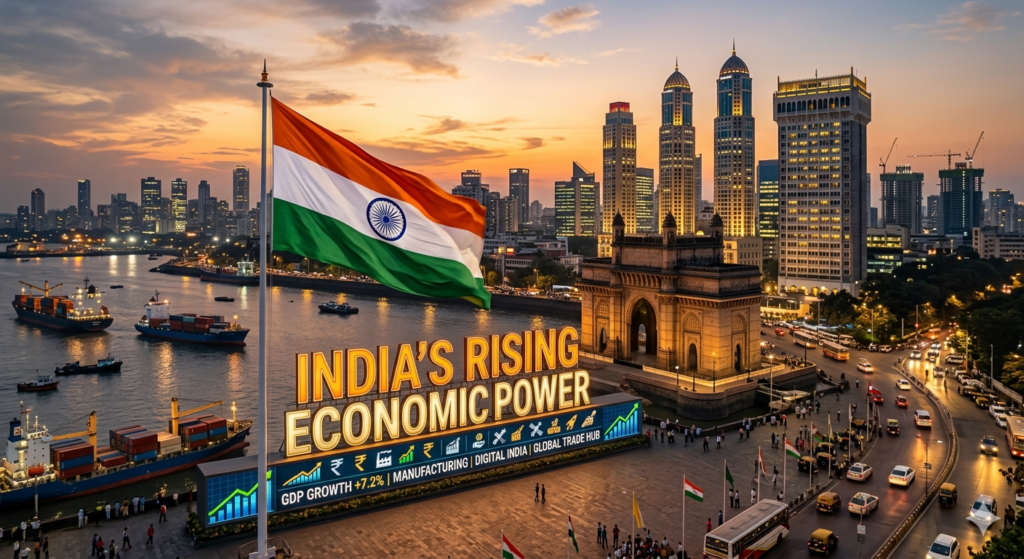
India’s economic journey in the 21st century is one of the most powerful transformations happening in the world right now. A country once known mainly for agriculture and a developing economy is now stepping forward as a major global growth engine. Nations across the world, global investors, and international institutions are all watching India closely—and with deep interest.
But what exactly is driving this rise??? Why is India suddenly becoming a central player in the global economy???? The answer lies in a mix of strong policies, new ideas, young talent, and a new level of confidence shaping the nation’s future.
- India’s Young Population:- (The Biggest Source of Strength)
One of the biggest reasons behind India’s rapid rise is its young population. While many countries face the problem of ageing citizens, India has a large number of people who are young, skilled and ready to work.
More than half of India’s population is below 30.
This means energy, creativity, and a strong workforce.
Young people learn fast and adapt easily to new technology.
This “youth advantage” creates continuous movement in the economy—more startups, more talent for industries, and more demand for products and services. In simple words: India’s youth are not just supporting the economy; they are driving it.
- Digital Transformation:- (India Becoming a Tech-Powered Nation)
In the last few years, India’s digital growth has been extraordinary. Internet access became cheap, smartphones reached every corner, and millions of people started using digital services daily.
India has become a leader in:-
Digital payments.
Online education.
Telemedicine.
Startups.
E-commerce.
Digital governance.
The UPI system alone has changed how money moves in the country. Even small tea stalls and local vendors accept digital payments—something many advanced countries still struggle to achieve.
Digital technology has brought transparency, reduced delays, and made everyday life easier. This shift is one of the main reasons global companies see India as a modern digital economy.
- Reforms That Strengthened India’s Economic Foundation:-
For any nation to grow steadily, it needs strong systems and clear rules. India has introduced several important reforms that have made doing business easier and more predictable.
Some major reforms include:-
GST:- (Created a single national market)
Aadhaar and digital governance:- (Improved transparenc)
Banking reforms & IBC:- (Improved financial health)
FDI liberalisation:- (Made India more open for investment)
These reforms create confidence. When domestic and international investors trust a country’s systems, they bring more money and business into the economy. India’s reforms have successfully sent a message to the world that India is ready for large-scale growth.
- Manufacturing Push:- (India Becoming a Global Factory Hub)
India is emerging as a major manufacturing destination. Global supply chains are shifting, and India is becoming a strong alternative for companies that earlier depended only on China.
The government’s Make in India and PLI schemes have encouraged global brands to build factories here. Today, India is rising in:-
Mobile manufacturing.
Electronics.
Electric vehicles.
Pharmaceuticals.
Automobiles.
Defence production.
Millions of jobs are being created and domestic industries are expanding. This manufacturing growth strengthens India’s economic stability and global presence.
- World-Class Service Sector:- (India’s Identity in the Global Market)
India’s service sector has been the backbone of the economy for many years. IT services, software development, consulting, and financial services have made India a trusted global partner.
Indian tech professionals support industries in the US, Europe, Asia, and the Middle East. Indian IT companies handle critical technology functions for top global corporations.
This sector:-
Creates millions of jobs.
Contributes significantly to GDP.
Strengthens India’s foreign exchange position.
India’s expertise in technology and service delivery has become one of its biggest global competitive strengths.
- Political Stability and Good Governance:-
A stable and democratic political system is crucial for economic growth. India, being the world’s largest democracy, enjoys strong institutions, independent bodies, and a consistent policy environment.
Investors prefer countries where:-
Laws are clear.
Policies do not change suddenly.
Governance is transparent.
Decision-making is steady.
India has shown remarkable policy continuity, even while handling global crises. This creates long-term economic trust and attracts foreign companies.
- India’s Growing Global Influence:-
India’s role in international affairs is growing rapidly. Through global platforms like G20, partnerships with the US, Japan, EU, UAE, and ASEAN countries, India has established itself as a stable and influential power.
India’s global diplomacy helps in:-
Attracting investment.
Strengthening trade partnerships.
Securing technology deals.
Improving energy security.
As India’s voice becomes stronger, its economic power also expands further.
- Infrastructure Growth:- Building the Base for Future India
India is witnessing one of the largest infrastructure expansions in its history. New highways, modern airports, metro systems, renewable energy plants, and faster rail networks are reshaping the country.
Key benefits of strong infrastructure:-
Lower logistics cost.
Faster business operations.
More investment in smaller cities.
Improved connectivity.
Better quality of life.
Infrastructure is the backbone of any growing economy, and India is building that backbone rapidly.
- Startup Boom:- Innovation Becoming India’s New Identity
India’s startup revolution is one of the biggest reasons behind its rising global status. Young entrepreneurs are solving real problems with modern solutions—whether it’s online learning, digital banking, health tech, clean energy, or logistics.
India now has one of the world’s largest startup ecosystems. Government programs like Startup India and Digital India give support, funding, and guidance to new entrepreneurs.
Innovation is not just happening in big cities; it is growing in smaller towns as well. This broad-based creativity is making India a future-ready economy.
- A Large and Expanding Market:-
India’s domestic market is huge—and it keeps growing. Rising incomes, increasing urbanisation, and better lifestyles create strong demand for goods and services.
A large market provides:-
Growth opportunity for global companies.
Stability during global economic slowdowns.
A strong domestic consumption base.
This makes India a self-sustaining economy with high potential.
Way forward:- India’s Rise Is a Story of Vision, Effort, and Possibility
India’s rapid emergence as a major global economy is the result of multiple forces working together—young talent, digital innovation, strong reforms, manufacturing expansion, global diplomacy, and increasing confidence among investors and citizens.
Challenges exist—like unemployment, income inequality, and environmental issues—but India’s long-term direction is clear. The country is building a balanced, modern, and future-ready economic model.
India is not just growing—it is shaping the global economic future.
If this momentum continues, India will stand among the world’s top economic powers in the decades to come.