
India’s GDP Growth Trends:- (A Journey of Resilience, Reforms, and Rising Aspirations)
India’s economic rise is not a simple story of numbers going up or down. It is a story of a nation constantly reinventing itself — sometimes slowly, sometimes rapidly, but always moving forward with determination. As the world’s fifth-largest economy, India’s GDP growth trend reflects its ability to manage internal challenges, respond to global shocks, and harness the potential of its people.
- Why GDP Growth Matters????:- (The Pulse of a Developing Nation)
In a country as diverse and dynamic as India, GDP growth acts like a health indicator. It tells us whether the economy is creating enough jobs, generating income, improving infrastructure, and uplifting living standards.
Strong growth means more opportunities for youth, higher tax revenues for the government, and better public services. Slow growth, on the other hand, puts pressure on employment, welfare schemes, and long-term development goals.
For a nation aiming to become a developed country by 2047, tracking the pattern of GDP growth becomes even more essential.
- India Before Liberalisation:- (A Controlled Economy and Its Limitations)
From independence until the early 1990s, India followed a system dominated by government control. Industries required licenses, trade was restricted, and private sector participation was limited. This phase is often linked with a modest growth rate of 3–4%, which came to be known as the “Hindu Rate of Growth.”
What held growth back in this era????
The License-Permit-Quota Raj slowed industrial expansion.
Imports were restricted and global integration was low.
Technology adoption was sluggish.
Public sector enterprises dominated most sectors.
Still, this period laid strong foundations — banks, educational institutions, heavy industries, scientific research — all of which helped India later accelerate growth.
- The 1991 Economic Reforms:- (India Steps Into a New Era)
The turning point arrived in 1991. A severe Balance of Payments crisis forced India to rethink its economic framework. The government introduced bold reforms like:-
Liberalisation of industries.
Opening up to global trade.
Encouraging private and foreign investment.
Deregulating markets.
Impact of the 1991 reforms.
India transitioned from a closed, controlled economy to a competitive, outward-looking one.
Growth rates jumped significantly, reaching an average of 6–7%, and sometimes even higher.
Reforms unleashed:-
The IT revolution.
Private sector dynamism.
Better inflow of capital.
Rapid urbanisation.
A larger middle class.
This period reshaped India’s growth trajectory for decades to come.
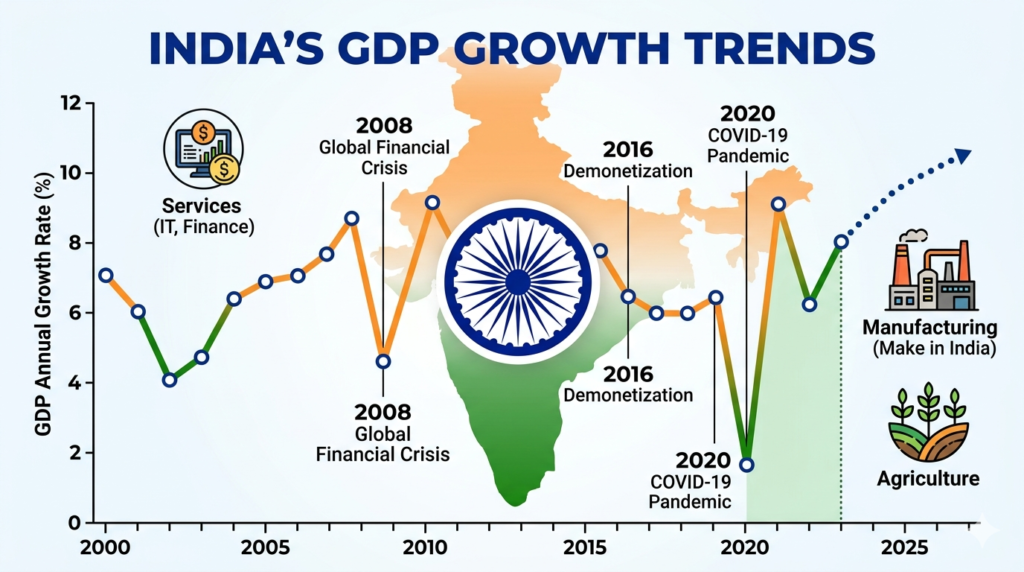
- 2003–2011:- (The Phase of Extraordinary High Growth)
The early 2000s marked perhaps the most vibrant chapter in India’s growth story.
GDP growth consistently touched 8–9%, making India one of the world’s fastest-growing major economies.
Why this era was special?????
Global trade was booming.
Corporate investment increased sharply.
IT and services sector expanded at an unmatched pace.
Stable macroeconomic environment.
Young workforce and rising consumption.
Millions of people moved out of poverty during this period, and India gained global confidence as a rising economic power.
- 2011–2014:- (Growth Moderation and Structural Challenges)
After years of high growth, the economy entered a correction phase. Several domestic and global factors slowed momentum.
Key reasons for the slowdown.
Aftershocks of the global financial crisis.
Weak export demand.
Stressed banking sector and rising NPAs.
Delay in major investment projects.
Policy bottlenecks.
Growth fell to around 5–6%, but India still remained one of the most promising emerging markets.
This phase highlighted the need for stronger reforms in infrastructure, banking, labour, and taxation.
- 2014–2020:- (Reforms to Strengthen Long-Term Growth)
From 2014 onwards, India introduced several structural reforms aimed at improving economic foundations rather than short-term growth alone.
Major reforms shaping GDP trends:-
Goods and Services Tax (GST) created a single national market.
Insolvency and Bankruptcy Code (IBC) improved resolution of stressed assets.
Digital India expanded digital access and payments.
Make in India tried to boost manufacturing.
AM trinity (Jan Dhan–Aadhaar–Mobile) improved welfare delivery.
Corporate tax cuts made India more investment-friendly.
These reforms brought initial disruptions but strengthened India’s long-term growth potential.
- COVID-19 and the Unavoidable GDP Contraction:-
The pandemic brought an unexpected shock to the world economy. India, too, faced a steep GDP contraction of around –7%.
The lockdowns halted businesses, affected supply chains, and hit small enterprises hard.
But India’s response was quick and targeted
Massive vaccination drive.
Emergency welfare schemes.
Support for MSMEs.
Push for self-reliance through the Atmanirbhar Bharat program.
Faster digital adoption.
This prepared the ground for a stronger rebound once restrictions eased.
- Post-Pandemic Revival:- (India Reclaims the Fastest-Growing Tag)
Once the economy reopened, India bounced back faster than many global economies.
Growth surged to 7–8% in multiple quarters.
Drivers of the strong recovery.
High government spending on infrastructure.
Services sector boom.
Increased use of digital payments and technology.
Manufacturing incentives through PLI.
Recovery in consumer demand.
Growing foreign investment interest.
India’s macroeconomic stability — high forex reserves, controlled inflation, stable banking sector — further supported growth.
- The Changing Shape of India’s GDP:- Services Lead, Manufacturing Rises
India has a distinct growth pattern where the services sector has grown faster than industry.
Services Sector-Contributes more than half of India’s GDP.
IT/ITeS make India a global digital powerhouse.
Financial services, telecom, healthcare, and education expanding rapidly.
Industrial Sector.
Now gaining momentum due to PLI schemes.
Focus on electronics, defence, semiconductors, EVs.
(Aim to increase manufacturing share in GDP)
Agriculture.
Stable growth but lower contribution to GDP.
Supports the largest share of workforce.
Increasing technology, irrigation, and storage facilities are boosting productivity.
Sectoral shifts reflect India’s journey from a primarily agrarian economy to a modern, service-led one.
- Current Decade Trends:- India at the Centre of Global Attention
The 2020s have positioned India as a key player in the global economy.
Major trends defining India’s growth path:-
Digital transformation through UPI, ONDC, AI, cloud services.
Infrastructure upgrade: high-speed highways, modern railways, better logistics.
Manufacturing push to become a global supply-chain alternative.
Start-up ecosystem making India a global innovation hub.
Demographic advantage with a young, skilled workforce.
These trends indicate strong potential for sustained, high-quality growth.
- Challenges:- (India Must Address for Consistent Growth)
Despite solid economic momentum, several structural challenges remain:-
Creating enough jobs for the young population.
Improving skill training for modern industries.
Reducing regional growth imbalances.
Strengthening the judiciary and contract enforcement.
Lowering import dependence in critical sectors.
Managing climate-related risks in agriculture.
Ensuring inclusive growth for rural and semi-urban areas.
Addressing these issues will ensure that growth remains stable and broad-based.
- Possibilities:- (India’s Path to Becoming a Developed Economy)
Most global institutions agree that India will continue to grow faster than many large economies in the coming decades.
Reasons for optimism.
Expanding middle class.
Strong domestic consumption.
Rapid digital adoption.
Rising global interest in India as an investment destination.
Government’s long-term focus on infrastructure and manufacturing.
With consistent growth above 7%, India can move steadily toward becoming:-
A $5 trillion economy.
A global manufacturing and innovation hub.
A country with stronger social development indicators.
Way forward:- (India’s Growth Story Is Still Being Written)
India’s GDP growth trend is a reflection of its character — resilient, adaptable, and forward-looking.
From slow early growth to post-reform acceleration, from crisis-driven contractions to strong recoveries, the Indian economy has always found its way forward.
Today, India stands at a historic moment. With its demographic strength, digital innovation, and deep structural reforms, the country has the opportunity to shape one of the most remarkable growth stories of the 21st century.
The journey is ongoing, the challenges are real, but the direction is promising — and the world is watching.