
Sectors That Drive India’s Growth
India is moving ahead on the path of rapid economic growth. From villages to cities, from farms to factories, and from small shops to global companies, the Indian economy is changing fast. This growth is not driven by one single factor. It is the result of the combined efforts of several important sectors of the economy.
Each sector has its own role. Some provide food, some create jobs, some bring technology, while others build roads and power plants. Together, these sectors shape India’s present and future. Understanding these growth-driving sectors helps us understand why India is emerging as a major global economy.
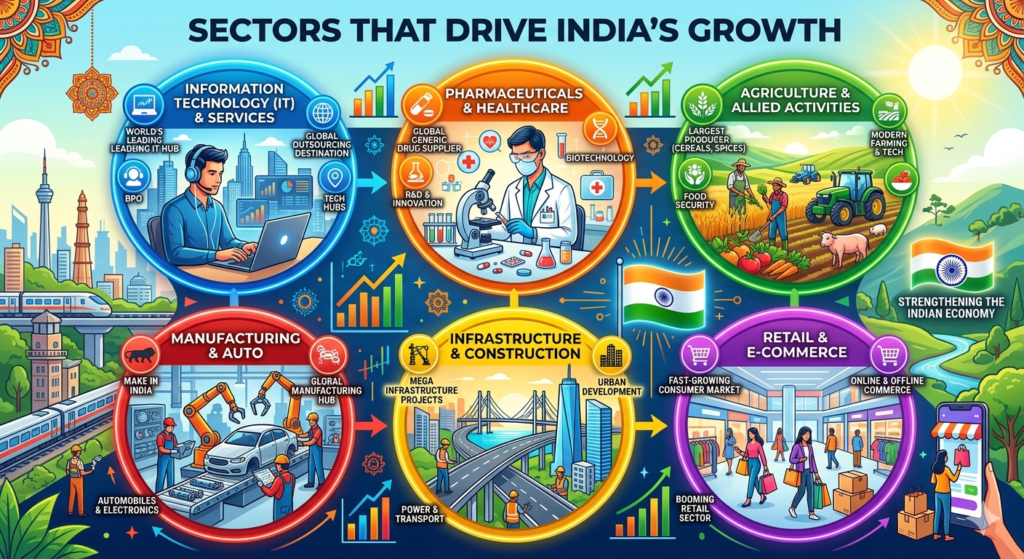
- Agriculture:- (The Strong Base of Indian Growth) Agriculture is the backbone of the Indian economy. Even today, a large part of India’s population depends on farming and related activities for their livelihood.
This sector ensures food security for more than a billion people. It also supplies raw materials to industries like textiles, sugar, food processing, and dairy. Crops such as rice, wheat, pulses, cotton, and sugarcane form the foundation of rural income.
In recent years, agriculture has become more modern. Use of better seeds, improved irrigation, soil testing, crop insurance, and digital platforms has increased productivity. Government schemes focused on farmers’ welfare have improved income stability.
Agriculture supports rural employment, reduces poverty, and balances regional development. Without a strong agriculture sector, overall economic growth cannot be sustainable.
- Manufacturing Sector:- (Turning Potential into Production)
The manufacturing sector plays a vital role in converting raw materials into finished goods. It adds value to natural resources and creates large-scale employment opportunities.
India is focusing on strengthening its manufacturing base to reduce import dependence and increase exports. Industries such as automobiles, electronics, pharmaceuticals, chemicals, textiles, and defence manufacturing are expanding.
Manufacturing supports both skilled and unskilled workers. It also promotes the growth of small industries and local businesses. When manufacturing grows, it increases income, boosts exports, and improves the country’s trade balance.
A strong manufacturing sector is essential for making India a self-reliant and globally competitive economy.
- Services Sector:- (The Largest Contributor to Growth)
The services sector is the biggest contributor to India’s Gross Domestic Product (GDP). It includes areas such as information technology, banking, education, healthcare, tourism, transport, media, and communication.
India’s IT and software services are known worldwide. They generate foreign exchange and create high-quality jobs for millions of young people. Banking and financial services support investment, savings, and business activities.
Education and healthcare improve the quality of human resources. Tourism creates employment and promotes cultural exchange. With rising digitalisation, the services sector continues to expand rapidly.
This sector reflects India’s strength in knowledge, skills, and innovation, making it a key driver of economic growth.
- Infrastructure Sector:- (Laying the Path for Development)
Infrastructure is the backbone of economic growth. Roads, railways, ports, airports, power supply, water systems, and digital connectivity are essential for development.
India has made large investments in highways, expressways, metro rail systems, ports, and airports. Improved infrastructure reduces transportation costs, saves time, and increases efficiency for businesses.
Reliable power supply supports industries, while digital infrastructure enables online services and e-governance. Good infrastructure attracts foreign investment and improves ease of doing business.
Without strong infrastructure, growth in other sectors cannot be sustained. Hence, infrastructure acts as a growth multiplier for the entire economy.
- MSME Sector:- (Supporting Inclusive Growth)
Micro, Small, and Medium Enterprises (MSMEs) are the backbone of India’s grassroots economy. They provide employment to millions of people, especially in rural and semi-urban areas.
MSMEs contribute significantly to manufacturing output and exports. They promote entrepreneurship, innovation, and local production. Many traditional industries such as handicrafts, textiles, and food processing depend on this sector.
Support in the form of easy credit, digital platforms, skill training, and market access has strengthened MSMEs. By creating local jobs, this sector reduces migration and regional inequality.
MSMEs ensure that economic growth reaches the common people, making development more inclusive.
- Digital Economy and Technology:- (A New Growth Engine)
Technology and digitalisation are transforming India’s economy. Digital payments, online shopping, e-learning, telemedicine, and e-governance have become part of daily life.
India has one of the largest digital user bases in the world. Start-ups in areas like fintech, health-tech, ed-tech, and artificial intelligence are growing rapidly. Digital platforms have increased transparency and efficiency.
Technology reduces costs, improves productivity, and connects businesses to global markets. It also creates new job opportunities for youth.
The digital economy is shaping the future of India and acting as a powerful driver of long-term growth.
- Energy Sector:- (Powering Economic Progress)
Energy is essential for development. Industries, transport, homes, and services all depend on reliable energy supply.
India is focusing on energy security through a mix of traditional and renewable sources. Coal, oil, and gas continue to play a role, while solar and wind energy are expanding rapidly.
Renewable energy supports sustainable growth and reduces environmental damage. Affordable and continuous power supply boosts industrial production and improves quality of life.
A strong energy sector ensures stable economic growth and supports India’s commitment to environmental responsibility.
- Human Capital:- (The Real Strength of India)
India’s population is its greatest asset. A young and growing workforce provides a strong base for economic growth.
Investment in education, healthcare, and skill development improves productivity and innovation. Skill training programs help youth become job-ready and industry-oriented.
Healthy and educated citizens contribute more effectively to the economy. Human capital supports all sectors, from agriculture to technology.
Long-term growth is possible only when people are empowered with knowledge, skills, and good health.
- Trade and Export Sector:- (Connecting India with the World)
Trade and exports play an important role in economic growth. India exports goods such as pharmaceuticals, textiles, engineering products, and software services.
Exports bring foreign exchange and strengthen international relations. Improved logistics, quality standards, and trade agreements have supported export growth.
A strong export sector increases global competitiveness and creates employment. It also helps Indian businesses expand beyond domestic markets.
Way forward:- (A Balanced Growth Story)
India’s growth is driven by multiple sectors working together. Agriculture provides stability, manufacturing creates value, services lead innovation, infrastructure supports progress, MSMEs promote inclusion, technology shapes the future, energy powers development, and human capital strengthens the foundation.
No single sector can drive growth alone. Balanced and coordinated development of all sectors is essential. This integrated approach will help India achieve sustainable, inclusive, and long-term economic growth.
As these sectors continue to evolve, India is steadily moving towards becoming a strong, self-reliant, and globally influential economy