
Privatisation in India:- A Step Towards Growth or a Cause of Concern
Introduction:-
India is growing and changing at a fast pace. New technologies, better infrastructure, and improved services are becoming part of daily life. One important factor behind this transformation is privatisation.
Privatisation means transferring ownership or management of government-run companies and services to private businesses. In India, this process started gaining importance after the economic reforms of 1991. Since then, many sectors like telecom, airlines, banking, and infrastructure have seen private participation.
While privatisation has helped improve efficiency and quality, it has also raised concerns about inequality and job security. To understand its real impact, it is important to look at both its advantages and disadvantages.
Why Privatisation is Growing in India???
Earlier, most industries in India were controlled by the government. However, many public sector companies faced problems like low efficiency, slow decision-making, and financial losses.
Managing a large number of industries was difficult for the government alone. To solve this, private companies were allowed to enter different sectors. The goal was to improve performance, reduce financial burden, and bring innovation.
Today, privatisation is seen as a key strategy to boost economic growth and development.
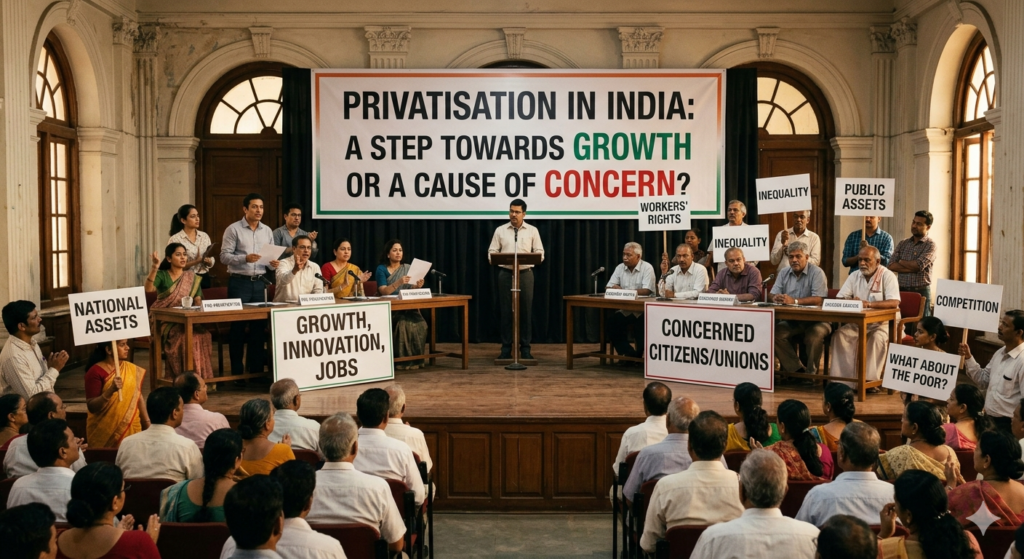
Advantages of Privatisation
1. Better Efficiency and Faster Work:-
Private companies usually work with clear goals and strong management systems. They focus on results and try to complete tasks on time.
Unlike many government systems where delays are common, private firms aim for speed and efficiency. This improves overall performance and productivity.
2. Improved Quality of Services:-
One of the biggest benefits of privatisation is better service quality. Private companies compete with each other to attract customers, so they focus on providing good services.
For example, faster internet, better airline services, and improved customer support are results of increased private participation.
3. Use of Modern Technology:-
Private companies invest more in technology and innovation. They use advanced machines, digital systems, and new ideas to improve their services.
This leads to faster processes, better communication, and more convenience for users.
4. Reduced Burden on Government:-
Running public sector companies requires a large amount of money. When these companies are privatized, the government can reduce its expenses.
This allows the government to focus on important sectors like education, healthcare, and social welfare.
5. Increased Competition:-
Privatisation brings competition into the market. When multiple companies provide the same services, they try to offer better quality at reasonable prices.
This benefits customers by giving them more choices and better value for money.
6. Economic Growth and Investment:-
Private sector involvement attracts both domestic and foreign investment. This helps in the development of new industries and expansion of existing ones.
As a result, the economy grows stronger and creates more opportunities.
Disadvantages of Privatisation
1. Job Insecurity:-
One major drawback of privatisation is the risk of job loss. Private companies often reduce staff to cut costs and improve efficiency.
Employees in private firms may not have the same level of job security as those in government jobs.
2. Higher Prices for Services:-
Private companies aim to make profit. In some cases, this leads to an increase in the cost of services.
Essential services like transportation, electricity, or healthcare may become expensive for common people.
3. Focus on Profit Over Public Welfare:-
Government services are mainly meant for public welfare, but private companies focus on earning profits.
This may result in neglect of less profitable areas, especially rural or low-income regions.
4. Growing Inequality:-
Privatisation can increase the gap between rich and poor. People who can afford private services get better facilities, while others may struggle.
This creates unequal access to important services.
5. Risk of Monopoly:-
If only a few companies dominate a sector, competition decreases. This can lead to monopoly, where companies control prices and services.
In such situations, customers may not have many options.
6. Reduced Government Control:-
When services are privatized, government control becomes limited. This can be risky in sectors that are important for national interest.
Too much dependence on private companies may create long-term challenges.
Current Scenario in India:-
In recent years, India has taken several steps toward privatisation. Many public sector units have been opened to private investment or partially sold.
Sectors like airports, railways, and banking are seeing increased private participation. At the same time, there is ongoing debate among people.
Some believe privatisation is necessary for growth, while others worry about its impact on jobs and affordability. The focus now is on finding a balanced approach.
The Need for a Balanced Approach:-
Privatisation is neither completely good nor completely bad. Its success depends on how it is implemented.
The government must ensure that:-
Workers’ rights are protected
Essential services remain affordable
Monopoly is avoided
Services reach all sections of society
Proper rules and regulations are followed
A balanced strategy can help India gain the benefits of privatisation while reducing its negative effects.
Conclusion:-
Privatisation has become an important part of India’s economic journey. It has improved efficiency, introduced modern technology, and supported economic growth.
At the same time, it has also created challenges like job insecurity, rising costs, and inequality.
Instead of fully supporting or opposing it, the focus should be on careful planning and proper regulation. If managed wisely, privatisation can help India grow faster while ensuring that development benefits everyone.