
1. A Decision Taken Far Away, Effects Felt at Home:-
When the US Federal Reserve announces a policy decision, it happens thousands of kilometers away from India. Yet, within hours, Indian stock markets react, the rupee shows movement, and economic discussions heat up. This is not coincidence. It reflects how deeply connected India has become with the global financial system.
In today’s world, economic borders are porous. A major decision taken by the world’s most influential central bank naturally sends ripples across emerging economies like India.
2. The Federal Reserve:-( More Than Just America’s Central Bank)
The US Federal Reserve was created to manage inflation, employment, and financial stability in the United States. However, because the US dollar dominates global trade and finance, Fed decisions act like global signals.
Whether it is an interest rate hike, a pause, or a future policy hint, global investors read these signals carefully. For India, these signals often influence investment flows, currency stability, and overall financial confidence.
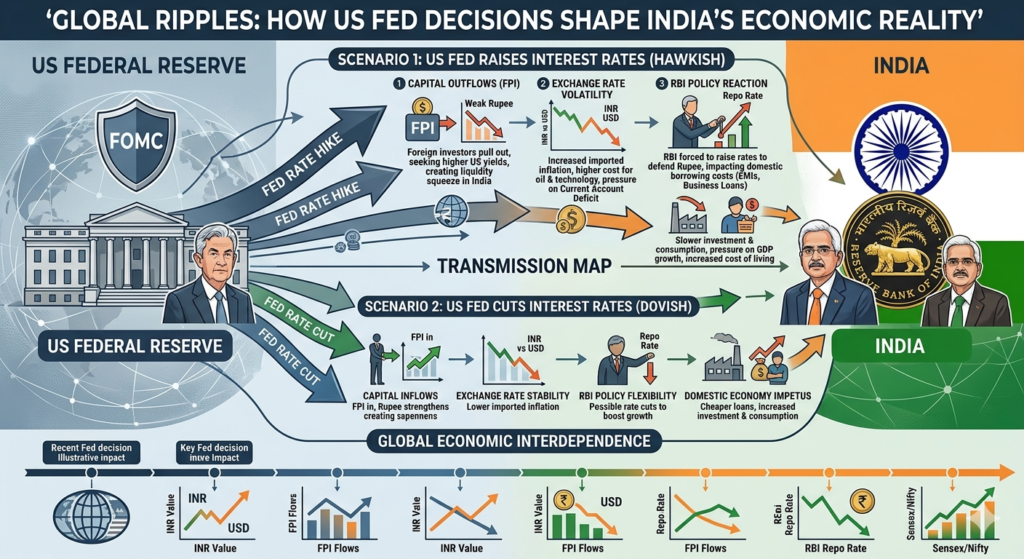
3. Interest Rates and the Global Money Movement:-
One of the strongest channels through which the Fed affects India is capital flow.
When the Fed raises interest rates, investing in US financial assets becomes more attractive. Investors prefer safety combined with higher returns. As a result, funds often move out of emerging markets and return to the US.
For India, mean:-
Sudden withdrawal of foreign investment
Pressure on stock and bond markets
Increased market uncertainty
Conversely, when the Fed adopts a softer stance, global investors search for higher growth opportunities, and India becomes a preferred destination.
4. The Dollar–Rupee Connection:-
Fed policy directly affects the strength of the US dollar. A tighter monetary policy usually strengthens the dollar. When this happens, the Indian rupee often weakens.
A weaker rupee brings mixed outcomes:-
Imported goods become more expensive
Fuel and raw material costs rise
Exporters gain price advantage
While exporters may benefit in the short term, the broader economy faces inflationary pressure, especially because India depends heavily on imports for energy needs.
5. Inflation Travels Without a Passport:-
Inflation is no longer a purely domestic issue. When the Fed tightens policy due to inflationary pressures in the US, the resulting dollar strength increases import costs for India.
impacts:-
Fuel prices
Transportation costs
Daily consumer goods
Even if domestic demand remains stable, external price shocks can raise inflation levels, forcing policymakers to respond carefully.
6. RBI’s Tightrope Walk in a Globalized World:-
The Reserve Bank of India designs its policies based on domestic growth and inflation. However, ignoring global monetary conditions is not an option.
Sharp Fed tightening creates challenges:-
Maintaining currency stability
Preventing excessive capital outflow
Balancing growth with inflation control
The RBI often faces a difficult balancing act—protecting India’s economy without unnecessarily slowing down growth. This reflects the reality of economic interdependence rather than policy weakness.
7. Impact on Borrowing and Investment:-
Fed decisions influence global interest rates. When global rates rise, borrowing becomes costlier.
In India, affects:-
Corporates raising funds from international markets
Infrastructure and long-term projects
Government debt servicing costs indirectly
Higher borrowing costs can delay investment decisions and slow private sector expansion, especially in capital-intensive industries.
8. Stock Markets:-( Sentiment Moves Faster Than Data)
Indian financial markets respond not only to actual Fed decisions but also to expectations and future guidance.
Even hints of prolonged tightening can lead to:-
Market volatility
Risk-averse investor behavior
Sector-specific corrections
Sectors closely linked to global demand or foreign investment tend to react more sharply. However, India’s strong domestic participation often provides stability during turbulent phases.
9. Trade Channel:- When Global Growth Slows, Exports Feel the Heat:-
A tight Fed policy can slow down economic activity in the US. Since the US is a major market for Indian exports, reduced demand affects several sectors.
These include:-
Information technology services
Pharmaceuticals
Engineering and manufactured goods
A slowdown in advanced economies indirectly affects employment and income generation in export-linked sectors within India.
10. India’s Growing Ability to Absorb Global Shocks:-
Compared to earlier decades, India is better prepared today. Several structural improvements act as buffers:-
Strong foreign exchange reserves
A more diversified export basket
A large domestic consumer base
Improved banking and regulatory systems
These strengths allow India to handle external pressures with greater confidence and stability.
11. Turning Global Pressure into Long-Term Opportunity:-
Interestingly, prolonged tightening in developed economies can create new opportunities for India. Global companies seek cost-effective, stable, and growth-oriented markets.
India’s advantages include:-
Young and skilled workforce
Expanding infrastructure
Large internal market.
Periods of global uncertainty often push countries like India to accelerate reforms and strengthen institutions.
12. Conclusion:-
( Influence Without Dependence)
US Federal Reserve decisions clearly influence India’s economy through capital flows, currency movement, inflation, and financial markets. However, influence does not mean control.
India today is not a passive observer. With improved policy frameworks, institutional maturity, and economic depth, it actively manages global spillovers. The relationship with the Fed reflects global interconnectedness rather than vulnerability.
The real challenge lies in remaining alert, flexible, and forward-looking in a world where economic decisions travel faster than ever.