
1. Introduction:-
In an increasingly interconnected global economy, international trade acts as a major driver of growth, employment and technological progress. Countries no longer function as isolated economic units; instead, they are deeply integrated through global supply chains and service networks.
In this context, Free Trade Agreements (FTAs) have emerged as powerful instruments to promote trade liberalisation and economic cooperation. In 2025, when supply chain diversification, digital trade and green transitions are reshaping global commerce, FTAs are not merely trade tools but strategic economic frameworks.
2. Meaning and Basic Features of Free Trade Agreements:-
A Free Trade Agreement is a formal arrangement between two or more countries to reduce or eliminate tariffs, quotas and other trade barriers on goods and services traded among them.
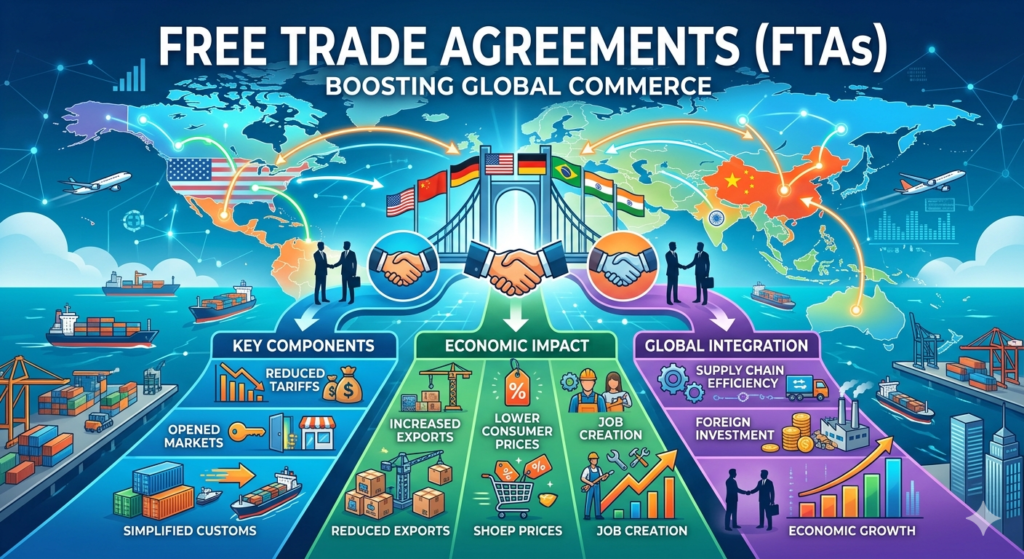
The core objectives include:-
Reduction or elimination of customs duties.
Promotion of service sector access.
Encouragement of cross-border investments.
Establishment of dispute settlement mechanisms.
Inclusion of rules of origin to prevent misuse.
Unlike earlier trade pacts, modern FTAs are comprehensive and extend beyond goods to cover digital trade, intellectual property rights, labour standards and environmental provisions.
3. Global Trade Scenario in 2025:-
The global trade landscape in 2025 reflects cautious recovery and strategic realignment.
Global merchandise trade growth is estimated at around 3–4 percent annually.
Services trade is expanding at a faster pace, particularly in digital services, financial services and professional consulting.
Supply chain resilience has become a priority after earlier global disruptions.
Strategic sectors such as semiconductors, renewable energy components and critical minerals dominate trade negotiations.
Countries are increasingly pursuing “friend-shoring” and diversification strategies to reduce dependency on a single trading partner. FTAs are central to these efforts.
4. Rationale Behind Signing FTAs:-
Countries enter into FTAs for multiple economic and strategic reasons:-
1 Expansion of Export Markets:-
Lower tariffs enhance competitiveness of domestic products in foreign markets.
2 Employment Generation:-
Higher exports stimulate production and create job opportunities across sectors.
3 Attraction of Foreign Direct Investment (FDI):-
Investors prefer economies that provide wider market access through trade agreements.
4 Strengthening Strategic Partnerships:-
Trade agreements often deepen diplomatic ties and geopolitical cooperation.
Thus, FTAs function as instruments of both economic policy and foreign policy.
5. India’s Trade Position in 2025:-
India has adopted a more calibrated and strategic trade policy in recent years.
India’s total merchandise exports remain in the range of several hundred billion US dollars annually.
Services exports, particularly in IT and business services, continue to show strong performance.
India remains among the leading recipients of foreign direct investment among developing economies.
Manufacturing initiatives and production-linked incentives aim to enhance global competitiveness.
India’s renewed focus on FTAs reflects its ambition to integrate into global value chains while protecting vulnerable domestic sectors.
6. Benefits of FTAs for India:-
1 Enhanced Market Access:-
Indian sectors such as pharmaceuticals, textiles, engineering goods and automobiles gain improved access to foreign markets.
2 Growth of Services Sector:-
Provisions on mobility of professionals and digital trade benefit India’s skilled workforce.
3 Integration into Global Value Chains:-
Reduced tariffs on intermediate goods facilitate participation in global production networks.
4 Consumer Welfare:-
Lower import duties reduce prices and increase product variety for consumers.
5 Boost to Investment:-
Trade openness strengthens investor confidence and encourages multinational corporations to establish manufacturing hubs.
7. Concerns and Challenges:-
Despite advantages, FTAs present certain challenges:
1 Trade Deficit Risk:-
If imports grow faster than exports, it may widen the trade deficit.
2 Impact on Small and Medium Enterprises (SMEs):-
Domestic firms may struggle against cheaper imported goods.
3 Agricultural Sensitivity:-
Farmers may face competition from large-scale agricultural exporters.
4 Stringent Quality Standards:-
Developed markets impose strict environmental and technical standards that increase compliance costs.
Therefore, negotiations involve safeguard clauses, phased tariff reductions and sector-specific protections.
8. Free Trade vs Protectionism:- (The Policy Debate)
The debate between free trade and protectionism continues globally.
Free trade enhances efficiency, innovation and global integration.
Protectionism safeguards domestic employment and strategic industries.
In 2025, most economies adopt a balanced approach — promoting trade liberalisation while protecting critical sectors such as food security, defence and emerging technologies.
9. Emerging Dimensions:- Digital and Green Trade
Modern FTAs increasingly incorporate new areas:-
1 Digital Trade:-
Rules related to cross-border data flows, cybersecurity, online consumer protection and e-commerce are becoming standard features.
2 Sustainability and Climate Commitments:-
Trade agreements now include provisions for clean energy cooperation, carbon reduction and sustainable production.
Given India’s expanding digital economy and renewable energy targets, these dimensions are strategically significant.
10. Strategic Importance of FTAs in the Future
The future of FTAs will likely focus on:-
Semiconductor and electronics supply chains.
Renewable energy technologies and green hydrogen.
Critical minerals required for electric vehicles and batteries.
Secure logistics corridors and resilient supply networks.
Trade policy is increasingly aligned with national security and long-term development goals.
11. Way Forward for India:-
For India to maximise benefits from FTAs, certain measures are essential:-
Strengthening domestic manufacturing competitiveness.
Supporting MSMEs through technology upgrades.
Ensuring effective implementation and monitoring of agreements.
Promoting skill development for service sector expansion.
Maintaining a balanced trade strategy to manage deficits.
Careful negotiation and strong domestic reforms are key to success.
12. Conclusion
Free Trade Agreements have become central pillars of the global economic architecture. They reduce trade barriers, expand market access and deepen economic cooperation. However, their success depends on domestic preparedness and strategic negotiation.
For India, FTAs represent an opportunity to position itself as a major player in global value chains while safeguarding national interests. In the evolving global economic order of 2025, balanced and forward-looking trade agreements will shape the trajectory of sustainable growth.