
Introduction:- Infrastructure Is Changing
When we hear the word infrastructure, we normally think about roads, bridges, railways, electricity, water supply and buildings. But today, infrastructure is becoming more than just concrete, steel and wires.
A road can have sensors that help manage traffic. A water network can identify unusual leakage. Streetlights can be controlled according to actual need. Public transport can share real-time information. Electricity systems can track demand more closely.
This is called smart infrastructure.
In simple words, smart infrastructure means using technology and information to make normal infrastructure more efficient, less wasteful and easier to manage.
For India, this is becoming important because the pressure on cities is increasing. According to the Economic Survey 2025-26, India’s towns and cities could be home to about 600 million people by 2036, around 40% of the population. Urban areas are also expected to contribute almost 70% of GDP.
This means that the quality of urban infrastructure will directly affect India’s economic growth.
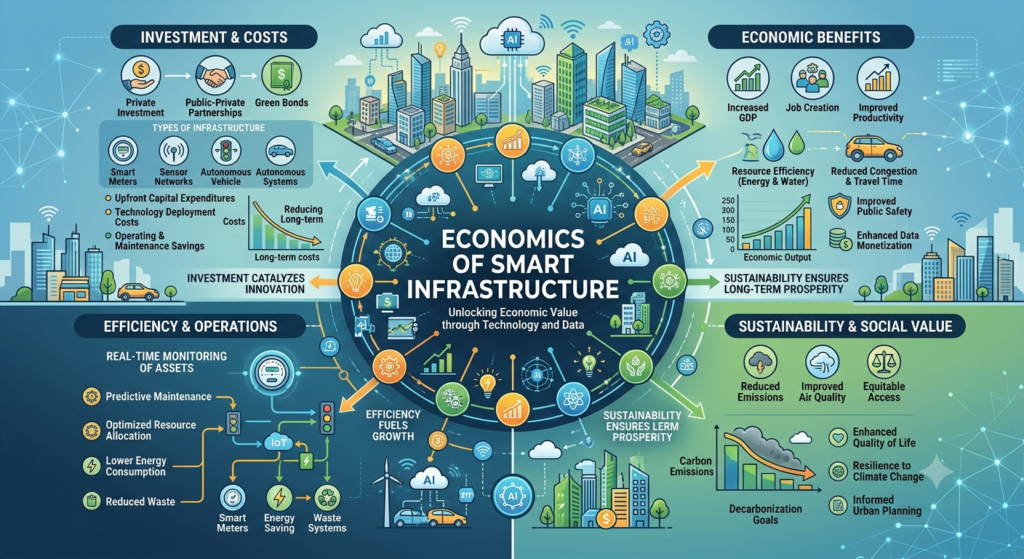
1. The Real Meaning of “Smart”:-
Smart infrastructure does not simply mean putting a camera or sensor everywhere.
It is about connecting infrastructure + technology + information.
For example, take a normal water pipeline.
If a pipe starts leaking underground, people may notice it only when water reaches the surface or the supply falls. By then, a large amount of water may already be lost.
A smarter system can monitor pressure and flow. If something unusual happens, officials can investigate the problem earlier.
The pipe is still the same.
The difference is that the system can understand what is happening.
That is the basic idea behind smart infrastructure.
2. Saving Money by Reducing Waste:-
The first economic benefit is very simple:- smart infrastructure can reduce unnecessary waste.
A city spends money on:-
electricity
water
fuel
road repairs
waste collection
public transport
maintenance
If these resources are poorly managed, public money is wasted.
Smart systems can help identify where the problem is.
For example:-
Water monitoring – early leak detection – less water loss – lower operating cost.
The same thinking can be applied to electricity, transport and waste management.
For a large city, even a small saving repeated every day can become a significant saving over a year.
3. Traffic Is Not Just a Transport Problem:-
A traffic jam also has an economic cost.
Imagine a delivery worker who normally completes ten deliveries in a day. Because of heavy congestion, the worker completes only seven.
The business loses time.
Fuel consumption increases.
Customers wait longer.
The vehicle needs more running and maintenance.
Now imagine this happening to thousands of workers every day.
This is why smart traffic management matters.
Traffic sensors, GPS-based information, better signal timing, intelligent parking and real-time public transport information can help cities use their existing roads better.
Sometimes the answer is not immediately building another road. Sometimes it is managing the existing road more intelligently.
4. A Streetlight Can Teach Us About Economics:-
Consider a street with hundreds of lights.
If every light operates at the same level throughout the night, electricity is being used even when there is very little movement.
A smart lighting system can adjust lighting according to actual conditions.
The saving from one light may look very small.
But multiply that saving by hundreds or thousands of lights and the picture changes.
This is an important economic principle:-
A small saving repeated many times can become a large saving.
Smart infrastructure often works in exactly this way.
5. Better Infrastructure Can Mean Better Productivity:-
Infrastructure affects how quickly people can work.
If a worker spends two hours travelling instead of one, productive time is lost.
If a truck takes longer to reach a market, goods become more expensive to move.
If electricity supply is unreliable, businesses may have to depend on backup systems.
If government services require repeated physical visits, people lose working hours.
Smart infrastructure can reduce some of these hidden costs.
This is why infrastructure is closely connected with productivity.
A better system allows people and businesses to spend more time on useful economic activity.
6. New Technology Also Creates New Jobs:-
Smart infrastructure needs people.
Not only software engineers, but also many other workers are required.
For example:-
technicians to install sensors
engineers to maintain systems
data workers to understand information
cybersecurity professionals
electricians
urban planners
renewable-energy workers
equipment repair workers
Suppose a city introduces smart water meters.
The project creates demand for people who design the system, manufacture or supply equipment, install the meters, manage the data and repair them when required.
So smart infrastructure can create a new employment chain around traditional infrastructure.
India’s Economic Survey 2025-26 notes that the country’s workforce is now above 56 crore, making skill development important for future economic growth.
technology works best when people have the skills to use and maintain it.
7. Small Businesses Can Benefit Too:-
The benefits of smart infrastructure are not limited to large companies.
Imagine a local market with:-
better street lighting
organised parking
cleaner roads
reliable public transport
digital payment facilities
better pedestrian movement
Customers may find it easier to reach the market.
A small shopkeeper can benefit from this improved environment even without owning any advanced technology.
This shows an important point:-
Good infrastructure can improve the business environment around it.
When travelling becomes easier and services become more reliable, economic activity can also become easier.
8. Waste Collection Can Become Smarter:-
Waste collection gives us another simple example.
Suppose a garbage vehicle follows the same route every day, even when some collection points have very little waste.
The vehicle still uses fuel.
The worker still spends time.
The city still pays for maintenance.
A data-based system can help plan routes according to actual requirements.
India has already used technology in areas such as waste management, water supply, transport and urban services under its smart-city programmes. The Economic Survey 2024-25 reported thousands of completed projects covering different parts of urban infrastructure.
Better information can lead to better planning, and better planning can reduce unnecessary expenditure.
9. Smart Infrastructure Can Also Protect Against Climate Damage:-
Today, infrastructure has to deal with more than normal population growth.
Cities also face floods, extreme heat, water stress and other climate-related risks.
Imagine a city where heavy rain regularly causes waterlogging.
Instead of waiting for roads to flood, the city can use water-level monitoring and early-warning systems to identify rising risks.
Similarly, heat-sensitive public spaces, better drainage, energy-efficient buildings and improved water systems can reduce future losses.
This is important because repairing damaged infrastructure can be extremely expensive.
The Economic Survey has highlighted the increasing importance of climate adaptation and resilience for India’s development.
So smart infrastructure is not only about convenience.
It can also be a form of economic protection.
10. The Biggest Problem:- Smart Infrastructure Costs Money
Smart infrastructure has benefits, but there is no free technology.
Sensors cost money.
Software costs money.
Maintenance costs money.
Skilled workers cost money.
Cities therefore have to think carefully before starting a project.
The right question should not be:-
“How much technology can we install?”
It should be:-
“What real problem will this technology solve?”
Buying an expensive system that is rarely used is not smart investment.
A simple system that solves an important problem may be much more valuable.
11. Building It Is Not Enough:-
One common mistake is to think that infrastructure is complete once construction ends.It is not.
A smart system needs regular maintenance.
A sensor can stop working.
Software can become outdated.
Machines can break.
Digital systems can face cyber threats.
Workers may need new training.
Therefore, governments should consider the full life of a project, not just its initial construction cost.
A cheaper project that works for many years may be better than an expensive project that becomes useless after a few years.
12. India Has a Major Financing Challenge:-
Smart infrastructure is part of a much larger urban infrastructure requirement.
Earlier estimates suggested that India would need about $840 billion in urban infrastructure investment over 15 years, around $55 billion per year, to meet the needs of its growing urban population.
This is a huge requirement.
Government spending will remain important, but cities also need stronger municipal finances and greater private participation.
Possible sources of finance include:-
government investment
private investment
public-private partnerships
municipal revenue
infrastructure financing
better property-tax collection
This is why smart infrastructure is not only a technology issue.
It is also a finance and governance issue.
13. A Smart City Must Not Leave People Behind:-
Technology can make life easier, but it can also create problems if everyone cannot access it.
Suppose a public service is available only through a smartphone app.
For a digitally comfortable person, this may be convenient.
But someone without a good phone, internet connection or digital skills may face difficulty.
Therefore, smart infrastructure should be:-
affordable
accessible
simple
inclusive
available with human support when needed
A city is not truly smart if its technology works well only for a section of society.
14. Data Is Becoming Part of Infrastructure:-
There was a time when cities mainly worried about roads, electricity and water.
Now they also have to manage data.
Traffic systems produce data.
Public transport produces data.
Electricity networks produce data.
Water systems produce data.
This information can help governments understand what is happening in a city.
But it also creates responsibilities.
Cities need to think about:-
data security
privacy
cybersecurity
safe storage
responsible use of information
So in the future, managing data may become as important as managing roads and pipelines.
15. India Should Build “Useful Smart”:- Infrastructure
India does not need every city to look like a science-fiction movie.
The focus should be on solving everyday problems.
For one city, the biggest problem may be water leakage.
For another, it may be traffic.
For another, it may be flooding.
For another, it may be electricity wastage.
The smart solution should depend on the problem.
A useful approach can be:-
Find the problem -collect the right information – choose the simplest useful technology – measure the result – improve the system.
This can make smart infrastructure more practical and less expensive.
16. What Would a Truly Smart City Look Like????
A truly smart city may not look futuristic at all.
It could simply be a place where:+
buses are easier to track,
water losses are detected earlier,
streetlights use electricity more carefully,
garbage collection follows better routes,
traffic signals respond to actual traffic,
flood warnings reach people on time,
public services require fewer unnecessary visits,
roads are repaired before small problems become major ones.
In short:-
A smart city is not the city with the most technology. It is the city where technology quietly makes everyday life easier.
17.The Bigger Economic Picture:-
The economics of smart infrastructure can be understood through one simple chain:
Better information – better decisions – less waste – lower costs – higher productivity – better services – stronger economic activity.
But this chain works only when technology is properly planned, financed and maintained.
India’s urban future makes this especially important. By 2036, about 600 million people are expected to live in urban areas, and cities are projected to play an even larger role in the economy.
At the same time, Indian cities face problems such as limited municipal revenue, infrastructure gaps and growing demand for better public services. The Economic Survey 2025-26 notes that Indian cities raise less than 0.6% of GDP in their own-source revenues, showing why city finances need serious attention.
So the future of smart infrastructure will depend on three things:-
good technology + good financing + good governance.
18.Conclusion:- The Smartest City Is the One That Works Well
Smart infrastructure should not be judged by the number of sensors, cameras or digital screens installed in a city.
Its real value is much simpler.
Does it save water?
Does it reduce wasted electricity?
Does it save people’s time?
Does it reduce business costs?
Does it protect infrastructure from climate risks?
Does it make public services easier?
If the answer is yes, then technology is doing its real job.
India does not simply need smart-looking cities.
It needs cities that work smarter every day.
The best smart infrastructure may not even be noticed by people. A water leak gets repaired before anyone sees it. A traffic signal changes at the right time. A garbage vehicle takes a shorter route. A flood warning arrives before the water reaches the road.
That is the real economic value of smart infrastructure:-
less waste, lower cost, better services and more productive lives.