
Introduction : -Why BRICS Cannot Be Ignored
The global economy is no longer controlled by only a few powerful Western nations. Over time, many developing countries have grown strong enough to influence global trade, investment, and policy decisions. Among them, the BRICS group has emerged as a major economic force.
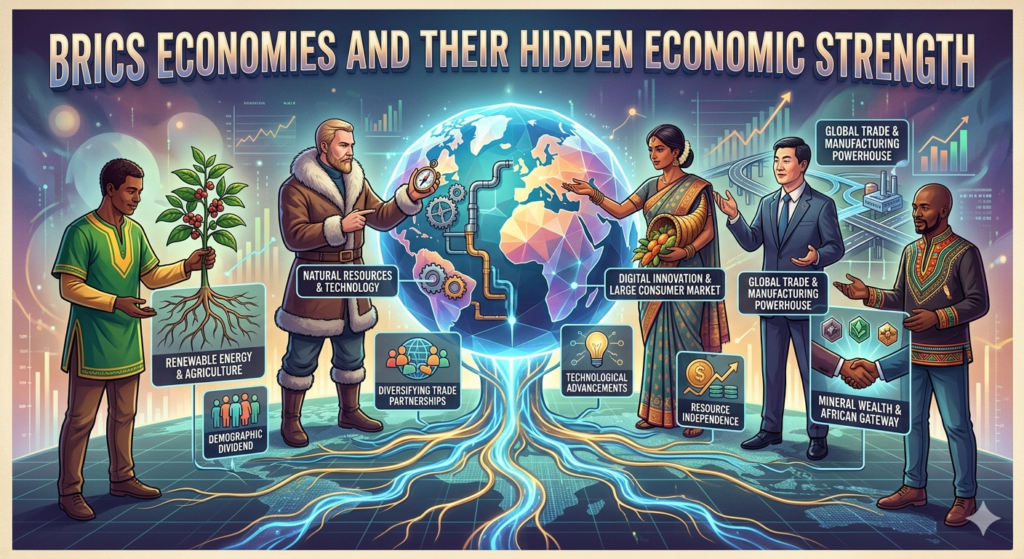
BRICS stands for Brazil, Russia, India, China, and South Africa. These countries may look very different from each other, but together they represent a shift in global economic power. Their strength does not come from one single factor. Instead, it comes from size, people, resources, markets, and long-term growth capacity.
the economic strength of BRICS in a clear and original way, focusing on real factors rather than slogans.
1. Size of the Economy:- Strength in Scale
One of the strongest features of BRICS is its combined economic size. When measured together, BRICS economies form a very large part of global output, especially in terms of purchasing power.
China and India contribute heavily due to their rapid economic expansion. Brazil and Russia add strength through energy and commodity production, while South Africa connects global markets with Africa’s growing economy.
What makes this group important is not only present output, but also future economic weight. Many developed economies are growing slowly, while BRICS nations still have space to expand industries, consumption, and investment.
2. Population as an Economic Asset:-
Population is often seen as a challenge, but for BRICS it is a major advantage.
BRICS countries together house a large share of the world’s people
India and China alone provide massive labour and consumer markets
A rising middle class is increasing demand for goods and services
India’s young population gives it a clear edge in the coming decades. A young workforce supports economic growth through productivity, innovation, and consumption. This demographic advantage strengthens the overall economic position of BRICS.
3. Control Over Natural Resources:-
Another major source of strength is access to natural resources.
Russia is rich in oil, gas, and minerals
Brazil is a global leader in agriculture and food exports
South Africa holds key minerals required for modern technology
China dominates processing of rare earth elements
In a world facing energy insecurity and climate challenges, countries that control resources gain economic and strategic importance. Many industrialised nations depend on BRICS members for energy, food, and raw materials.
4. Growing Domestic Markets:-
Unlike export-dependent economies, BRICS nations benefit from strong internal demand.
Large populations mean:-
Expanding consumer markets
Less dependence on foreign demand
More stability during global slowdowns
Even when global trade weakens, domestic consumption helps BRICS economies continue growing. This internal strength reduces vulnerability to global shocks such as recessions or trade disruptions.
5. Trade Beyond the West:-
Earlier, BRICS countries depended heavily on Western markets. This has slowly changed.
Today:-
Trade among BRICS members is increasing
South-South trade is expanding
Partnerships with Africa, Asia, and Latin America are growing
This diversification protects BRICS economies from political pressure, sanctions, and demand fluctuations. It also helps them negotiate better terms in global trade discussions.
6. Financial Independence Through New Institutions
A major step taken by BRICS is the creation of alternative financial institutions.
New Development Bank (NDB):-
The NDB finances infrastructure and development projects, especially in developing countries. Unlike traditional institutions, it focuses more on economic needs rather than political conditions.
Contingent Reserve Arrangement (CRA):-
The CRA acts as a financial safety net during economic stress, reducing dependence on institutions dominated by developed countries.
These steps show that BRICS is not only questioning the existing system but also building practical alternatives.
7. Technological and Industrial Progress:-
BRICS economies are no longer limited to basic industries.
China leads in manufacturing, renewable energy, and electric vehicles.
India has made strong progress in digital services, startups, and fintech.
Brazil uses technology to improve agricultural productivity.
Russia maintains advanced capabilities in defence and space sectors.
This combination of technology and industry strengthens BRICS competitiveness and supports long-term economic growth.
8. Currency Cooperation and Reduced Dependence
Another emerging strength is the effort to reduce over-dependence on the US dollar.
Recent trends include:-
Local currency trade settlements.
Alternative payment mechanisms.
Stronger domestic financial systems.
While these steps are gradual, they increase. economic autonomy and reduce exposure to global financial instability.
9. Unity Without Uniformity:-
BRICS countries do not share the same political systems or ideologies. However, this diversity has not stopped economic cooperation.
Included unites is:-
Demand for fair representation in global institutions.
Desire for balanced global growth.
Focus on development rather than dominance.
This flexible structure allows BRICS to cooperate without forcing political alignment, making the group more practical and durable.
10. Challenges Within BRICS:-
Despite strong fundamentals, BRICS faces internal challenges:-
Uneven growth across member countries.
Income inequality and unemployment.
Political tensions and external pressure.
Environmental and climate risks
These issues limit short-term performance but do not erase long-term economic strength. Most challenges are structural and manageable with reforms.
Conclusion:- Economic Strength Beyond Headlines
The strength of BRICS lies not just in numbers, but in balance and potential. Large populations, resource security, expanding markets, financial initiatives, and technological growth together form a solid economic foundation.
As the world moves towards a multi-polar economic order, BRICS economies will continue to influence global decisions. They represent the voice of emerging nations and the changing nature of global power.
BRICS is not perfect, but it is economically relevant, strategically important, and future-oriented.