
Can Local Money Change Global Trade :-
When two countries trade with each other, the goods are not the only thing that matters. Money matters too.
Imagine an Indian company buying machinery from another BRICS country. The company has to pay the foreign seller, banks have to process the payment, and the currencies have to be converted. For many international transactions, the US dollar becomes part of this process.
But BRICS countries are increasingly discussing another possibility:- using their own local currencies for more trade and investment transactions.
This does not mean that a new BRICS currency has suddenly been created. The idea is much simpler. Countries can try to make it easier for businesses to trade using currencies such as the Indian rupee, Chinese yuan, Russian rouble or Brazilian real.
It sounds like a small change in the payment process, but economically it can have much bigger effects.
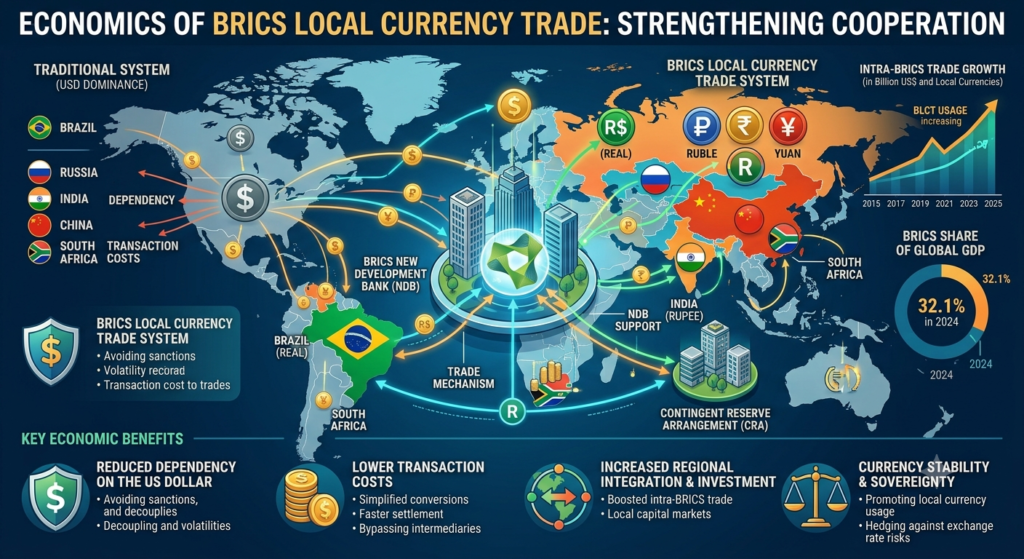
1. First, What Does Local-Currency Trade Mean???
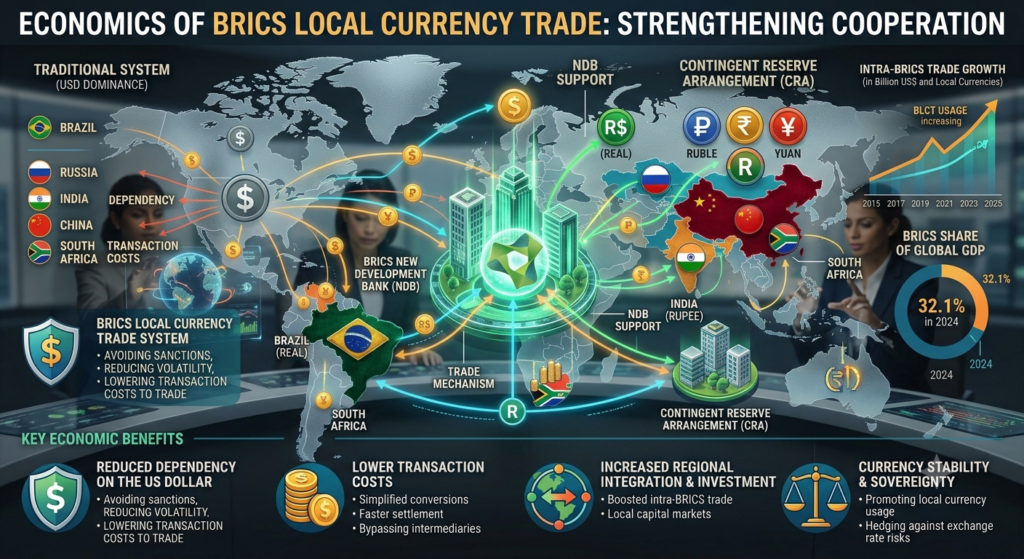
Local-currency trade means that two countries settle a transaction using their own currencies instead of depending completely on a third currency.
For example, suppose an Indian pharmaceutical company exports medicines to Russia.
Under a traditional arrangement, the payment may involve conversion into US dollars.
Under a local-currency arrangement, the two sides may agree on a mechanism through which the Indian company receives rupees and the Russian side makes payment using roubles.
The exact banking arrangement can differ from one country to another.
The basic idea is:-
Indian goods – Russia
Russian payment – India
with less dependence on a third currency.
2. Why Are BRICS Countries Interested???
The interest is partly connected with the growing economic size of BRICS.
The group has expanded beyond its original members and now includes major emerging economies from different regions. These countries are important producers and consumers of energy, food, minerals, manufactured goods and services.
If these countries trade more with each other, they naturally have a reason to make their payment systems easier and cheaper.
Some possible benefits are:-
Lower dependence on one foreign currency
Fewer currency conversions in suitable transactions
More payment choices for businesses
Faster settlement if payment systems are well connected
Greater use of domestic banking systems
More opportunities for local financial markets
However, these benefits are possible benefits, not automatic results.
3. India-Russia Trade Shows the Real Problem:-
India and Russia provide a useful real-world example.
India’s merchandise trade with Russia was around $68.7 billion in FY2024-25. A major reason for this high trade value has been India’s large imports of Russian crude oil.
But there is a problem hidden inside these numbers.
India buys much more from Russia than it sells to Russia.
In FY2024-25, India’s exports to Russia were below $5 billion, while imports were around $64 billion.
Now think about this situation in a simple way.
Suppose ,a shopkeeper sells ₹10,000 worth of goods but buys ₹60,000 worth of goods from another person. Money will naturally flow more in one direction.
International trade can face a similar problem.
If India receives a large amount of roubles but does not have enough Russian products to buy with them, businesses and banks have to find another way to use or convert those balances.
This is one of the biggest challenges of local-currency trade.
4. The Currency Is Not the Real Challenge:-
At first glance, it may seem that the biggest question is:-
“Which currency should we use???”
But the more important question is:-
“What will businesses do with that currency after receiving it????”
Consider a small Indian exporter selling engineering goods to a Russian buyer.
The exporter may be happy to receive payment in roubles if the money can easily be converted into rupees or used for another business transaction.
But if conversion is difficult or expensive, the exporter may prefer another currency.
So successful local-currency trade needs more than political agreement.
It needs:-
Reliable banks
Easy settlement systems
Reasonable exchange rates
Currency convertibility
Clear financial rules
Confidence among businesses
Without these things, local-currency trade may remain limited.
5. Local Currency Is Not the Same as a BRICS Currency???
This point often creates confusion.
Local-currency trade and a common BRICS currency are two different ideas.
A common BRICS currency would mean creating a new currency shared by participating countries.
Local-currency trade does not require this.
India can continue using the rupee.
Russia can continue using the rouble.
China can continue using the yuan.
Brazil can continue using the real.
The countries simply make arrangements that allow more transactions to be settled in their existing currencies.
This makes local-currency trade a much more gradual approach.
6. The Rupee Can Get a Bigger International Role:-
For India, one important advantage could be the wider international use of the rupee.
India already has a large domestic economy and a strong services sector. If more foreign businesses become comfortable receiving or making payments in rupees, the currency could gradually gain greater international use.
For example, an Indian exporter may receive payment in rupees from an overseas buyer under an agreed settlement arrangement.
That can reduce the need for the exporter to manage every transaction through a third currency.
But there is an important condition.
International use of a currency depends on confidence in that currency.
Stable inflation, strong financial institutions, deep financial markets and predictable policies therefore matter.
Local-currency trade cannot replace the need for a strong domestic economy.
7. Digital Payments Can Make the Difference:-
There is another part of this story that people sometimes miss:- payment technology.
Imagine an Indian company wants to pay a supplier in another BRICS country.
If banks have to pass the payment through several systems, the transaction can become slower and more expensive.
But if payment systems become better connected, the process can become smoother.
This is why BRICS discussions have also included cross-border payment cooperation and greater interoperability between payment systems.
India’s experience with fast digital payments shows why technology can matter.
A payment that feels simple on a mobile phone inside India can become much more complicated when it crosses an international border because different countries have different currencies, banking rules, security systems and regulations.
So the future of local-currency trade will depend partly on building the digital roads through which money can move.
8. What Can Small Businesses Gain????
Large companies can usually afford teams of financial experts to manage foreign exchange risks.
Small businesses cannot always do that.
For a small exporter, even a small increase in transaction charges can matter.
Suppose a handicraft producer exports products worth ₹5 lakh. If the payment process becomes cheaper and faster, the saving may look small to a large corporation but can be meaningful to a small business.
Local-currency arrangements could therefore become useful for:-
Small exporters
Agricultural exporters
Pharmaceutical companies
Engineering businesses
Textile producers
Technology and service firms
But again, this will happen only if banks provide simple and affordable services.
9. Trade Deficit Cannot Be Solved by Changing Currency:-
This is perhaps the most important economic point.
Changing the currency used for payment does not automatically reduce a country’s trade deficit.
India’s trade deficit with the wider BRICS group was about $226.1 billion in FY2025-26.
This shows the scale of India’s import-export imbalance with the group.
If India continues importing much more than it exports, simply changing the payment currency will not solve the underlying problem.
India still needs to:-
Increase exports
Improve manufacturing competitiveness
Produce more value-added goods
Expand services exports
Improve logistics
Find new international markets
Currency arrangements can support trade, but they cannot replace production and competitiveness.
10. What Happens If a Currency Moves Sharply????
Currencies do not remain at one fixed value.
Suppose an Indian company agrees to receive payment in a foreign currency. If that currency loses value before the company converts it into rupees, the company may receive less money than expected.
This is called exchange-rate risk.
For this reason, companies may still prefer currencies with deeper and more liquid international markets.
Local-currency trade therefore needs good financial tools that allow businesses to manage currency risks.
This is where banks and financial markets become important.
11. Why the Dollar Will Not Disappear Overnight:-
It would be unrealistic to say that local-currency trade will suddenly end the importance of the US dollar.
The dollar is deeply connected with global banking, investment, commodity markets and foreign exchange.
Businesses generally choose a currency not only because governments support it, but because that currency is easy to use.
Therefore, the more realistic future is probably greater choice rather than complete replacement.
A company may use the dollar for one transaction, a local currency for another and another payment arrangement for a third.
That is how international trade usually changes – gradually.
Example :- How the System Could Work???
Imagine an Indian company exports medicines worth ₹10 crore to a BRICS partner.
Instead of converting the payment through a third currency, the countries have a local-currency settlement arrangement.
The Indian exporter receives rupees.
The foreign buyer pays through its own banking system.
Banks on both sides settle the transaction according to their agreed mechanism.
Now imagine thousands of such transactions taking place.
Over time, businesses could become more comfortable using local currencies.
But this works best when there are enough two-way trade flows and businesses can easily use the currencies they receive.
That is why trade balance and payment infrastructure must develop together.
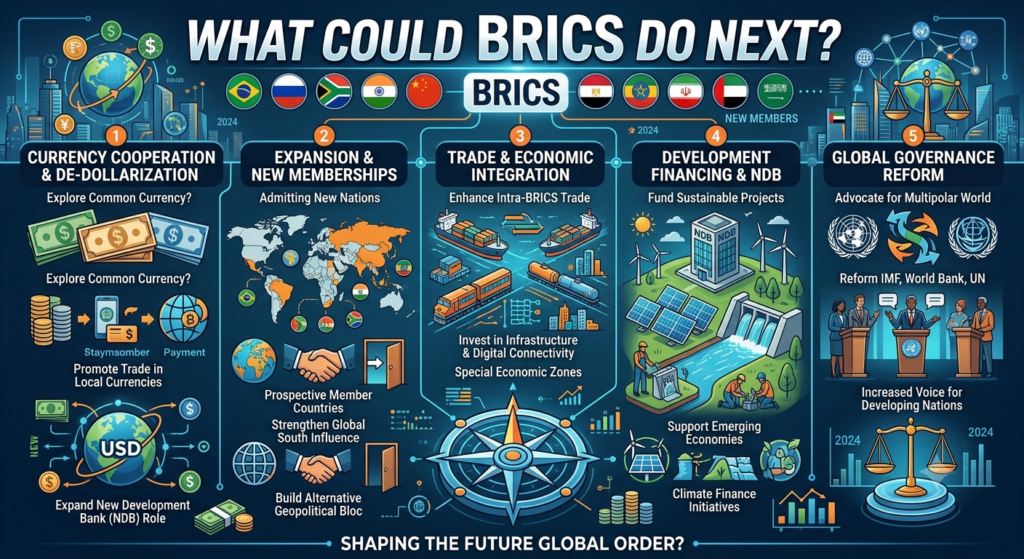
12. What Could BRICS Do Next????
A practical approach would be to focus on smaller steps rather than expecting one dramatic change.
BRICS countries could work on:-
Better cross-border payment links
Faster bank-to-bank settlements
Greater use of local currencies in selected sectors
Currency-swap arrangements
Easier rules for exporters and importers
Better foreign-exchange risk management
More local-currency financing.
The 2026 BRICS discussions continued to support local-currency settlements and cross-border payment cooperation, while recognising that members may follow different approaches according to their own economic conditions.
This is important because every BRICS economy is different.
13. The Real Test Will Be Business Confidence
Governments can make agreements, but businesses will decide whether the system actually becomes successful.
An exporter will ask:-
Can I receive the money easily?????
An importer will ask:-
Can I make the payment safely???
A bank will ask:-
Can I settle the transaction without excessive risk????
If the answer to these questions is yes, local-currency trade can grow naturally.
If the process remains complicated, businesses will continue using the payment methods that they already trust.
That is why the real test is not the number of announcements.
The real test is whether an ordinary exporter can use the system without unnecessary difficulty.
Conclusion:- (A Small Change in Payment Can Create a Bigger Economic Shift)
BRICS local-currency trade is not about changing the global financial system overnight.
It is about giving countries and businesses more options.
For India, the opportunity is important. Greater use of the rupee in international transactions could support Indian exporters and strengthen India’s financial position. Better payment connections could also make trade faster and more convenient.
But there are clear limits.
Trade imbalances, exchange-rate risks, currency convertibility, banking infrastructure and business confidence cannot be ignored.
Therefore, the success of local-currency trade will depend on much more than reducing the use of the dollar. India will need stronger exports, competitive industries, stable financial markets and efficient payment systems.
The biggest change may not come from creating a new currency at all.
It may come from creating a world where businesses have more than one practical way to trade.
That is the real economic importance of the BRICS local-currency idea.