
For a long time, people thought of mining as something that happened on mountains, in forests or deep inside the land.
Thousands of metres below the sea surface, the ocean floor contains rocks and mineral deposits with metals such as copper, nickel, cobalt and manganese. These metals are useful for batteries, electricity networks, electric vehicles and many other modern products.
This makes deep-sea mining sound like a huge business opportunity.
But there is a catch.
The ocean floor is one of the most difficult places on Earth to work. Mining there can require expensive machines, ships, underwater technology and careful environmental monitoring.
So the real economic question is not simply “How many minerals are under the sea???”
It is:-
“Can these minerals be collected, processed and sold at a profit without creating costs that society cannot afford later???”
What Is Deep-Sea Mining???
Deep-sea mining means removing mineral-rich material from the seabed in very deep parts of the ocean.
The main deposits being studied include:-
Polymetallic nodules -small rounded rocks lying on the seabed.
Polymetallic sulphides – deposits linked with underwater volcanic activity.
Cobalt-rich crusts – mineral layers found on underwater mountains.
These deposits can contain several metals at the same time.
That is what makes them economically interesting.
A company may not be looking for just one metal. It may be interested in recovering several useful materials from the same deposit.
Why Has the Ocean Suddenly Become Economically Important????
The answer is the growing demand for minerals.
The world is using more electric vehicles, batteries, renewable energy systems, power lines and electronic equipment. All of these require raw materials.
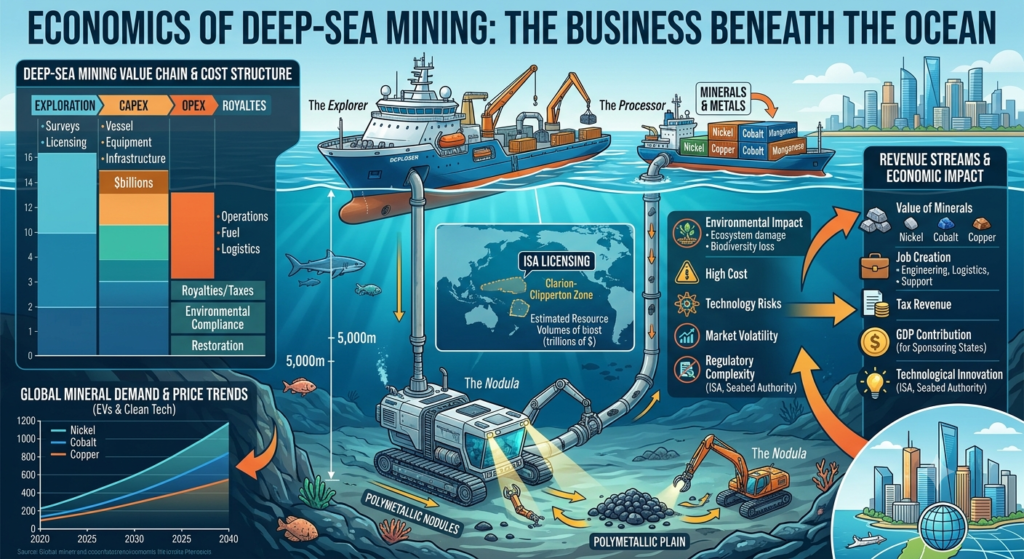
In 2025–26, the demand story remains strong. The latest global outlook shows that demand for critical minerals is expected to keep rising towards 2040. Copper is especially important because it is heavily used in electricity networks and modern technology.
This creates pressure to find new sources.
example:-
Think about an electric vehicle.
It needs a large amount of materials for:-
Battery systems
Wiring
Motors
Charging equipment
Electronic parts
Now imagine millions of such vehicles being produced.
The demand for minerals grows with them.
That is one reason companies and governments are studying resources under the ocean.
The Economic Attraction of Seabed Minerals:-
One interesting feature of deep-sea deposits is that a single deposit may contain several valuable metals.
For example, polymetallic nodules can contain combinations of:-
Manganese
Nickel
Copper
Cobalt
This could create a different kind of mining business.
Instead of depending completely on one mineral, a project may potentially earn money from several materials.
But having valuable minerals does not automatically mean the project will make money.
The cost of reaching those minerals matters just as much.
Why Deep-Sea Mining Is So Expensive???
Imagine trying to operate a giant machine several kilometres below the ocean surface.
It has to work under:-
Very high water pressure
Complete darkness
Very low temperatures
Difficult communication conditions
Strong technical limitations
A normal mining machine can be repaired on land.
An underwater machine may require a specialised ship, remotely operated equipment and expensive recovery work.
This can increase the cost of the whole project.
Major expenses may include:-
Exploration
Underwater robots
Mining equipment
Special ships
Energy
Mineral lifting systems
Processing plants
Ocean monitoring
Insurance
Environmental studies
Worker training
This means deep-sea mining could require large amounts of money before a company earns significant revenue.
Mineral Prices Can Change the Entire Business:-
Mining companies do not control the prices of metals.
Prices can rise when supply is tight and fall when production increases.
This is a major risk for deep-sea projects because they may require very large investments.
Suppose a company spends billions developing a project when nickel prices are high.
Later, if nickel prices fall sharply, the expected profit may become much smaller.
Recent mineral markets have already shown how quickly conditions can change. The latest outlook notes that increasing supplies have put downward pressure on several battery-metal prices, while long-term supply concerns remain for some important minerals.
So investors have to think about a difficult question:-
What if the cost of mining from the ocean is higher than the market price of the minerals????
Copper Makes the Story More Interesting:-
Among all the minerals connected with deep-sea mining, copper deserves special attention.
Copper is used in:-
Electricity cables
Power grids
Electric vehicles
Buildings
Electronics
Renewable energy systems
The latest 2026 outlook still expects a copper supply gap in 2035, although the estimated gap has become smaller as new projects move forward. The current base case puts the potential gap at around 25%.
This does not mean deep-sea mining will solve the copper problem.
It simply explains why new sources of copper are receiving attention.
The Ocean Could Offer Supply Diversification:-
There is another economic reason behind the interest in deep-sea minerals- supply concentration.
Many important minerals are produced or processed by a small number of countries.
If a major producer faces:-
Political problems
Export restrictions
Natural disasters
Transport problems
Production cuts
global prices can be affected.
The latest mineral outlook shows that supply chains for several critical minerals remain highly concentrated.
Deep-sea mining could potentially become another source.
That could reduce dependence on a small number of suppliers.
However, this would only work if seabed mining becomes technically reliable and economically competitive.
The Cost We Cannot See on a Balance Sheet:-
This is where the economic debate becomes complicated.
The deep ocean is not an empty place.
It contains ecosystems and species that are still being studied.
Mining can disturb the seabed and may create sediment plumes. Machines can also produce noise and physical disturbance.
The problem is that some environmental effects may continue long after the mining equipment has left.
This creates what economists call an external cost.
In simple words, an external cost is a cost created by a business activity that may not be fully paid by the company doing the activity.
For example:-
A mining project may earn money from selling minerals.
But if the project damages marine ecosystems, society may later spend money on:-
Research
Monitoring
Environmental protection
Restoration attempts
Long-term scientific studies
If those costs are ignored, the mining project may appear more profitable than it really is.
Jobs Could Grow Around the Industry:-
Deep-sea mining is not only about digging minerals from the ocean.
A new industry could create demand for different skills.
Possible areas include:-
Marine engineering
Robotics
Shipbuilding
Ocean science
Software
Remote sensing
Equipment repair
Mineral processing
Environmental monitoring
example:-
Suppose a company develops a robot that can work safely at extreme ocean depths.
Even if large-scale mining does not begin immediately, that technology could be useful for ocean research, underwater construction or other marine activities.
So the economic value may come from technology development as well as mining itself.
Recycling Is a Competitor to New Mining;-
Deep-sea mining should not be compared only with land-based mining.
There is another option -(recycling).
Old batteries, electronics and industrial products contain materials that can be recovered.
If more metals are recycled, the need for newly mined materials can decrease.
This creates an important economic competition:-
Should society extract more minerals, or recover more of the minerals already being used????
The answer may be both.
A future mineral system could depend on:-
Existing mines
New mines
Recycling
Better technology
Reduced material waste
Possibly deep-sea mining.
Regulation Can Affect the Business:-
Mining an ocean floor is not like opening an ordinary factory.
Companies need clear rules about:-
Where mining can happen
What environmental standards must be followed
How damage will be monitored
What companies must report
What happens after an accident
Who pays for environmental harm
This matters to investors.
A company is less likely to spend billions on a project if the rules are unclear.
At the same time, governments need rules that protect the environment without making useful innovation impossible.
This balance is one of the hardest parts of the deep-sea mining debate.
The World Is Still Far From a Normal Deep-Sea Mining Industry,:-
It is important to understand that deep-sea mining is not yet a simple, established mining business.
Much of the international activity has focused on exploration, scientific research and the development of rules.
At the same time, interest is increasing in some national waters. In 2026, proposals for mineral exploration around American Samoa showed how strategic the issue has become, while also highlighting continuing concerns about limited knowledge of deep-water ecosystems.
So the industry is moving through a period of testing, investment and debate rather than ordinary large-scale production.
What Could Make Deep-Sea Mining Successful???
For deep-sea mining to become a strong business, several things would need to work together.
1. Better technology:-
Machines must become safer, stronger and more efficient.
2. Lower operating costs:-
The minerals must be collected at a cost that makes commercial sense.
3. Stable mineral demand;-
Companies need confidence that buyers will continue to need the metals.
4. Strong environmental rules:-
Environmental risks must be measured instead of simply ignored.
5. Clear regulation:-
Investors need predictable rules.
6. Better recycling:-
Recycling can reduce pressure on mineral supplies and make the whole system more efficient.
A Simple Economic Test:-
The idea is simple:-
Money earned from minerals – Total mining cost = Economic benefit
For example, if a company earns ₹100 crore but spends ₹70 crore on mining and other costs, its benefit is ₹30 crore.
If the cost becomes ₹110 crore, it faces a ₹10 crore loss.
So, deep-sea mining is profitable only when the value of minerals is higher than the total cost of mining them.
The Bigger Question for the Future:-
The world needs minerals.
The latest 2026 outlook shows that demand for critical minerals will continue to grow, especially because of electric vehicles, batteries, renewable energy and electricity networks. At the same time, new mining projects require huge investment, and supply risks remain for minerals such as copper and cobalt.
Deep-sea mining may become one part of the answer.
But it should not be treated as a magic solution.
The world also needs:-
More recycling
Smarter use of minerals
Better land-based mining
Less waste
New material technologies
Stronger supply chains.
Conclusion:- (The Ocean Is Valuable, But Minerals Are Not Free)
Deep-sea mining looks exciting because it opens the possibility of finding new sources of important minerals.
But the ocean floor is not a cheap warehouse full of free resources.
Getting those minerals out may require huge investment, advanced machines and years of research. Mineral prices can change. Rules can change. Environmental risks can create costs that are difficult to calculate.
So the future of deep-sea mining will depend on one basic economic test:-
Can the value of the minerals be greater than the full cost of obtaining them??
And “full cost” should mean more than the company’s electricity bill, ship cost and worker salaries. It should also include environmental protection, monitoring and the risks that may affect future generations.
If technology becomes cheaper and safer, deep-sea mining may become a useful source of critical minerals.
If the risks remain too high, recycling and better use of existing resources may prove to be the smarter economic choice.
The real treasure of the deep ocean, therefore, may not simply be the minerals beneath it.