
Introduction:- Growth Needs Energy, But At What Cost
India is one of the fastest-growing major economies in the world. Every new highway, factory, and city adds to its energy demand. Among all energy sources, crude oil remains the most crucial because it powers transport, industries, and logistics.
But there is a serious concern—India produces very little oil and depends heavily on imports. This makes energy security not just an economic issue, but also a strategic and national priority.
Understanding Energy Security in Simple Terms
Energy security means ensuring that a country always has:-
Enough energy to meet demand
Stable and uninterrupted supply
Affordable prices
Protection from global disruptions
For India, this concept is closely tied to oil imports because crude oil still dominates its energy consumption pattern.
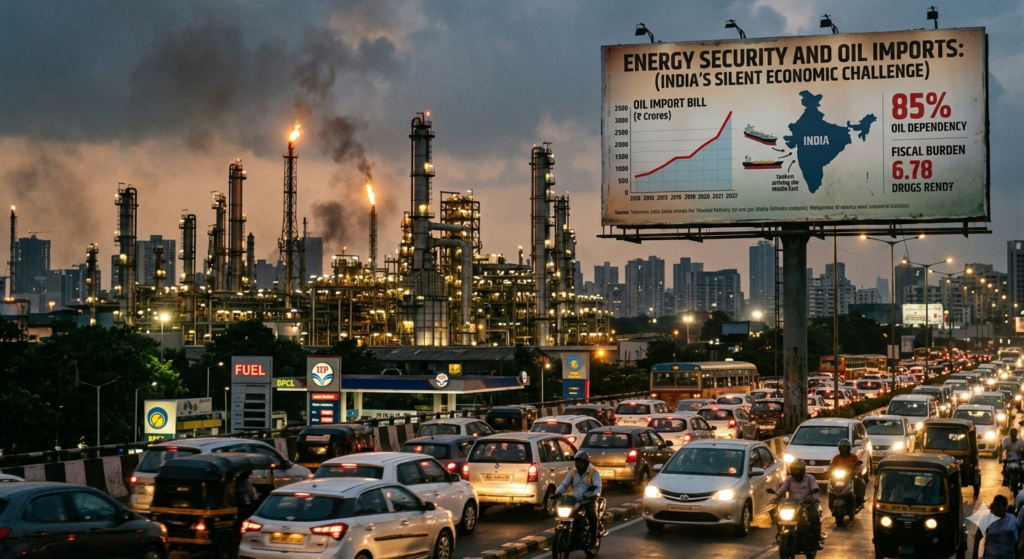
India’s Oil Reality:- High Demand, Low Production
India’s situation can be understood in one line:- high consumption, low production.
India consumes around 5.2 million barrels per day (2025 estimate)
Domestic production meets only 12–15% of demand
Around 85%–88% of crude oil is imported
India is currently the 3rd largest oil importer in the world, after the US and China.
With rising population, urbanization, and vehicle usage, demand is expected to grow further in the coming years.
Import Sources:- Changing Trends in Recent Years
India imports oil from multiple regions to reduce risk.
Major suppliers (2025):-
Russia – emerged as a top supplier due to discounted crude
Iraq – consistently among the largest suppliers
Saudi Arabia & UAE – traditional partners
United States & Africa – smaller but important sources
This diversification strategy helps India avoid overdependence on any single country.
Why Heavy Oil Imports Are Risky???
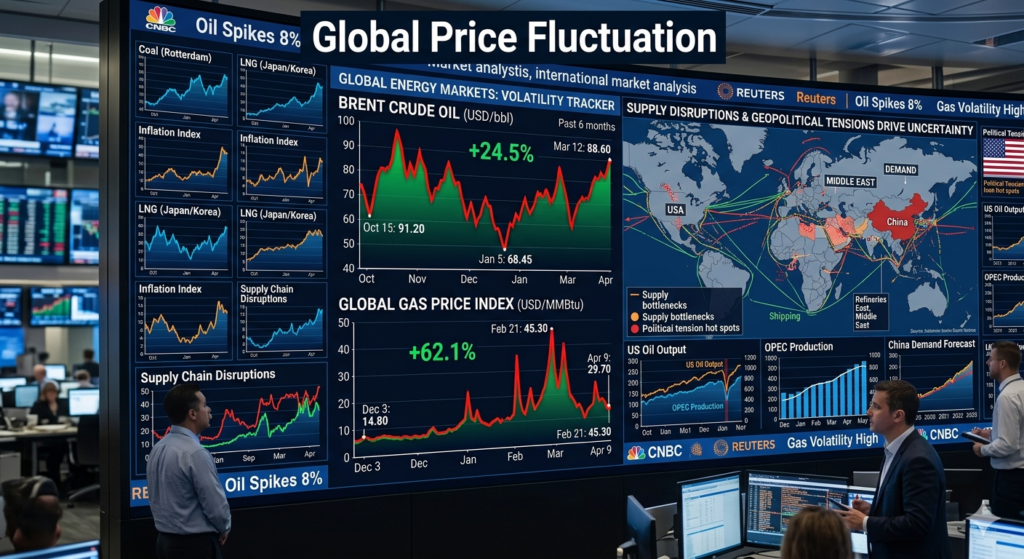
1. Global Price Fluctuations;-
Oil prices are highly unstable. They depend on:-
Wars and geopolitical tensions
Production decisions by oil-exporting countries
Global demand changes
Even a small price rise can increase India’s import bill by billions of dollars.
2. Pressure on India’s Economy:-
High oil imports directly impact:-
Inflation – fuel cost affects everything from food to transport
Trade deficit -more imports than exports
Rupee value – higher dollar demand weakens currency
For example, when crude prices rise above $80–90 per barrel, India faces serious economic pressure.
3. Geopolitical Dependence:-
India depends on politically sensitive regions for oil supply.
Middle East conflicts can disrupt supply
Sanctions (like those on Russia or Iran) complicate trade
Shipping routes like the Strait of Hormuz are vulnerable
This makes energy security a foreign policy issue as well.
(Impact on Common People)
Energy insecurity is not just a government problem—it directly affects citizens:-
Increase in petrol and diesel prices
Higher transport costs
Expensive goods and services
Reduced household savings
So, oil imports indirectly impact daily life.
(Steps Taken by India to Strengthen Energy Security)
India is actively working on multiple fronts to reduce risks.
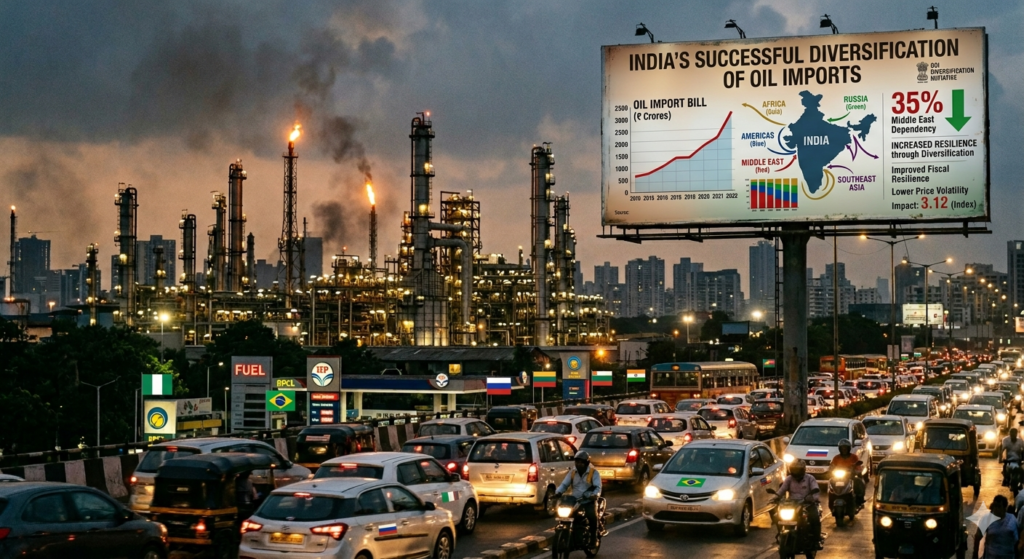
1. Diversification of Oil Imports:-
India is buying oil from a wider range of countries, including discounted crude from Russia.
This reduces dependence on traditional suppliers and improves bargaining power.
2. Strategic Petroleum Reserves (SPR):-
India has developed emergency oil storage facilities.
Current capacity:- around 5.3 million tonnes
Enough to meet 9–10 days of demand
Expansion plans are underway
These reserves act as a safety buffer during crises.
3. Push Towards Renewable Energy:-
India is rapidly expanding clean energy capacity.
Installed renewable capacity crossed 180+ GW (2025)
Target:- 500 GW non-fossil capacity by 2030
This reduces long-term dependence on imported fossil fuels.
4. Promotion of Electric Vehicles (EVs):-
Transport consumes the largest share of oil.
To reduce this:-
EV subsidies under government schemes
Expansion of charging infrastructure
Electrification of public transport
EV adoption is slowly but steadily increasing.
5. Ethanol Blending Program:-
India is mixing ethanol with petrol to reduce crude oil usage.
Current blending level: around 15–16% (2025)
Target:- 20% blending
This also benefits farmers and reduces import bills.
6. Natural Gas Expansion:-
Natural gas is cleaner and partially reduces oil dependence.
Target to increase gas share to 15% in energy mix
Expansion of pipelines and CNG networks
Can India Increase Domestic Oil Production???
India has oil reserves, but production is limited due to:-
High extraction costs
Technological challenges
Aging oil fields
The government is encouraging:-
Private investment
Foreign participation
Exploration of new basins
However, domestic production alone cannot solve the problem.
Global Energy Transition:- A Big Opportunity
The world is slowly shifting towards clean energy.
For India, both a challenge and an opportunity:- Opportunity:-
Reduce oil import dependence
Become a leader in solar and green hydrogen
Challenge:-
Transition requires huge investment
Fossil fuels still dominate current energy use
India must carefully balance both.
(Major Challenges Ahead)
Despite progress, several issues remain:-
Rapidly increasing energy demand
Slow pace of behavioral change (fuel consumption habits)
Infrastructure gaps for EVs and renewables
Continued dependence on imports in short term
Way Forward:- A Practical Strategy
India needs a balanced and realistic approach:-
1. Reduce Oil Dependence Gradually:-
Promote public transport
Improve fuel efficiency
2. Invest in Clean Energy:-
Solar rooftops
Wind energy expansion
Green hydrogen mission
3. Strengthen Energy Storage:-
Expand strategic reserves
Invest in battery storage
4. Stable Energy Policies:-
Long-term planning
Investor-friendly environment
5. Encourage Responsible Consumption:-
Awareness about fuel saving
Shift towards sustainable lifestyle
Conclusion:- From Dependence to Resilience
India’s energy story is at a turning point. While oil imports currently dominate, the country is actively working to reduce risks and build a secure energy future.
Energy security is not about eliminating imports overnight-it is about managing risks smartly while preparing for the future.
With the right mix of diversification, renewable energy, technological innovation, and policy support, India can move from energy dependence to energy resilience.