
How a Global Commodity Quietly Shapes India’s Economic Direction
Introduction: -One Global Price, Many Domestic Effects
Global oil prices may appear to be an international issue, discussed mainly in financial markets and diplomatic circles. However, for a country like India, oil prices directly influence everyday economic life. From fuel bills and food prices to government finances and currency stability, oil plays a silent but powerful role in shaping economic outcomes.
India depends heavily on imported crude oil to meet its energy needs. As a result, even small changes in global oil prices can create large ripple effects across the Indian economy. Understanding this connection is essential to understand inflation, growth, and macroeconomic stability in India.
India’s Heavy Dependence on Imported Oil:-
India is among the world’s largest consumers of energy, yet its domestic oil production meets only a small part of total demand. Most of the crude oil required by India is imported from foreign countries. This dependence makes the economy highly sensitive to global price movements.
Oil is not limited to transport fuels like petrol and diesel. It is a critical input for electricity generation, fertilizers, chemicals, plastics, logistics, and manufacturing. Therefore, when oil prices rise, costs increase across multiple sectors simultaneously, affecting both production and consumption.
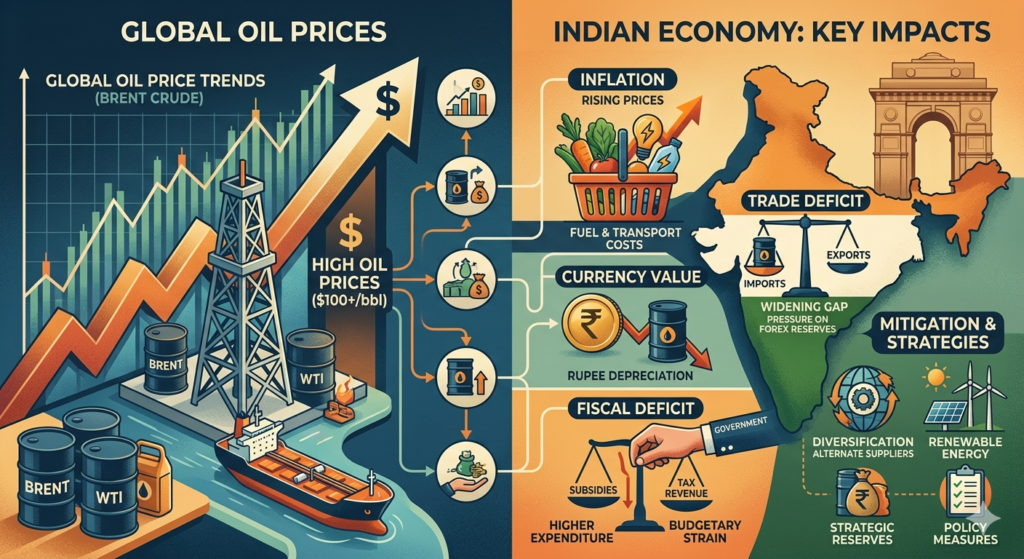
What Determines Global Oil Prices
Global oil prices are shaped by several international factors, many of which lie beyond India’s direct control.
Production Decisions by Oil Exporters:-
Major oil-producing countries control a significant share of global supply. When these countries reduce production, global supply tightens and prices rise. When supply increases, prices tend to soften.
Geopolitical Tensions:-
Conflicts, sanctions, political instability, or disruptions in oil-producing regions can reduce supply or create uncertainty in markets. Even the fear of supply disruption can push prices upward.
Global Demand Conditions:-
During periods of strong global economic growth, demand for energy rises, leading to higher oil prices. Conversely, during global slowdowns, demand weakens and prices often fall.
Strength of the US Dollar:-
Oil is traded internationally in US dollars. A stronger dollar makes oil more expensive for importing countries like India, even if the global oil price remains unchanged.
Inflation: -The Most Immediate Impact
One of the fastest and most visible effects of rising oil prices in India is inflation.
When fuel prices increase:-
Transportation costs rise
Goods become more expensive to move
Food prices increase due to higher logistics costs
As a result, overall prices in the economy rise. This affects household budgets, especially for middle- and lower-income groups. Persistent fuel-driven inflation reduces purchasing power and weakens economic stability.
Pressure on Government Finances:-
High oil prices create difficult choices for the government. Fuel prices are politically sensitive, and sudden increases can affect millions of consumers.
To reduce the burden on the public, the government may:-
Reduce fuel taxes
Increase subsidies
Ask oil marketing companies to absorb part of the cost
While these measures provide short-term relief, they increase government expenditure and reduce revenue.
This can widen the fiscal deficit and limit spending on development areas such as infrastructure, education, and health.
Impact on Trade Deficit and External Balance:-
Since India imports large quantities of crude oil, higher oil prices significantly increase the import bill. Exports usually do not rise at the same pace, leading to a widening trade deficit.
A higher trade deficit contributes to:-
A larger current account deficit:-
Greater pressure on foreign exchange reserves
Increased vulnerability to external shocks
This weakens overall external stability and can affect international investor confidence.
Oil Prices and the Indian Rupee:-
There is a strong link between oil prices and the value of the Indian rupee.
When oil prices rise:-
India needs more US dollars to pay for imports
Demand for dollars increases
The rupee faces depreciation pressure
A weaker rupee further raises the cost of imports, including oil, creating a cycle where high oil prices and currency weakness reinforce each other. This also increases the cost of servicing external debt.
Impact on Industries and Businesses:-
Higher oil prices increase input costs for many industries.
Sectors most affected include:-
Transport and logistics
Aviation
Manufacturing
Chemicals and fertilizers
Large firms may absorb some costs, but small and medium enterprises often struggle. Reduced profitability can lead to lower investment, slower expansion, and employment challenges.
Effect on Agriculture and Rural Economy:-
Oil prices also affect agriculture, though this impact is often indirect.
Higher diesel prices raise irrigation and machinery costs
Fertilizers become more expensive
Transporting crops to markets costs more
This increases farmers’ input costs and reduces profit margins unless crop prices rise proportionately. As a result, rural inflation can increase even when urban consumers feel limited impact initially.
Challenges for Monetary Policy:-
Rising oil prices complicate the task of the central bank. Higher fuel-driven inflation may force monetary authorities to tighten policy.
This can involve:-
Increasing interest rates
Reducing liquidity in the economy
While such steps help control inflation, they also slow down borrowing, investment, and consumption. Policymakers must balance inflation control with the need to support economic growth.
India’s Strategy to Manage Oil Price Shocks:-
India has taken several steps to reduce its vulnerability to global oil price fluctuations.
Diversification of Import Sources
India imports oil from multiple regions to reduce dependence on any single supplier.
Strategic Petroleum Reserves:-
Emergency oil reserves provide a buffer against short-term supply disruptions.
Push for Renewable Energy
Expansion of solar, wind, and bio-energy reduces long-term reliance on fossil fuels.
Promotion of Electric Mobility
Electric vehicles help lower oil consumption in the transport sector over time.
Focus on Energy Efficiency
Improved fuel efficiency standards reduce oil demand without harming growth.
Long-Term Economic Implications:-
Sustained high oil prices can slow economic growth by increasing costs, weakening external balances, and reducing household savings. In contrast, stable oil prices support growth, fiscal stability, and investment.
India’s long-term objective is not complete elimination of oil use, but reducing vulnerability through diversification, innovation, and cleaner energy alternatives.
Conclusion:-( A Global Variable with Local Consequences)
Global oil prices may be decided far from India’s borders, but their impact is deeply domestic. They influence inflation, government finances, currency stability, industrial performance, and everyday life.
For India, managing oil price volatility is not just an economic challenge but a strategic necessity. Until dependence on oil imports reduces significantly, global oil prices will continue to shape the direction and resilience of the Indian economy.