
India Budget & Economic Survey 2026
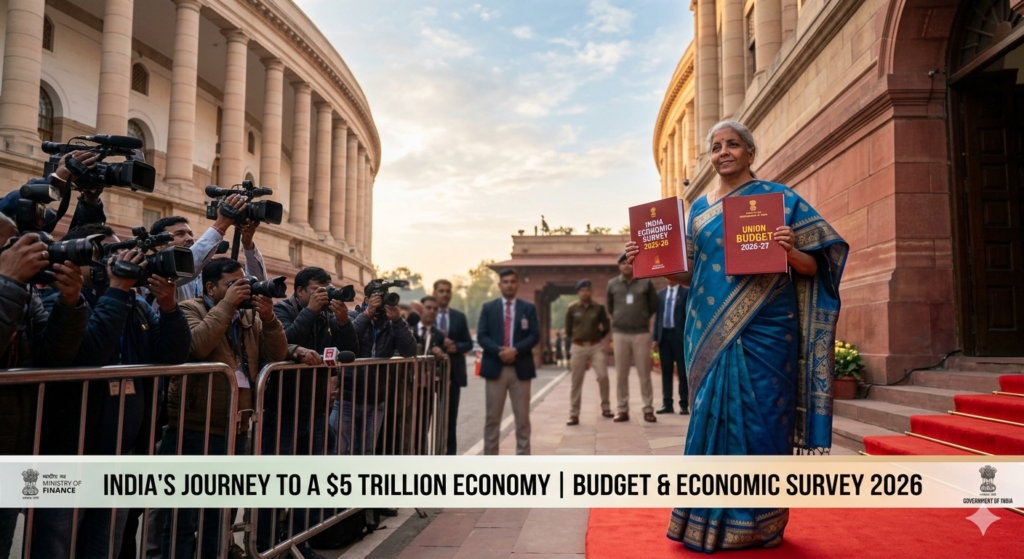
The Union Budget and the Economic Survey together present a detailed picture of the Indian economy. While the Economic Survey works like a report card of the past year, the Union Budget acts as a roadmap for the coming financial year. The Budget and Survey of 2026 reflect India’s attempt to balance growth, welfare, fiscal discipline and long-term structural reforms in a challenging global environment.
1. Economic Survey 2026:- Overall Economic Outlook
The Economic Survey 2026 highlights that India remains one of the fastest-growing major economies in the world. Despite global uncertainties such as geopolitical tensions, weak global demand and inflationary pressures, India’s domestic fundamentals are shown as relatively strong.
The Survey estimates India’s real GDP growth for the coming year in the range of around 6–6.5 percent, driven mainly by domestic consumption, public investment and services sector performance. Inflation is expected to remain under control due to better supply management and moderation in global commodity prices.
The Survey stresses that India’s growth story is becoming increasingly investment-led rather than consumption-only, which is considered healthier for long-term development.
2. Fiscal Position and Government Finances:-
One of the key themes of Budget 2026 is fiscal consolidation without compromising growth. The government has continued its path of reducing the fiscal deficit gradually.
The fiscal deficit is targeted at around 4.3% of GDP, showing commitment to medium-term fiscal discipline.
Revenue receipts are expected to improve due to better tax compliance and stable economic activity.
Capital expenditure remains a priority, while revenue expenditure is kept under control.
This approach indicates that the government wants to avoid excessive borrowing while still investing heavily in productive assets.
3. Capital Expenditure and Infrastructure Push:-
Infrastructure continues to be the backbone of Budget 2026. The government has allocated a record level of capital expenditure, focusing on sectors that have strong multiplier effects.
Major areas include:-
Roads and highways
Railways and metro projects
Ports, logistics and inland waterways
Urban infrastructure and housing
The logic behind this strategy is clear: infrastructure spending not only creates immediate employment but also improves long-term productivity, reduces logistics costs and attracts private investment.
The Economic Survey also highlights that infrastructure-led growth has helped crowd-in private investment rather than crowd it out.
4. Manufacturing and ‘Make in India’ Focus:-
Budget 2026 strengthens the government’s long-term goal of transforming India into a global manufacturing hub.
Key focus areas include:-
Electronics and semiconductor manufacturing
Defence production and indigenisation
Pharmaceuticals and biotechnology
Critical minerals and clean energy equipment
The Production-Linked Incentive (PLI) approach is continued, with emphasis on improving domestic value addition rather than mere assembly. The Survey notes that India’s share in global manufacturing exports is gradually improving, though challenges like skill gaps and logistics efficiency remain.
5. Agriculture and Rural Economy:-
Agriculture remains a crucial sector due to its role in employment and food security. Budget 2026 adopts a balanced approach by combining income support with productivity enhancement.
Major highlights include:-
Focus on agri-technology, digital agriculture and AI-based advisory services
Strengthening irrigation and climate-resilient farming
Continued support to farmer credit and allied activities like dairy and fisheries
The Economic Survey emphasises that rural demand has remained resilient and can act as a stabilising force during global slowdowns.
6. Social Sector: -Health and Education
Health:-
The Budget increases focus on:-
Public healthcare infrastructure
Preventive and primary healthcare
Availability of affordable medicines
Special attention is given to reducing out-of-pocket expenditure and strengthening district-level healthcare systems.
Education:-
Education spending is aligned with future workforce needs:-
Emphasis on skill development and vocational education
Support for research, innovation and higher education institutions
Integration of digital tools and AI in learning
The Survey highlights that India’s demographic advantage can turn into a liability if skill development is not prioritised.
7. Employment and Skill Development:-
Employment generation is addressed indirectly through:-
Infrastructure investment
MSME support
Manufacturing incentives
Instead of short-term job schemes, the focus is on sustainable employment creation. Skill development programs are aligned with emerging sectors such as green energy, electronics, logistics and healthcare.
The Economic Survey acknowledges challenges like informal employment and underemployment but notes improvement in labour force participation, especially among women.
8. Taxation Policy and Reforms:-
Budget 2026 avoids major tax shocks and instead focuses on stability and simplification.
No major changes in personal income tax slabs
Continued emphasis on faceless assessment and digital compliance
Steps towards a simplified Income Tax framework
This approach reflects the government’s intent to build trust and improve voluntary compliance rather than frequent rate changes.
9. MSMEs and Startup Ecosystem:-
MSMEs are recognised as the backbone of employment generation.
Key initiatives include:-
Improved access to credit
Faster dispute resolution mechanisms
Support for technology adoption and digitalisation
The startup ecosystem continues to receive policy support, especially in innovation-driven and technology-based sectors.
10. External Sector and Global Position:-
The Economic Survey notes that:-
India’s foreign exchange reserves remain comfortable
Export diversification is improving, though global demand remains weak
Services exports continue to be a strong pillar
India’s strategy is shifting from export volume to export value and resilience, reducing over-dependence on a few markets.
11. Key Themes Emerging from Budget & Survey 2026:-
Some clear themes emerge:-
Growth with Stability – Avoiding reckless spending while maintaining momentum
Public Investment as a Catalyst – Using government capex to attract private investment
Structural Reforms over Populism – Limited freebies, more long-term planning
Human Capital Focus – Health, education and skills as growth enablers
Domestic Strength – Leveraging internal demand amid global uncertainty
Conclusion:-
The Union Budget and Economic Survey 2026 together present a pragmatic and forward-looking vision for India’s economy. Instead of headline-grabbing announcements, the focus is on continuity, credibility and long-term capacity building.
this Budget is important because it reflects:-
India’s evolving development model
The balance between welfare and fiscal prudence
The increasing role of capital expenditure in growth
The shift towards technology-driven and investment-led growth
Overall, Budget and Survey 2026 aim to strengthen India’s economic foundation while preparing the country for future global and domestic challenges.