
Introduction:- When Money Started Moving at the Speed of Life
In the last few years, India has experienced a quiet yet powerful transformation—one that did not require massive factories or physical infrastructure. This change happened through mobile screens, QR codes, and instant transfers. Digital payments altered how Indians earn, spend, save, and trust money. From tea stalls to technology startups, from village markets to metro cities, digital payments became a common language of exchange.
This transformation was not merely about replacing cash. It redefined accessibility, transparency, and participation in the economy. Digital payments turned financial activity into something faster, simpler, and more inclusive, touching every layer of society.
2.Life Before Digital Payments:- A Cash-Dependent Reality
For a long time, cash dominated India’s economy. Most transactions were physical, undocumented, and location-bound. Carrying cash was risky, handling change was inconvenient, and transferring money across distances was slow.
Large sections of the population, especially in rural and informal sectors, remained disconnected from banks. Without transaction records, people struggled to access credit, insurance, or financial support. The economy moved, but much of it moved invisibly.
This heavy dependence on cash limited efficiency, encouraged informal practices, and widened the gap between those with access and those without.
3.The Turning Point:- Technology Meets Simplicity
The true breakthrough came when digital payments were designed for ordinary people, not just for banks or businesses. Mobile-based systems allowed users to send money instantly without complex procedures.
The need for physical presence disappeared. A phone and basic internet connection became enough to perform transactions. Digital payments fit naturally into daily life—paying bills, sending money home, buying groceries, or booking transport.
What made this shift powerful was not technology alone, but ease of use. Digital payments worked in regional languages, required minimal steps, and suited people with different levels of education.
4.Financial Inclusion:- Opening Doors for Millions
One of the most meaningful impacts of digital payments has been the expansion of financial inclusion. People who had never used formal banking services became active participants in the financial system.
Daily wage workers, farmers, women, and small traders gained access to secure money transfers and savings. Government benefits reached recipients directly, reducing dependence on intermediaries.
Digital payments provided financial identity. This identity helped people build trust with institutions, access credit, and plan for the future. Inclusion was no longer limited by geography or income.
5.Empowering Small Businesses and Street Economy:-
India’s economy runs on small enterprises—shops, vendors, service providers, and self-employed workers. Digital payments transformed how they operate.
Accepting digital money reduced cash handling risks and attracted more customers. Transaction histories helped businesses prove income stability, enabling access to loans and growth opportunities.
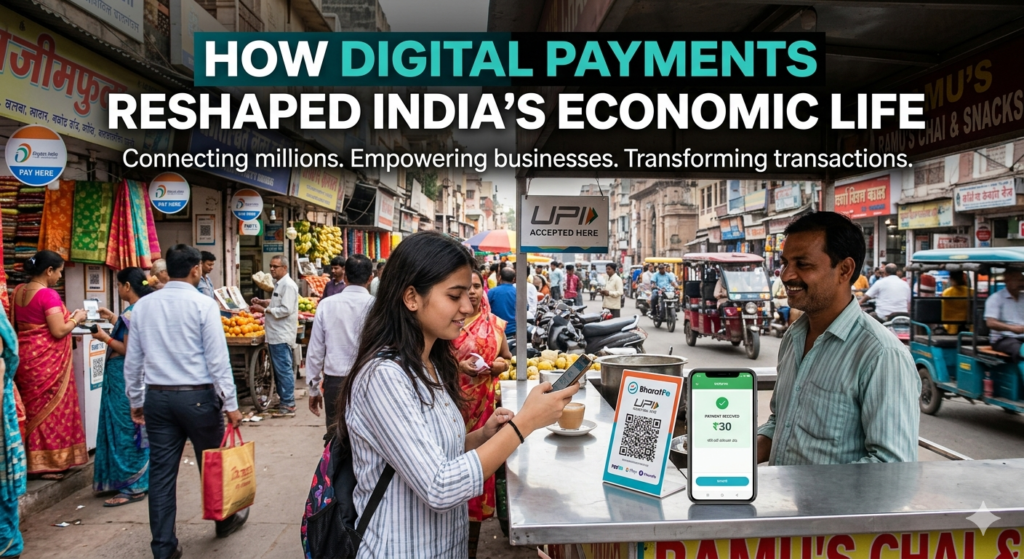
Even the street economy benefited. Vendors selling vegetables or snacks found digital payments convenient, hygienic, and efficient. Technology quietly strengthened the backbone of the informal sector.
6.Speed and Convenience:- Redefining Everyday Transactions
Digital payments changed expectations. People no longer planned payments around bank hours or physical locations. Transactions became instant, anytime, anywhere.
This speed improved economic efficiency. Businesses received payments faster, individuals managed money better, and emergencies were handled with immediate transfers.
The simplicity of scanning a code or clicking a button reduced mental and physical effort. Over time, convenience turned into habit, and habit turned into trust.
7.Transparency and Cleaner Money Flow:-
Digital payments introduced visibility into financial transactions. Each transaction created a record, improving accountability for individuals, businesses, and institutions.
This transparency discouraged unaccounted transactions and encouraged formal practices. Tax compliance improved, and financial planning became more data-driven.
For policymakers, digital transaction data offered insights into consumption patterns, regional needs, and economic behavior, supporting better decision-making.
8.Strengthening Governance and Public Service Delivery:-
Digital payments significantly improved governance outcomes. Welfare benefits, pensions, scholarships, and relief funds reached beneficiaries faster and more accurately.
The reduction of intermediaries minimized leakages and delays. Citizens experienced greater confidence in public systems when money reached them directly.
In times of crisis, digital transfers became a lifeline, ensuring timely support without physical contact or paperwork.
9.A Cultural Shift:- From Cash Comfort to Digital Confidence
Beyond economics, digital payments triggered a cultural change. Indians gradually shifted from trusting physical cash to trusting digital value.
Elderly citizens learned to use mobile payments. Rural households adopted digital methods. This change was supported by digital awareness efforts and user-friendly designs.
Money became something that moved quietly, safely, and instantly. This psychological shift marked a new stage in India’s relationship with finance.
10.Challenges on the Digital Path:-
Despite progress, challenges remain. Cyber fraud, digital illiteracy, and connectivity gaps continue to affect certain groups.
Some users hesitate due to fear of mistakes or lack of technical understanding. Others face infrastructure limitations in remote areas.
However, stronger security systems, awareness campaigns, and better regulations are steadily addressing these concerns.
11.India’s Emerging Global Identity:-
India’s success with digital payments has positioned it as a global example of scalable financial innovation. The ability to serve a large and diverse population with low-cost digital solutions has gained international recognition.
This transformation strengthened India’s image as a technology-driven economy capable of inclusive growth.
12.Possibilities:- Beyond Transactions
The future of digital payments lies in deeper financial integration. Payments will connect with savings, credit, insurance, and cross-border trade.
As digital literacy improves, digital payments will support entrepreneurship, employment, and economic resilience. The focus will shift from convenience to capability.
12.Conclusion:- A Transformation That Goes Beyond Money
Digital payments transformed India not just by changing how transactions occur, but by reshaping economic participation, governance, and social behavior. They empowered individuals, strengthened businesses, increased transparency, and built trust in systems.
This transformation shows that when technology is inclusive and simple, it can quietly change the course of a nation. In India, digital payments are no longer just a tool—they are a foundation of modern economic life.