
UPI Growth Story:- How India Built the World’s Most Used Digital Payment System???
The Unified Payments Interface, commonly known as UPI, represents one of the most important transformations in India’s financial history. In less than a decade, UPI has changed how money moves across the country. What began as an alternative payment method has now become the default choice for everyday transactions. From small street vendors to large businesses, UPI has deeply penetrated economic life. This article explains the growth story of UPI in a clear, structured, and original manner.
1. The Background That Made UPI Necessary:-
Before UPI, digital payments in India were fragmented and inconvenient. The financial ecosystem faced several challenges:
Money transfers required long bank details like account numbers and IFSC codes
Net banking systems were slow and difficult to use
Card payments depended on physical infrastructure
Cash dominated daily transactions, especially in small-value payments
UPI was introduced to solve these structural problems by creating a single, simple, and interoperable payment system that worked across banks and mobile applications.
2. What Exactly Is UPI????
UPI is a real-time payment system that allows instant transfer of money between bank accounts through a mobile device.
Its basic working rests on three ideas:
Account-to-account transfer without intermediaries
Single virtual identity instead of bank details
24×7 availability, including holidays
This simplicity removed fear and hesitation from digital payments, especially among first-time users.
3. Early Phase:- Slow Start but Strong Foundation
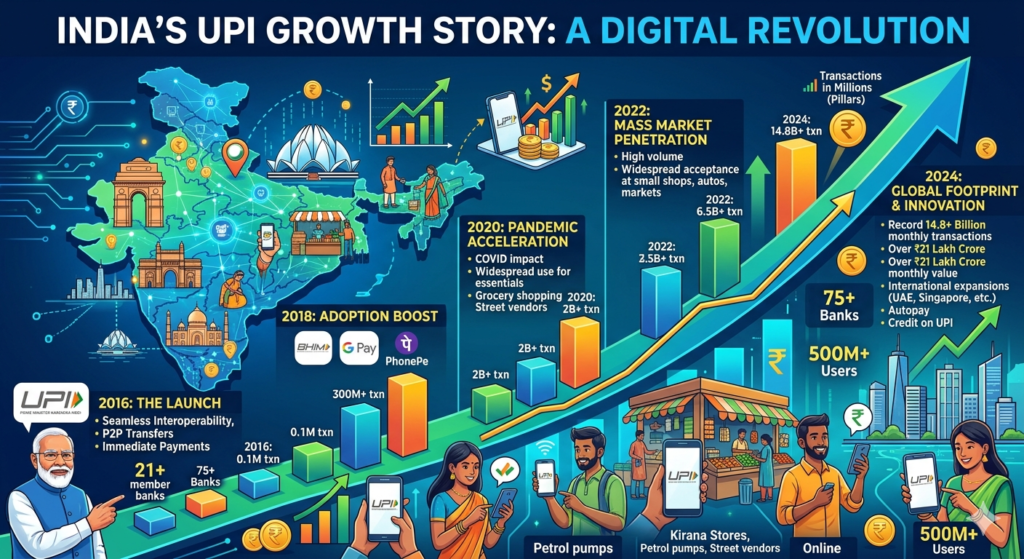
When UPI was launched in 2016, adoption was limited. The reasons:-
Low awareness among people
Limited smartphone penetration
Hesitation to trust digital systems
However, the system was carefully designed with strong security, bank integration, and scalability. This foundation ensured that once users began adopting it, the system could handle rapid growth without breakdowns.
4. Turning Point:- From Experiment to Everyday Habit
The real growth of UPI began when it entered daily life rather than remaining a special payment option.
Key factors behind this shift were:-
Ease of use: Sending money became as simple as sending a message
Zero or minimal cost:- Users did not feel burdened by charges
Instant confirmation:- Payments happened in seconds
Wide acceptance:- Merchants began displaying QR codes everywhere
By the early 2020s, UPI had moved from urban centres to small towns and rural markets.
5. Expansion Phase:- Numbers That Show Real Impact
UPI’s growth is best understood through its transaction scale.
Current trends show:-
Monthly transactions now run into tens of billions
Annual transaction volume has crossed one hundred billion payments
Monthly transaction value regularly exceeds twenty lakh crore rupees
Daily transactions are approaching 700 million payments per day
These numbers place UPI among the largest payment systems globally, not just in India.
6. Role of UPI in Daily Economic Life:-
UPI is no longer limited to money transfer. Its role has expanded into almost every economic activity.
Major areas where UPI plays a role:-
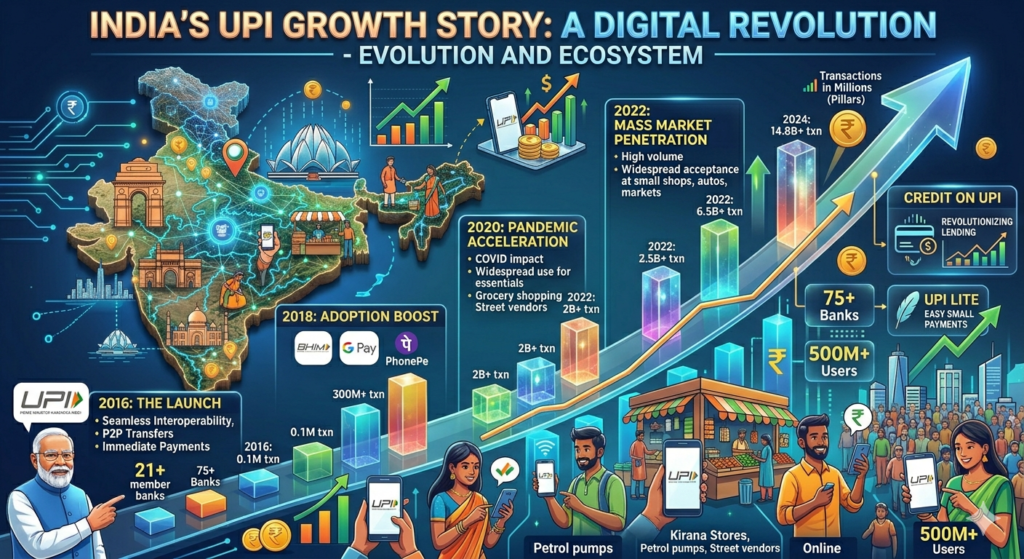
Retail purchases including groceries, fuel, and medicine
Utility bill payments like electricity and water
Public transport and ticketing
Salary payments for small businesses
Peer-to-peer transfers among families and friends
This everyday usage has reduced dependency on cash significantly.
7. How UPI Empowered Small Merchants:-
One of the most powerful outcomes of UPI growth is its impact on small businesses.
UPI helped small merchants by:-
Eliminating the need for card machines
Reducing cash handling risks
Providing instant payment confirmation
Creating a transaction history useful for loans and credit
Street vendors, shopkeepers, and service providers became part of the digital economy without large investment.
8. Financial Inclusion Through UPI:-
UPI played a silent but strong role in expanding financial inclusion.
Key contributions include:-
Bringing first-time users into digital banking
Encouraging account usage beyond withdrawals
Helping people manage money digitally
Creating trust in formal financial systems
Even individuals with basic smartphones and limited digital skills were able to use UPI confidently.
9. UPI as an Economic Infrastructure:-
UPI should be seen not just as a payment tool, but as national financial infrastructure.
Its infrastructure value lies in:-
Supporting economic formalisation
Improving transparency in transactions
Enabling data-driven economic planning
Reducing transaction friction across sectors
This infrastructure role explains why UPI continues to receive long-term policy support.
10. Global Expansion of UPI
UPI’s success within India has encouraged its expansion beyond national borders.
Current developments include:-
Use of UPI for payments in select foreign countries
Acceptance for Indian travellers abroad
Linkages with local payment systems
Interest from other countries in replicating the model
This expansion reflects global confidence in India’s digital payment capability.
11. Challenges That Come With Large Scale:-
Despite its success, UPI faces certain challenges that must be managed carefully.
Major concerns include:-
System load due to massive transaction volume
Cyber security and fraud risks
Market concentration among a few major apps
Long-term sustainability of free transactions
Addressing these issues is essential to maintain trust and stability.
12. Innovation Layer Built on UPI:-
UPI is no longer limited to simple payments. New services are continuously added.
These include:-
Auto-pay for subscriptions
Credit-linked payments
Bill reminders and recurring mandates
Business-focused payment solutions
This innovation ensures that UPI remains relevant as user needs evolve.
13. Future Direction of UPI:-
Looking ahead, UPI is expected to grow both in scale and scope.
Future possibilities include:-
Near one billion transactions per day
Deeper integration with credit systems
Wider international acceptance
Greater role in government and public services
UPI’s future growth will depend on balancing innovation with security and fairness.
14. Conclusion:- Why UPI Is historic transformation???
The growth story of UPI is not just about technology. It is about trust, simplicity, and scale. In a short time, UPI has reshaped payment behaviour across income groups, regions, and sectors. It reduced dependency on cash, empowered small businesses, and strengthened the digital economy.
UPI stands as proof that when systems are designed for people, adoption follows naturally. Its journey from a new idea to a national habit makes it one of India’s most significant economic innovations.