
(How the Reserve Bank of India Controls Inflation)
1. Inflation and Its Relevance in a Developing Economy:-
Inflation is one of the most sensitive indicators of economic health because it directly affects the cost of living, savings behaviour, and investment decisions. In a country like India, where income levels vary widely and a large population depends on fixed or informal incomes, even moderate inflation can create social and economic stress. Persistent price rise erodes purchasing power and widens inequality, making inflation control not just an economic objective but also a social necessity. This responsibility largely rests with the Reserve Bank of India (RBI), which functions as the monetary authority of the country.
2. RBI’s Mandate:- Balancing Price Stability and Growth
The Reserve Bank of India is legally entrusted with maintaining price stability while supporting economic growth. Price stability does not imply zero inflation; instead, it means keeping inflation within a predictable and manageable range. India follows a flexible inflation targeting framework that allows the central bank to respond to changing economic conditions. This framework provides the RBI with credibility and ensures that inflation control does not come at the cost of economic expansion. The emphasis is on maintaining medium-term stability rather than reacting mechanically to short-term price fluctuations.
3. Understanding the Nature of Inflation in India:-
Inflation in India is structurally different from that in advanced economies. It is influenced by a combination of demand pressures, supply constraints, and external factors. Food prices are often affected by weather conditions and supply chain inefficiencies, while fuel prices are linked to global energy markets. Rapid urbanisation, rising incomes, and public expenditure can increase demand-side pressures. At the same time, global commodity price movements and exchange rate fluctuations can transmit inflation into the domestic economy. This complex nature of inflation requires a nuanced and flexible policy response from the RBI.
4. Policy Interest Rates as the Primary Anti-Inflation Tool:-
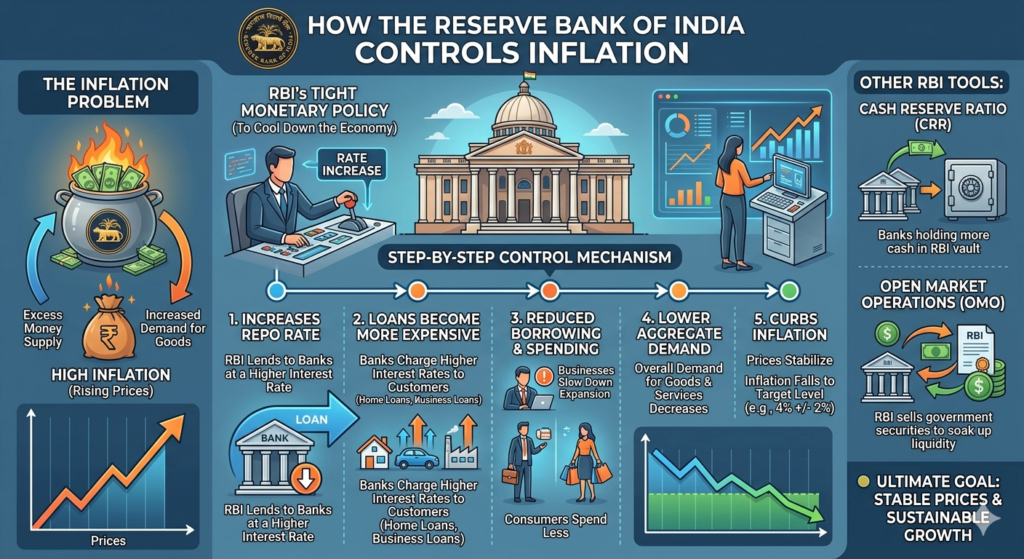
The most prominent instrument used by the RBI to control inflation is the policy interest rate. By adjusting this rate, the central bank influences the cost of borrowing across the economy. When inflationary pressures rise, higher interest rates make loans more expensive, discouraging excessive consumption and investment. This leads to a moderation in aggregate demand, which helps contain price rise. Conversely, when inflation is under control and growth needs support, interest rates may be reduced. This interest rate channel remains the backbone of India’s inflation control strategy.
5. Monetary Policy Committee::- Institutional Strength in Decision-Making
Inflation control decisions in India are taken by the Monetary Policy Committee, a statutory body that brings together internal expertise and external perspectives. This collective decision-making process ensures transparency and accountability. Regular policy announcements, voting patterns, and forward guidance help markets and the public understand the direction of monetary policy. Such institutional arrangements strengthen the credibility of the RBI and anchor inflation expectations, which is crucial for long-term price stability.
6. Liquidity Management:- Controlling Excess Money Supply
Inflation is closely linked to the availability of money in the financial system. Excess liquidity can encourage speculative activities and push up prices. The RBI actively manages liquidity to ensure that money supply remains aligned with the productive capacity of the economy. During inflationary periods, surplus liquidity is absorbed to prevent overheating. During economic slowdowns, liquidity is infused to support growth. This dynamic liquidity management helps prevent inflation caused by monetary excess without disrupting economic activity.
7. Open Market Operations:- Subtle but Effective Intervention
Open Market Operations play a crucial role in fine-tuning inflation control. Through the purchase or sale of government securities, the RBI influences long-term interest rates and credit conditions. Selling securities withdraws money from the system and helps contain inflation, while purchasing securities supports liquidity when inflationary pressures are low. These operations allow the RBI to manage inflation smoothly without resorting to abrupt policy changes, thereby ensuring financial market stability.
8. Credit Regulation and Macro-Prudential Measures:-
Inflation does not always arise uniformly across the economy; it often originates in specific sectors such as real estate or consumer lending. The RBI uses macro-prudential tools to address such sector-specific risks. By tightening lending norms or increasing capital requirements in overheated sectors, the central bank prevents asset price inflation without harming productive investment. This targeted approach ensures that inflation control remains balanced and growth-friendly.
9. Exchange Rate Management and Imported Inflation:-
India’s dependence on imports for energy and essential inputs makes it vulnerable to imported inflation. Sharp currency depreciation increases the domestic cost of imports, leading to higher prices. While the exchange rate is largely market-determined, the RBI intervenes to prevent excessive volatility. By maintaining orderly conditions in the foreign exchange market, the RBI reduces the inflationary impact of global shocks and protects domestic price stability.
10. Managing Inflation Expectations Through Credible Communication:-
Inflation is as much a psychological phenomenon as an economic one. If households and businesses expect prices to rise in the future, their behaviour can itself generate inflation. The RBI recognises this and places strong emphasis on communication. Clear policy statements, inflation forecasts, and consistent actions help anchor expectations. When people trust the central bank’s commitment to price stability, inflation becomes easier to control even with limited intervention.
11. Coordination with Fiscal Policy for Effective Inflation Control:-
Inflation control is most effective when monetary and fiscal policies work in harmony. Excessive fiscal expansion can weaken the impact of monetary tightening, while supply-side interventions can complement RBI actions. The RBI maintains coordination with the government while safeguarding its independence. Rational public spending, efficient supply management, and targeted welfare measures help reduce inflationary pressures without compromising growth.
12. Addressing Food and Fuel Inflation with Policy Realism:-
Food and fuel inflation pose a unique challenge because they are often driven by supply-side factors beyond the direct control of monetary policy. Recognising this limitation, the RBI avoids excessive tightening in response to temporary supply shocks. Instead, it focuses on medium-term inflation trends and overall price stability. This realistic approach prevents unnecessary economic slowdown while maintaining policy credibility.
13. Emerging Challenges in Inflation Management:-
Inflation control has become more complex due to climate variability, global geopolitical uncertainty, and changing consumption patterns. Supply disruptions and external shocks can quickly translate into domestic inflation. The RBI continuously adapts its analytical tools and policy framework to respond to these evolving challenges, ensuring that inflation management remains effective in a dynamic global environment.
14. Conclusion:- (Inflation Control as a Pillar of Economic Stability)
The Reserve Bank of India controls inflation through a comprehensive and balanced approach that goes beyond interest rate adjustments. By combining monetary policy, liquidity management, regulatory oversight, exchange rate stabilisation, and effective communication, the RBI ensures that inflation remains within manageable limits. This sustained commitment to price stability strengthens economic confidence and supports India’s long-term growth trajectory.